A Triumphant Start: Bach Society Orchestra Opens Its 73rd Season
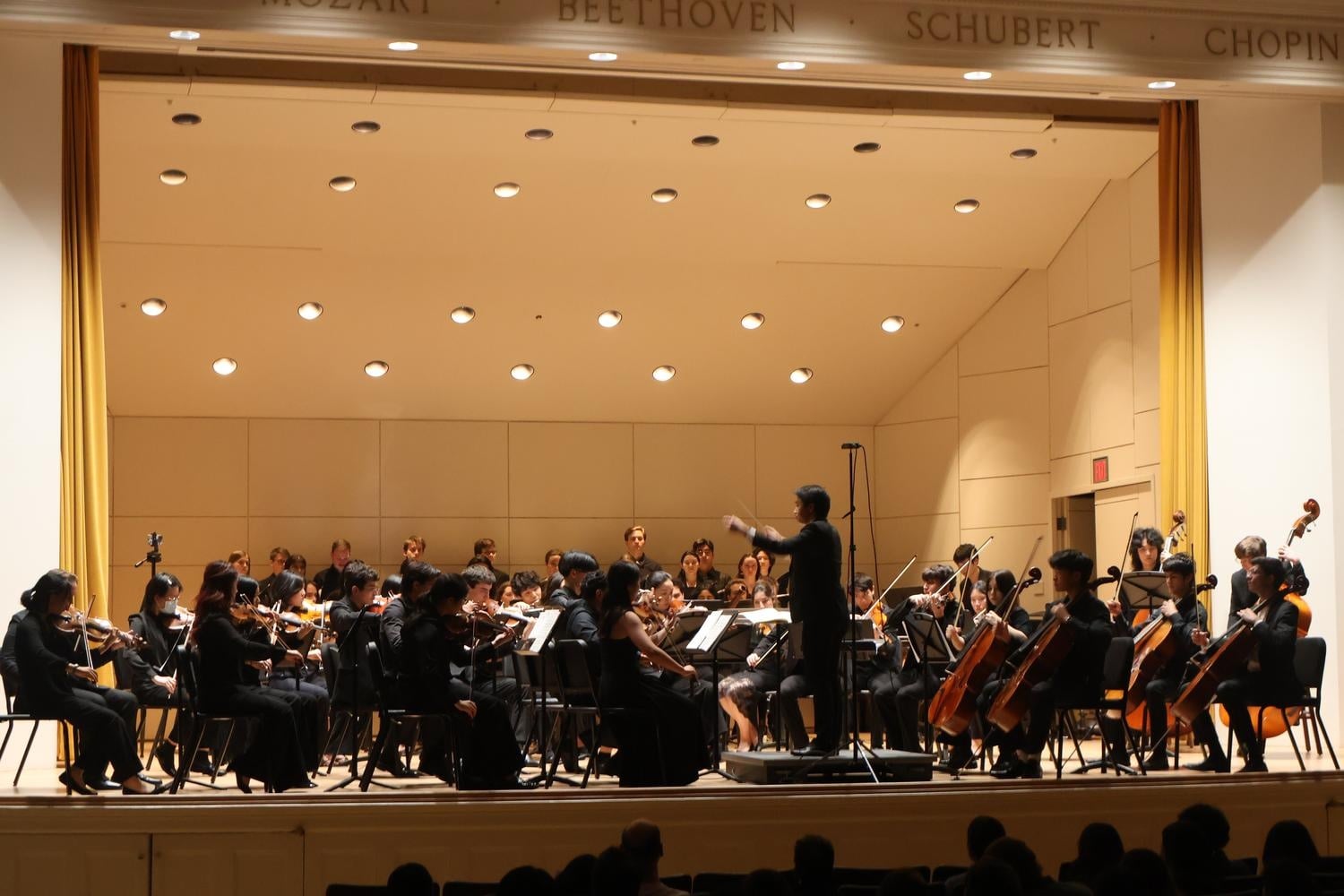
The Bach Society Orchestra’s opening concert on Oct. 10 in Paine Hall was a triumphant performance showcasing the skill of 52 instrumentalists and 19 singers from the Harvard University Choir. The orchestra is completely run by undergraduates. Founded in 1954, the 2026-2027 season marks their 73rd year of performing.
The orchestra put together an outstanding performance. The concert opened with Franz Schubert’s “Rosamunde Overture,” a piece of incidental music that accompanies the 1823 play “Rosamunde, Fürsten von Zypern” by Helmina von Chézy. In the play, a young princess Rosamunde seeks to regain her throne, and all the while governor Fulgentius attempts to thwart her. This exciting opener was followed by Johannes Brahms’ “Schicksalslied,” a more contemplative piece based on Friedrich Holderlin’s poem “Hyperions Schicksalslied.” Brahms was supposedly so affected by the poem that he immediately began sketching out “Schicksalslied” that same day. Finally, after a brief intermission, the orchestra closed out the night with Joseph Haydn’s Symphony No. 101, often referred to as “The Clock”.
Throughout the Rosamunde Overture, the performers beautifully captured the playful spirit of the piece. The string and woodwind sections passed the theme back and forth with effortless grace: sometimes dancing lightly with controlled pizzicatos, sometimes playing out the theme triumphantly. While there were moments of joy in the piece, there were also moments of intrigue, mirroring the suspense of von Chézy’s play and Fulgentius’s schemes. The orchestra communicated the competing tensions deftly through a controlled movement of the theme between sections.
Joined by the Harvard University Choir, the orchestra’s second act was just as impressive, if not more so, than their first piece. The piece opened sentimentally, strings softly and sweetly pouring out a theme reminiscent of a waterfall. Just as the flute began a new theme, the choir entered swiftly and the intensity picked up. Throughout the rest of the piece, the instruments and singers seamlessly passed the baton back and forth, weaving together a harmony sometimes calm and contemplative, other times sentimental and morose.
Starting the final piece with energy and precision, the orchestra tackled the first movement of Haydn’s Symphony No. 101 with incredible skill. The violins began with a joyful jig-like motif, leading to a triumphant, sweeping main theme. In the second movement, the cello and bass sections maintained a soft, steady pizzicato — the “tick-tock” rhythm giving the symphony its signature nickname, “The Clock.”
The flute skillfully interjected with the melody to move the piece along, and soon a tension rose beneath the steady, rhythmic pizzicato of the cello and bass. With all eyes on conductor Moshi Tang ’27, the orchestra sprang into action, building drama with layered counterpoint between strings and brass. Returning to a calmer state, the flute took the reins with a graceful melody, deftly performing the mordents and carrying the orchestra along, until finally the violins led a fiery ending.
What was striking about this performance was the collective effort and skill displayed. Each section communicated intently with the others, never crowding out each other, making space for the melody to poke through the harmony, and collaborating beautifully with the choir and the instrumentalists. There was no single star of the show; rather, the whole emerged as greater than the sum of its parts.
Want to keep up with breaking news? Subscribe to our email newsletter
Have a tip for The Crimson? Share it confidentially