Promising Program, Mixed Results: The BSO Performs Simon and Tchaikovsky
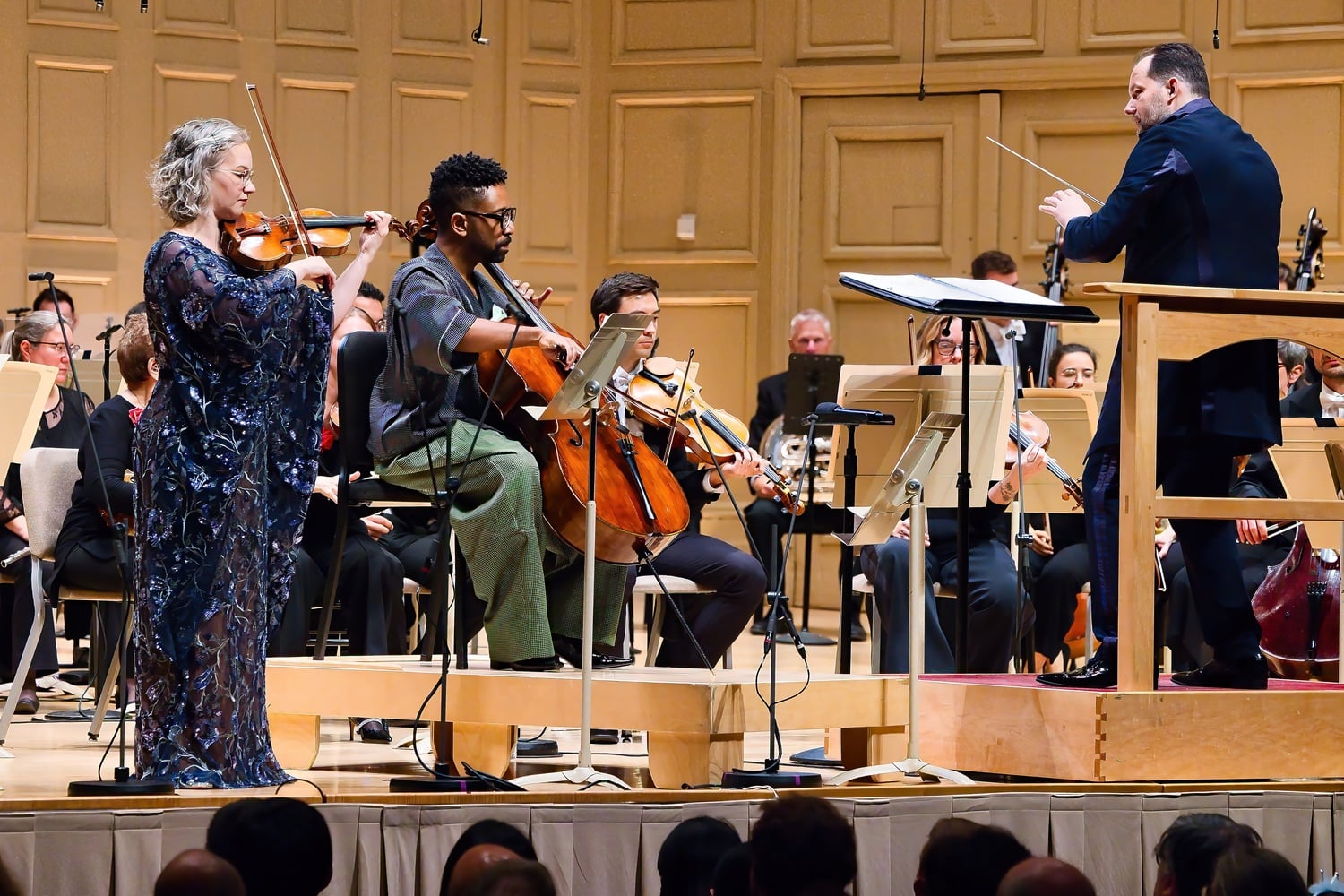
You won’t find many programs that, on paper, pack as much of a punch as those presented by Andris Nelsons and the Boston Symphony Orchestra from Oct. 15 to 17.
These concerts were set to feature a new Double Concerto Suite for violin, cello, and orchestra written by American composer Carlos Simon, commissioned specifically for modern violin by acclaimed violinist Hilary Hahn and acclaimed cellist Seth Parker Woods, alongside the BSO’s first performance of Act II of Tchaikovsky’s “The Nutcracker” in nearly eight years.
The concert opened with a different composition by Tchaikovsky: the Polonaise from “Eugene Onegin” Op. 24. A triumphant statement from the trumpet rang throughout Symphony Hall as the brass entered in unison with D major chords. The string section was generally well-blended, while the brass was consistently powerful and regal throughout. The elegant and sophisticated nature of this piece, which introduces a ball scene at the beginning of the last act of “Eugene Onegin,” shone through particularly in the middle section, when tranquil, singing lines were passed around the strings and the wind section. However, the more energetic passages lacked the bright and stately energy that should characterise a polonaise, a traditional Polish processional dance — especially one that depicts a high-society ball.
Following this energetic opening, Carlos Simon then took the stage to introduce his Double Concerto Suite for violin, cello, and orchestra. It is the latest of several BSO-commissioned works from Simon, who is the BSO’s inaugural Composer Chair — which entails not only composing new orchestral works, but also helping to put together the concert programming and helping to lead educational and community outreach initiatives.
The suite opened with a dance-like section, with repeated harp ostinatos underpinning exchanged melodies between the various sections of the strings. Indeed, despite its Baroque influence, the piece commenced in an almost cinematic manner with dramatic, unison hits interrupting extended quaver lines in both solo parts. Hahn and Parker Woods were flawless in their technical execution of the piece, with Hahn, in particular, playing with the utmost clarity and precision.
The second movement commenced with an ominous and sombre cello passage, with Parker Woods sounding equally plaintive and introspective. The dynamic restraint from the orchestra complemented Parker Woods’ rich tone, although the natural tessitura of the solo part did not lend particularly well to projection over the orchestral texture. Although the melodies were well-written and expressive, they tended to stretch thin towards the end of the movement, with a lack of harmonic and rhythmic variation leading to an overall sense of listener fatigue. In particular, the harmonies — which had a distinctly modal quality — did not generate the necessary tension to move the piece forward in a compelling manner.
On the other hand, the third movement opened with a glittering texture in the percussion, before the soloists entered with hypnotic, semiquaver lines. In stark contrast to the introspective second movement, the rhythms of this movement were heavily syncopated and infused with a restless energy.
Still, the fourth movement resembled the rest of the work in that both soloists tended to play in parallel for extended passages, usually separated by fourths or fifths. Indeed, it became increasingly apparent that this Double Concerto did not fully capitalize on the “double” part of its name: the violin and cello were often either playing the same melody or interacting in a way that was not particularly contrapuntally engaging.
Furthermore, the piece was not particularly virtuosic in nature for either of the solo parts, which is a shame given the sheer musical prowess of the two musicians it was written for. Nevertheless, this movement featured some of the most interesting harmonies of the entire piece, with distinctly blues-inflected passages lending a welcome richness and unpredictability to the harmonic language.
The performance ended in an incredibly frantic manner, with the brass, violins, and percussion all interacting in a whirl of chaos. Perhaps owing to some ambiguity in Nelsons’ conducting gestures, the violins sounded somewhat tentative during these sections, especially in contrast to the assertive and commanding brass.
Following a brief intermission, the orchestra returned with a colourful performance of one of classical music’s most renowned works: “The Nutcracker.”
Overall, Nelsons’ interpretation was rich in both character and nuance. Although the strings lacked a bit of bite during some of the more energetic divertissements such as “The Old Woman Who Lived in A Shoe and her Children” and “Trepak,” the overall orchestral sound was cohesive and well-blended throughout.
The opening movement of the piece, “The Kingdom of Sweets” was characterized by flowing string and brass melodies, as well as glittering harp passages. These compositional features lent themselves particularly well to the BSO’s rich, warm sound, with the orchestra effortlessly capturing the playful, enchanting atmosphere of Tchaikovsky’s score. In the “Spanish Dance,” a bright and playful piccolo solo sat atop delicate, pizzicato figures in the strings and a bassoon ostinato.
Perhaps the work’s most famous movement, “Dance of the Sugar Plum Fairy,” was taken considerably slower than the typical tempo. Although this approach produced a heightened sense of tension and eeriness, it also compromised the vibrancy and buoyancy of the movement. However, the final movement of the piece, “Final Waltz and Apotheosis,” was a fitting conclusion to the concert. As always, the BSO’s brass shone throughout, while the strings performed the waltz in a majestic, stately manner.
Despite an exceptionally promising program and impressive performances from the soloists, Simon’s new concerto was compositionally underwhelming, while the BSO’s rendition of “The Nutcracker” featured the concert’s most convincing music-making. Although Simon’s composition was full of textural variety, it failed to capitalise on the boundless possibilities of the double-concerto form, with Hahn and Parker Woods too often confined to parallel melodic lines rather than engaging in a compelling musical dialogue. For a work written for two musicians of such extraordinary calibre, it was a disappointing missed opportunity.
—Staff writer Alexander J. S. Chieng can be reached at [email protected].
Want to keep up with breaking news? Subscribe to our email newsletter
Have a tip for The Crimson? Share it confidentially