Ballot Question 3 Seeks to End Single-Party Primaries
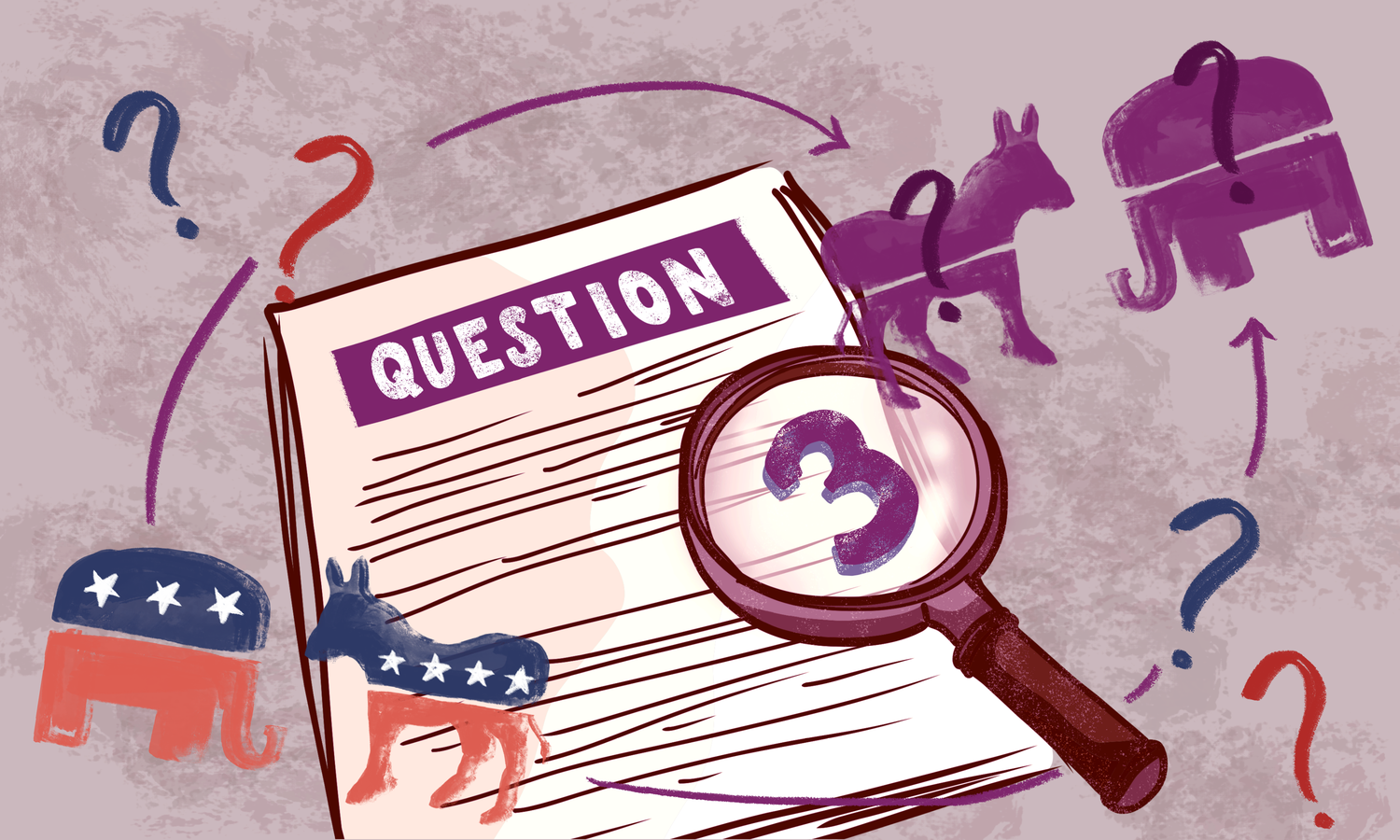
When Massachusetts voters head to the polls in 2028, they may see all candidates — regardless of party — on the same ballot for the first time in more than a century.
Ballot Question 3 aims to eliminate partisan primaries in favor of a top-two primary system.
Under this initiative, voters would trade in their party ballots for a single, all-party primary ballot listing all candidates. Following the primary, the top two candidates selected would advance to the general election regardless of party status.
University professor Danielle S. Allen has backed the initiative since 2023 to help “voters have real choices in November,” forming the Coalition for Healthy Democracy to push the proposition forward. The coalition has spent more than $4.63 million in support of Question 3. The two committees opposing Question 3, by comparison, have spent more than $50,000, according to campaign finance records.
The proposition has divided lawmakers. Question 3 has seen support from a host of elected officials and advocates, including Massachusetts State Auditor Diana DiZoglio, and former Governors Deval L. Patrick ’78 and Charlie D. Baker ’79. But more than 55 state and local elected officials — including Boston Mayor Michelle Wu ’07 and U.S. Rep. Ayanna S. Pressley (D-Mass.) —have all thrown their weight behind the opposition campaign.
And support for Question 3 is split, according to recent polling results: a Suffolk University/Boston Globe poll last week found that roughly 46 percent of respondents support the initiative, and 41 percent oppose it. A UMass Amherst/WCVB poll, which was also released last week, showed 49 percent of respondents would cast a “yes” vote on Question 3, while 39 percent of respondents would likely vote “no”.
What Would Question 3 Do?
Massachusetts voters currently cast their ballots in single-party primaries, picking their top candidate from within the party they are enrolled in. Unenrolled voters — approximately 67 percent of registered voters in the state — can select either party’s ballot at their polling location.
Question 3, if passed, would merge partisan races into a single primary, and all voters would receive the same ballot with all registered candidates for a given seat. The top two vote-getters would then advance to the general election, irrespective of party affiliation.
Question 3 would also reshape the gubernatorial race — placing candidates for governor and lieutenant governor on the same ticket in the primary.
Get The Crimson in your inbox.
Candidates would also appear on the ballot alongside their political parties and endorsements, allowing candidates to accept and display multiple endorsements on the ballot.
Similar all-party systems have also been run in California and Washington, and Allen said both states have seen their legislatures “diversify faster than Massachusetts.”
According to a report from FairVote, a nonpartisan organization cited by the No on 3 campaign, three-quarters of preliminary races in Washington have been uncontested in the three cycles since all-party primaries were instituted.
Bring More Competition
Allen, who ran for governor in 2022, said Question 3 would help foster competition and hold candidates accountable to voters.
“We have the fewest contested elections in any state in the country, and it’s just a very basic fact of democracy that if elected officials or candidates don’t face rivals, they don’t have to listen to voters,” Allen said. “They can ignore them and disregard them, and that’s how voters feel.”
DiZoglio wrote that the current system favors powerful incumbents and allows them to rely on the establishment instead of listening to constituents.
“Right now, party insiders can often box out newcomers before voters ever have a say. That’s totally backwards and anti-democratic. We need more people who are willing to speak truth to power, challenge the status quo and stand up to the entrenched establishment,” DiZoglio wrote.
But the Massachusetts Democratic Party has opposed the proposition, and party chair Stephen “Steve” J. Kerrigan argued that an all-party primary would constrain voters’ options.
“There’s a myth that if you pass this, which allows wealthy people to buy access to the ballot, that will also magically produce 200 candidates for 200 legislative seats,” Kerrigan said. “We’re using the cudgel of ‘we want to have more competition’ to make a seismic change to how we decide who our leaders are.”
Jonathan R. Cohn, a policy director for Progressive Massachusetts, which has backed the No on 3 campaign, also said that the all-party primary system risks creating a “lockout effect” where one political party is not represented between the two candidates that advance to the general election.
Allen said that this was unlikely to hold true in Massachusetts, though, citing the higher monetary and signature requirement Massachusetts mandates for candidates to get on the ballot – a rule she says would prevent the huge slate of Democratic candidates seen in the California gubernatorial race.
“In terms of the number of candidates that California has, Massachusetts will never have that many candidates, because the ballot access rules are completely different to the two states,” Allen said.
Massachusetts State Sen. Julian A. Cyr, who represents parts of Cape Cod, said that new candidates often lack the networks and funding necessary to sustain their campaign if faced with an all-party primary.
“I really worry that Question 3 is going to make it harder for progressive candidates, first-time candidates, and candidates from diverse backgrounds to actually get elected,” Cyr said, pointing to his own first election ten years ago. “We ran a really strong grassroots campaign, and it would have been much more difficult for me to win what was a four-way primary and then a competitive general election if I basically had to repeat the primary.”
Cohn also argued that the gubernatorial provision, which prevents governor and lieutenant governor candidates from running individually, would hinder the chances of grassroots gubernatorial candidates advancing past the primaries.
“If people don’t think you can win, why would they sign up to be your running mate, right?” Cohn said. “If you’re a kind of a grassroots or insurgent candidate, you expect to peak later on in that race, and the need to pick a running mate early on is a lot of vetting work.”
Allen argued that organizing power ultimately decides elections and that the probability for victory for the top fundraiser has gone down.
“Think about the contrast between Michelle Wu and Josh Kraft,” Allen said. “Kraft had loads of money, but he didn’t make a dent against the kind of organizing power that Michelle Wu had.”
Question 3’s Warchest
Question 3 has also sparked debate over campaign funding, as opponents have taken aim at the proposition’s coffers.
The proposition is the second highest dollar question of the nine on the ballot — with opposition and support efforts spending a combined $5.82 million. But opponents have been quick to criticize the makeup of Question 3’s backers.
Six-figure donations have flowed into the Question 3 campaign largely from donors tied to private equity — including $500,000 from those who listed Bain Capital as their employer and another $250,000 from those working for Berkshire Partners. Critics have argued that voters should take into consideration the influx of billionaire donations propping up Question 3.
“For a self-described democracy campaign, it’s jarring that it’s pretty much almost entirely funded by private equity executives from Bain Capital and Berkshire Partners,” Cohn said.
“I’m proud to stand with a broad and diverse coalition to say HELL NO to Question 3, a billionaire, private equity-backed scheme to buy our elections, tilt the playing field, and make it harder for working class people to run for office and win,” Pressley wrote.
Allen contested the negative implications of wealthy donors supporting the initiative. Allen described personally reaching out to donors with track records as “deep democracy reformers” while building the campaign for Question 3.
“What motivates me is having a political system where the power does actually belong to the voters, where voters have real choices in November, and where elected officials have to listen to voters,” Allen said.
—Staff writer Samuel Ruiz-Macias can be reached at [email protected].
—Staff writer Mirei S. Saneyoshi can be reached at [email protected] and Signal at mireisaneyoshi.09. Follow her on X at @mireisaneyoshi.
Want to keep up with breaking news? Subscribe to our email newsletter
Have a tip for The Crimson? Share it confidentially