Nine Questions Are on Tuesday’s Midterm Ballot. Here’s What Your Vote Will Do.
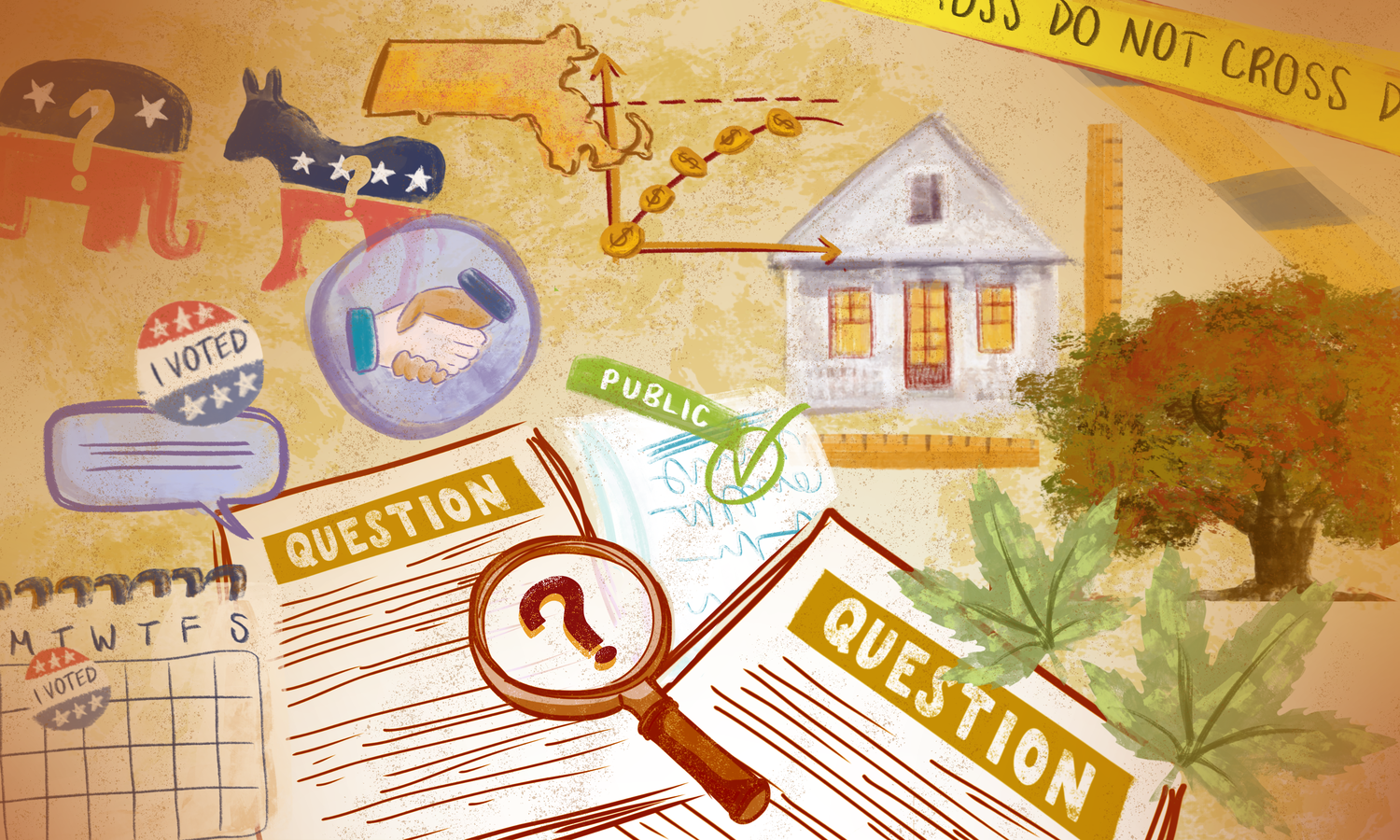
As Massachusetts voters head to the polls on Tuesday, they will be tasked with deciding a record-tying nine ballot questions — ranging from efforts to limit recreational marijuana sales to reshape the state’s primary elections.
More than 14,000 Cambridge residents have already cast their ballots through early in-person and mail-in voting. And on Tuesday, polls across the state will open again from 7 a.m. to 8 p.m.
Before you vote, here’s what to know about your ballot.
Question 1: Subjecting the Legislature to Public Records Laws
Ballot Question 1 would open the state Legislature and Governor’s Office to public records law, allowing members of the public to request financial documents, contracts, and administrative correspondence available upon request.
A “yes” vote will subject the Legislature and Governor’s office to the public records law, which supporters argue increases transparency.
A “no” vote maintains the current law, keeping the Legislature and Governor’s office exempt from public records requests.
Question 2: Allowing Public Defenders to Unionize
Question 2 proposes a law that would allow the Committee for Public Counsel Services (CPCS) to unionize. The proposition comes after public defenders have unsuccessfully tried to unionize three times in the past four decades.
A “yes” vote allows CPCS to unionize, which supporters argue will help public defenders advocate for better wages and hours.
Get The Crimson in your inbox.
A “no” vote maintains current law, and opponents to Question 2 have argued that allowing unionization may increase operational and financial risks for the judiciary.
Question 3: Eliminating Single-Party Primary Elections
Question 3, if passed, will overhaul the state’s current single-party primary system in favor of an open primary, where all candidates — regardless of party — appear on the same primary ballot, and the top two candidates advance to the general election.
A “yes” vote implements the top-two primary system, which supporters argue will move the decision to the general election, increasing political competition and connecting parties with everyday voters.
A “no” vote keeps the current primary system intact, as critics have argued that top-two primaries favor wealthy candidates who have established donor networks, pushing out grassroots candidates.
Question 4: Same-Day Voter Registration on Election Day
Question 4 aims to open same-day voter registration on Election Day, allowing eligible voters to register to vote at the polls. Current state law requires voters to register at least 10 days before Election Day.
A “yes” vote allows voters to register on Election Day, which supporters say will increase voter access and participation in democracy.
A “no” vote maintains the current 10-day deadline, which opponents argue will avoid creating vulnerabilities in elections and diminish trust in elections.
Question 5: Limitations on State Revenue
Question 5 seeks to change the state’s formula for calculating resident tax rebates, proposing to change the limit on how much tax revenue Massachusetts can collect in a given fiscal year — prompting refunds for residents if the limit is exceeded.
A “yes” vote supports the reformulation, which supporters tout as an option to give more money back to residents and limit state spending.
A “no” vote keeps the current state revenues limits. Opponents argue that passing Question 5 could cut into funds needed for state-funded services, like housing, healthcare, and childcare.
Question 6: Funding Natural Resource Conservation
This proposition would create a Nature for All Fund to protect natural resources — funded by diverting tax revenue from sporting goods, recreational vehicles, and golf courses.
A “yes” vote creates the fund, which supporters say will treat nature as necessary infrastructure.
A “no” vote does not establish the fund, which opponents argue would avoid cutting into other necessary state program funding.
Question 7: Smaller Lot Sizes for Single-Family Homes
Question 7 would lower the lot-size requirement to 5,000 square feet to allow for the construction of more single-family homes.
A “yes” vote lowers the minimum lot-size requirement, which supporters argue will bring affordability and flexibility to housing development by allowing more homes on smaller lots.
A “no” vote keeps the current size requirement, as opponents argue that a one-size-fits-all approach at the state level would strip local control over zoning.
Question 8: Ending Recreational Marijuana Sales
Question 8 would stop the sale of recreational-use marijuana starting in 2028, while keeping current medical-use laws intact.
A “yes” vote ends the sale of marijuana for recreational purposes, as supporters have argued that it will limit addiction and prevent marijuana-linked youth hospitalizations.
A “no” vote keeps current regulations intact, as opponents argue that banning recreational sales would cut off existing tax revenue streams and push users into unregulated markets.
Question 9: Repealing 2024 Gun Control Reform
Question 9 will ask voters whether to keep intact a 2024 gun control reform, which added restrictions on homemade firearms and expanded weapon categories.
A “yes” vote keeps the current law intact, which supporters argue keeps communities safe from gun-related deaths.
A “no” vote repeals the 2024 law, which opponents say has sparked confusion and heavy penalties for legal gun owners.
—Staff writer Samuel Ruiz-Macias can be reached at [email protected].
Want to keep up with breaking news? Subscribe to our email newsletter
Have a tip for The Crimson? Share it confidentially