‘Daughter of the Regiment’ Review: A Disservice to a Heroic American Woman
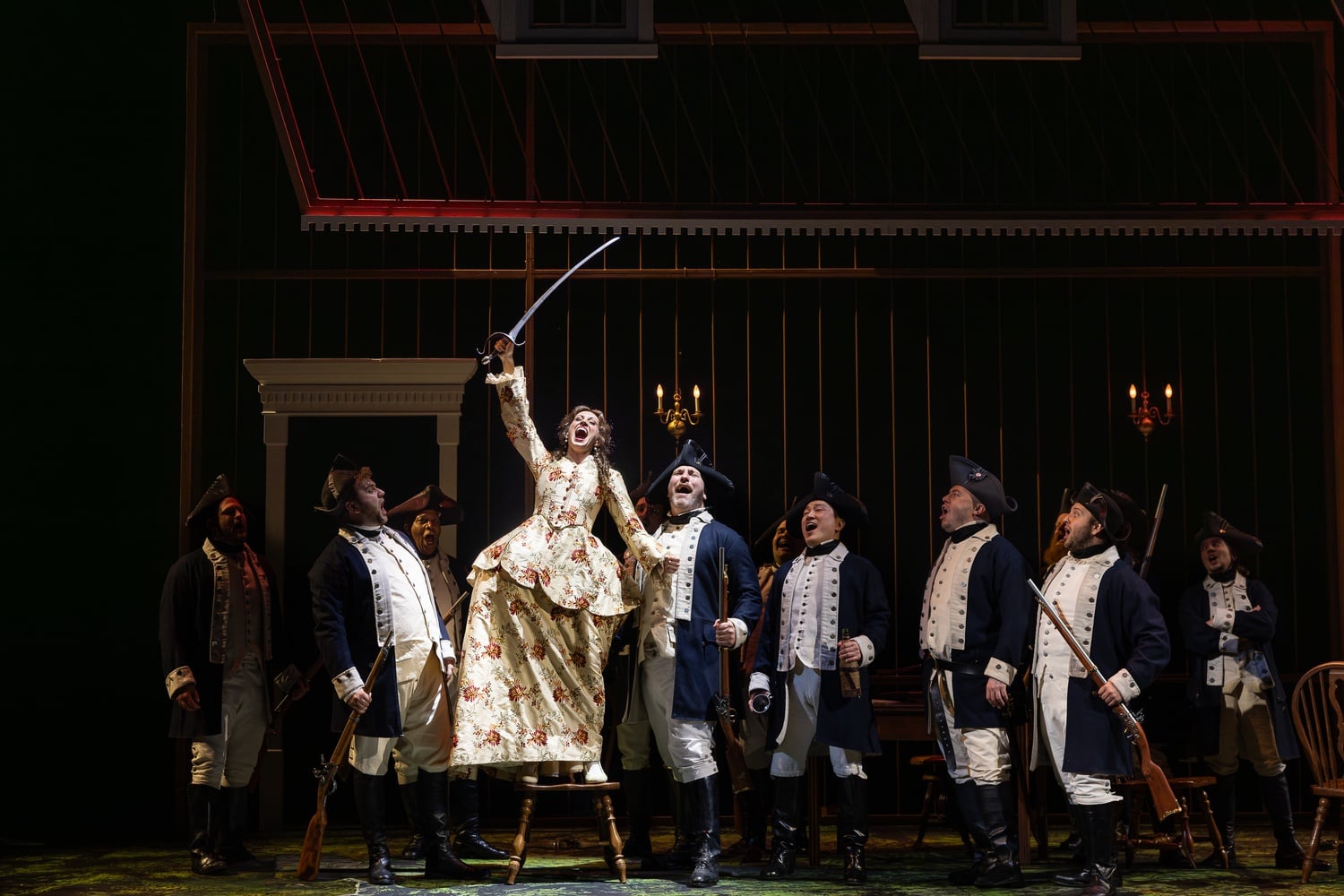
The opening bars of Boston Lyric Opera’s “Daughter of the Regiment” — a lone clarinet’s self-assured, but singular tune soon joined by a roaring symphony — seems to prefigure the story that follows. That confident clarinet evokes the opera’s fiery protagonist, a young woman — based on actual revolutionary figure Deborah Sampson — who overcame societal prescriptions to fight in the American Revolution. The immensity of the tune’s transition thus evokes the roaring tide of America’s vast history, and that tide of history threatens to swallow Sampson’s story. Boston Lyric Opera’s goal seems clear: to ensure that no such subsuming happens.
Unfortunately, despite a passionate and convincing cast and the orchestra’s moving performance, Boston Lyric Opera did not succeed in delivering the important story the overture promised. Subjecting Sampson to a storyline almost exclusively devoted to romance, Kirsten Greenidge — the opera’s adapter — failed Sampson once again, just as the historical record has.
Boston Lyric Opera’s intentions were certainly noble. In “Daughter of the Regiment,” which ran from April 23 to May 3, Nina Yoshida Nelsen made the honorable decision to spotlight the story of Deborah Sampson, a woman who fought in the 4th Massachusetts Regiment from 1782 to 1783 while disguising herself as a man. During her time in the regiment, Sampson assumed the dangerous task of reconnoitering neutral territory and led thirty infantrymen into battle. Ahead of the country’s 250th anniversary, Boston Lyric Opera honorably sought to celebrate Sampson and remind its audience that marginalized figures also took on great personal risk to contribute to our nation’s freedom struggle.
The source text that Nelsen selected provided ample material to produce an aesthetically rich work of art. Gaetano Donizetti’s delightful French opera of the same name follows an orphaned girl who is adopted by a French regiment during the Napoleonic Wars. With a rich artistic repository and a remarkable true story to adapt, Boston Lyric Opera had all the makings of a heartwarming, poignant, and artistically accomplished opera.
However, the opera barely revised the French source text, and in doing so failed to do justice to Sampson. Instead of illuminating her contributions to the American freedom struggle, Greenidge plunged Marie — the character on whom Sampson is based — into a mundane romance with a French soldier fighting alongside her. The romance was frustrating not only because it deflected from Sampson’s heroic revolutionary achievements but also because it was devoid of any conflict, challenge, or complication which would have lent it intrigue. A great portion of the opera is devoted to long, if beautifully sung arias, in which the two endlessly and tediously profess their love for one another.
The arias, aside from being tiresome, provoke immense incredulity. One has to wonder, how do these two soldiers — in the midst of a revolution in which their lives and freedom are at stake — have the time to endlessly profess their love for one another? One has to doubt that the real Sampson would have concerned herself with romance. She did, after all, have more pressing matters to attend to, like the war in which she was fighting, her freedom, and preventing others from discovering her true gender to name a few.
Indeed, the two gunshots fired in the background at the beginning of the opera are the only indicator that a momentous revolution is happening at all. The war is relegated to the opera’s background, then seems to disappear from the storyline altogether.
The opera was at its best when providing comic relief. In a moment towards the end, young debutantes are announced with great pomp and circumstance as ladies of Worcester or Waltham. It makes for a ridiculous and hilarious moment.
But the comic moment perhaps also speaks to what the opera failed to do: Its project was to adapt the highfalutin French “Daughter of the Regiment” into an American story. While in this one instance, Greenidge artfully acknowledges the absurdity of transferring the French opera’s original content to an American context, she seems to overlook how equally absurd her transfer of the French content was in every other aspect of the opera. Again, Deborah Sampson, a soldier fighting in the American Revolution, certainly would not have had time to indulge in a French-opera style romance.
Instead of singling out Sampson’s wave from the greater tide of American history, Boston Lyric Opera plunged her into a mundane and degrading storyline, drowning her once again.
“Daughter of the Regiment” ran at the Emerson Colonial Theatre from April 24 to May 3.
—Staff writer Alexandra M. Kluzak can be reached at [email protected]
Want to keep up with breaking news? Subscribe to our email newsletter
Have a tip for The Crimson? Share it confidentially