Jake Sullivan, Ylli Bajraktari Warn of Narrowing Gap in AI Development Between U.S. and China at IOP Forum
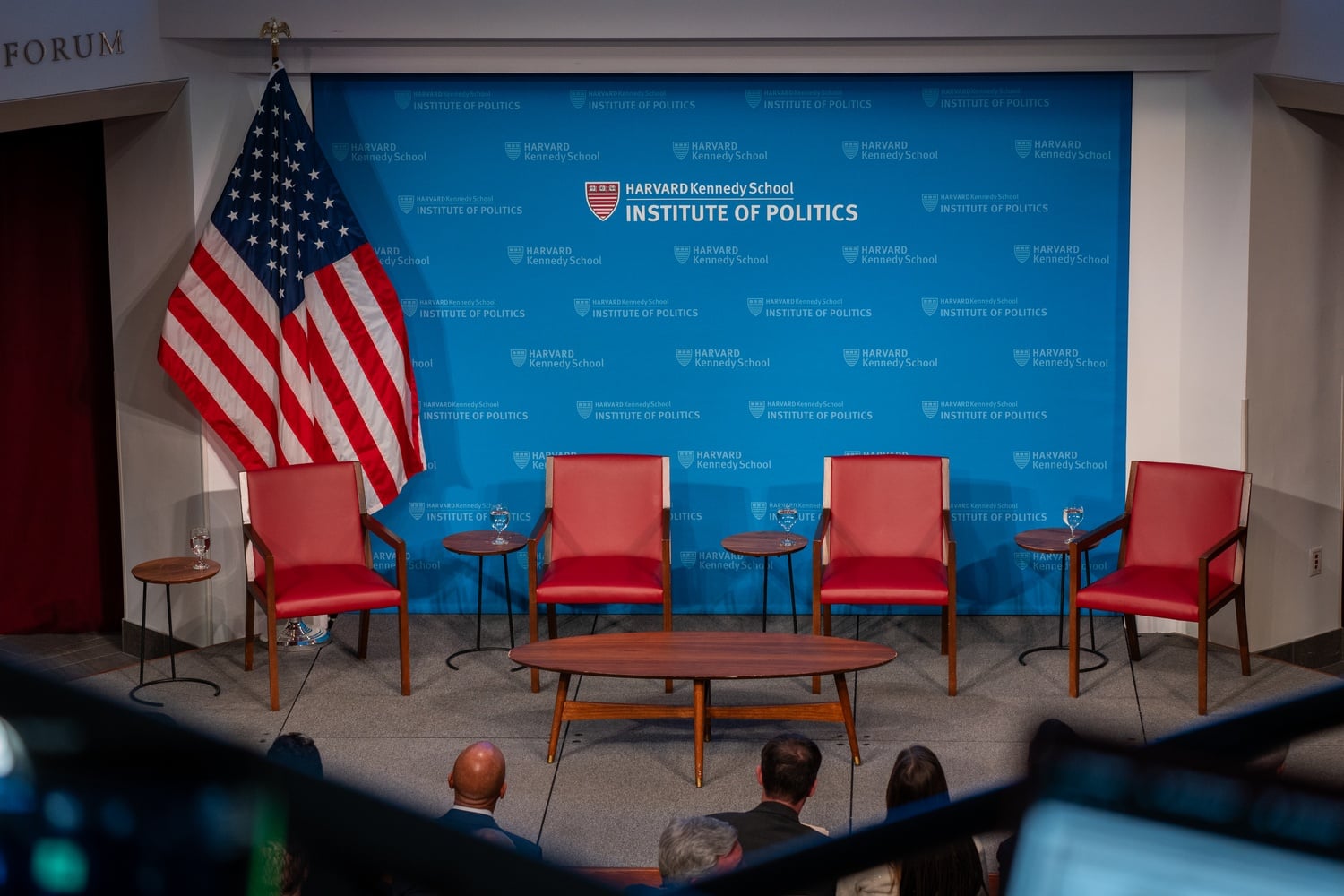
Former U.S. National Security Adviser Jacob J. Sullivan said the United States holds about a six-month lead over China in frontier artificial intelligence development at a Harvard Institute of Politics forum Monday evening.
Sullivan and Ylli Bajraktari, the president and CEO of the Special Competitive Studies Project, both described a tight race between the two countries, though Sullivan cautioned that the push to stay ahead should not come at the expense of AI safety.
Sullivan, who served under former U.S. President Joe Biden from 2021 to 2025, now teaches at the Harvard Kennedy School. Bajraktari’s think tank is nonpartisan and focuses on U.S. technological competitiveness. Kennedy School professor Graham T. Allison ’62 moderated the discussion.
“Today the United States still holds a material lead at the frontier,” Sullivan said, adding that the advantage “nets out to probably somewhere in the order of six months or so.”
He credited the lead largely to America’s access to advanced chips. China produces only about four percent as many chips as Nvidia, Sullivan said, though smuggling and remote access push its effective share closer to 40 percent.
Bajraktari, who served as chief of staff to National Security Adviser H.R. McMaster during President Donald Trump’s first term and later led the National Security Commission on Artificial Intelligence, agreed that the U.S. remains ahead on frontier models but described the race as increasingly “neck and neck.”
He said China’s rapid global rollout of open-weight models fits a strategy Beijing has used for years.
“They take a technology — whether they steal it, distill it, or take the IP — build it domestically, scale it, and then deploy it at a really low cost globally,” Bajraktari said, citing 5G, drones, and solar panels. “Industry after industry has been crushed because of the Chinese playbook.”
Sullivan said Americans’ growing skepticism of AI is understandable, given that the technology’s own architects have warned it could wipe out large numbers of jobs and cause human extinction.
Get The Crimson in your inbox.
“It is totally logical, based on that picture, which is the picture that has been painted to people, that folks would feel that way,” he said.
Instead of assuring the public that AI’s benefits will outweigh its harms, Sullivan said, policymakers should offer a concrete plan with guardrails that could ultimately help speed innovation.
“We have a plan to make sure this is safe, to make sure the gains are broadly shared,” Sullivan said, describing the message he believes Americans need to hear.
“Perhaps the most important race of them all, frankly, is avoiding a race to the bottom, where because each is so intent on beating the other, neither side is prepared to take the steps on the safety front to ensure that AI does more good than harm,” he added.
Sullivan said he did not think China was currently ready for an agreement on “pacing the frontier,” but that the two powerhouses would still have to come to the table eventually.
“I do not believe that we will get through this period without something happening in the way of diplomacy between the U.S. and China,” he said.
Sullivan also took aim at Senator Ted Cruz (R-Texas), who has argued that any killer robot should be American instead of Chinese.
“I do not agree with Ted Cruz that there is a difference between American killer robots and Chinese killer robots,” Sullivan said.
Bajraktari, meanwhile, called on the U.S. to work more closely with its allies to counter China’s growing technological reach.
“We have to be much more, for lack of a better word, aggressive in terms of working with our allies and partners to create some kind of a common technology stack about this era,” he said.
Want to keep up with breaking news? Subscribe to our email newsletter
Have a tip for The Crimson? Share it confidentially