Three Years After Oct. 7 Attack, More Than 100 People Gather for Vigil Mourning Victims
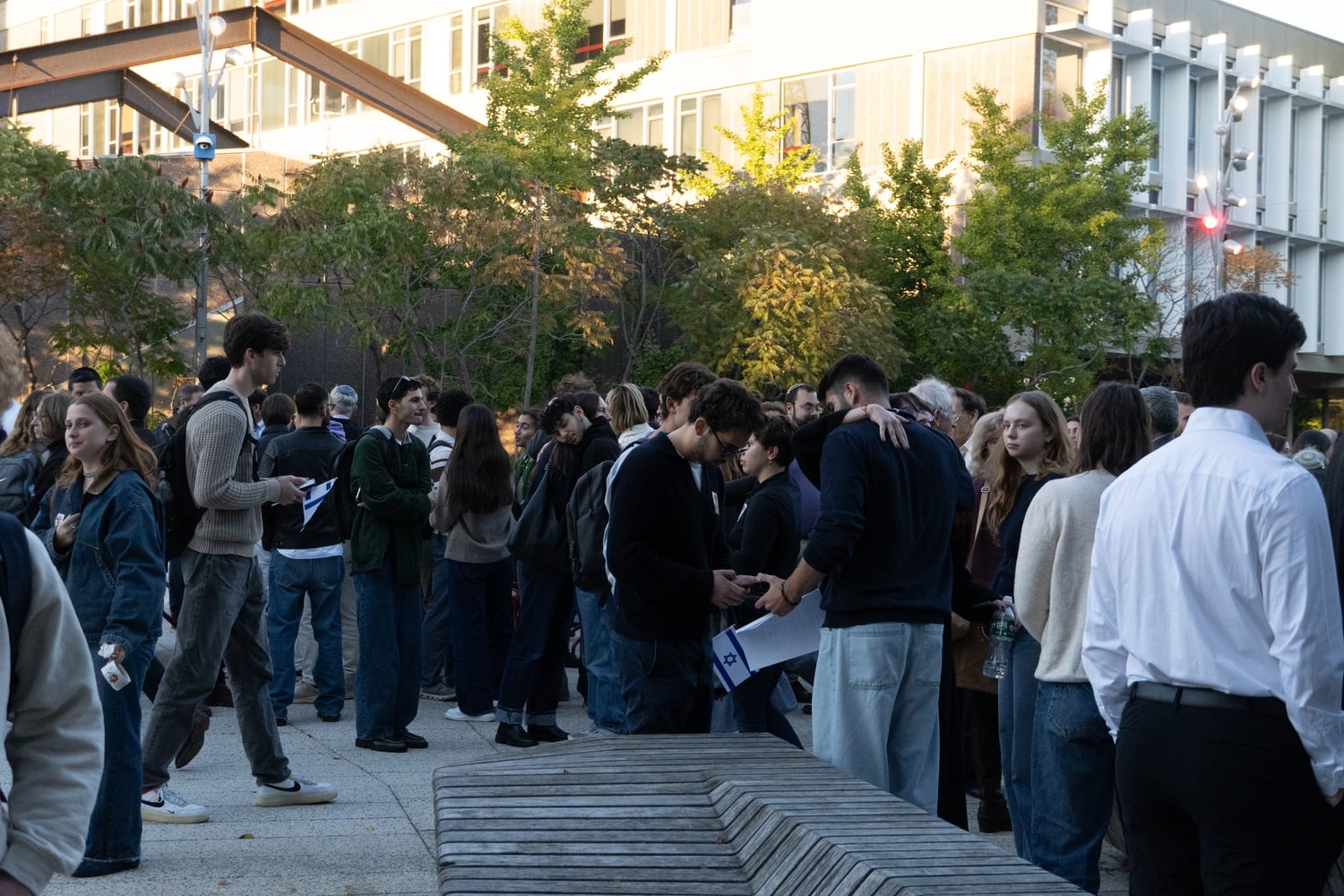
More than 100 people gathered in the Zimmer Hall Plaza on Wednesday for a vigil to mourn those killed in Hamas’ Oct. 7, 2023 attack on Israel, three years to the day after the attack.
Hosted jointly by Harvard Hillel and Harvard Chabad, the event featured remarks from Rabbi Harvard Hillel Executive Director Rabbi Jason B. Rubenstein ’04 and Harvard Chabad Rabbi Hirschy Zarchi, as well as students Segev Rome ’28 and Harvard Business School student Maya Eytan, who shared their personal stories. The groups also organized vigils marking the first two anniversaries of the attack.
Students huddled under Israeli flags, wore remembrance flower stickers, sang Jewish hymns, and were led in prayer by Rabbi Berel Feldman before student a cappella group ApiChorus performed a song.
The vigil marked the anniversary of Hamas’ Oct. 7, 2023 attacks on Israel, in which militants killed around 1,200 people and took about 250 hostages, including a dozen Americans. Israel’s military campaign in Gaza has since killed more than 73,000 Palestinians, according to the Gaza Health Ministry, and destroyed or damaged roughly 80 percent of the territory’s physical infrastructure, according to the United Nations.
After the event began with remarks from undergraduate student leaders from Harvard Chabad and Harvard Hillel, Rubenstein compared the community’s grief to the biblical lament for Jonathan, who fell in battle against the Philistines on Mount Gilboa.
“Our tradition is wise in grief,” he said. “We, over the last years since October 7, have learned from its wisdom and have become, in the saddest of ways, wiser as well.”
Rubenstein also said that the attacks had left Jewish people feeling less safe.
“There’s a sense I think each of us feels sometimes at the front of our minds and always at the back that the very world we inhabit is not the same world,” he said. “It’s not as safe a world. It’s not as sure a world.”
Zarchi, who spoke after Rubenstein, said Jewish people remain “profoundly troubled and haunted” by the attacks. He urged attendees to push back against what he called “a narrative that’s a lie” and to better educate their peers.
“I see so many of the members of the Class of 2030 who are not educated on these issues, and no one could blame them,” he added. “I know we’re here to mourn, and we’re here to remember. I don’t want to deflect from it, but we can’t just mourn. We need to come away energized with a sense of mission to ensure that those who were murdered live on.”
Get The Crimson in your inbox.
Zarchi also told students their place at Harvard made them leaders.
“We’re at Harvard. You’re here because, in some of the important offices here, they affirmed by admitting you that you have the goods to be leaders in the world,” he said.
Eytan, who is from Israel, spoke about a personal loss. She told the story of Johnny, one of her closest friends, who was killed at the Nova music festival on Oct. 7 along with two of his best friends.
In the last months of his life, Johnny had a partner “whom he loved deeply,” had just started his dream job in investment banking, and had taken the GMAT in the hopes of earning an MBA at Columbia. Then, he was murdered.
“Everyone who knew Johnny believed he had an extraordinary future ahead of him, and I truly believe that the world lost not only an incredible person and friend, but also someone who could have become one of the great future leaders,” Eytan said.
Erica S. Ho ’27, the undergraduate co-president of Harvard Chabad, said this year’s vigil drew a larger crowd than last year’s.
“I think it’s not often that you have a gathering so large even three years out,” she said. “It does show that the Jewish community remembers the events that happened three years ago, and we continue to show out for it every year.”
Ari Ne’eman, an assistant professor of health policy at the Harvard School of Public Health, said he has attended every vigil since the attacks.
“I think it was very powerful,” he said. “Many of the people here, like all of the people in Israel, were only one or two steps removed from someone who lost their life or was taken hostage during the attacks on October 7, so marking the occasion, and holding space for grief and remembrance is something that I think is very important.”
—Staff writer Alma T. Barak can be reached at [email protected] and on Signal at almabk.54. Follow her on X @almabk_.
—Staff writer Theresa F. Bartelme can be reached at [email protected] and on Signal at theresabartelme.15. Follow her on X @theresabartelme.
Want to keep up with breaking news? Subscribe to our email newsletter
Have a tip for The Crimson? Share it confidentially