The Fringe at the Lilypad: A Cornerstone of Cambridge Jazz
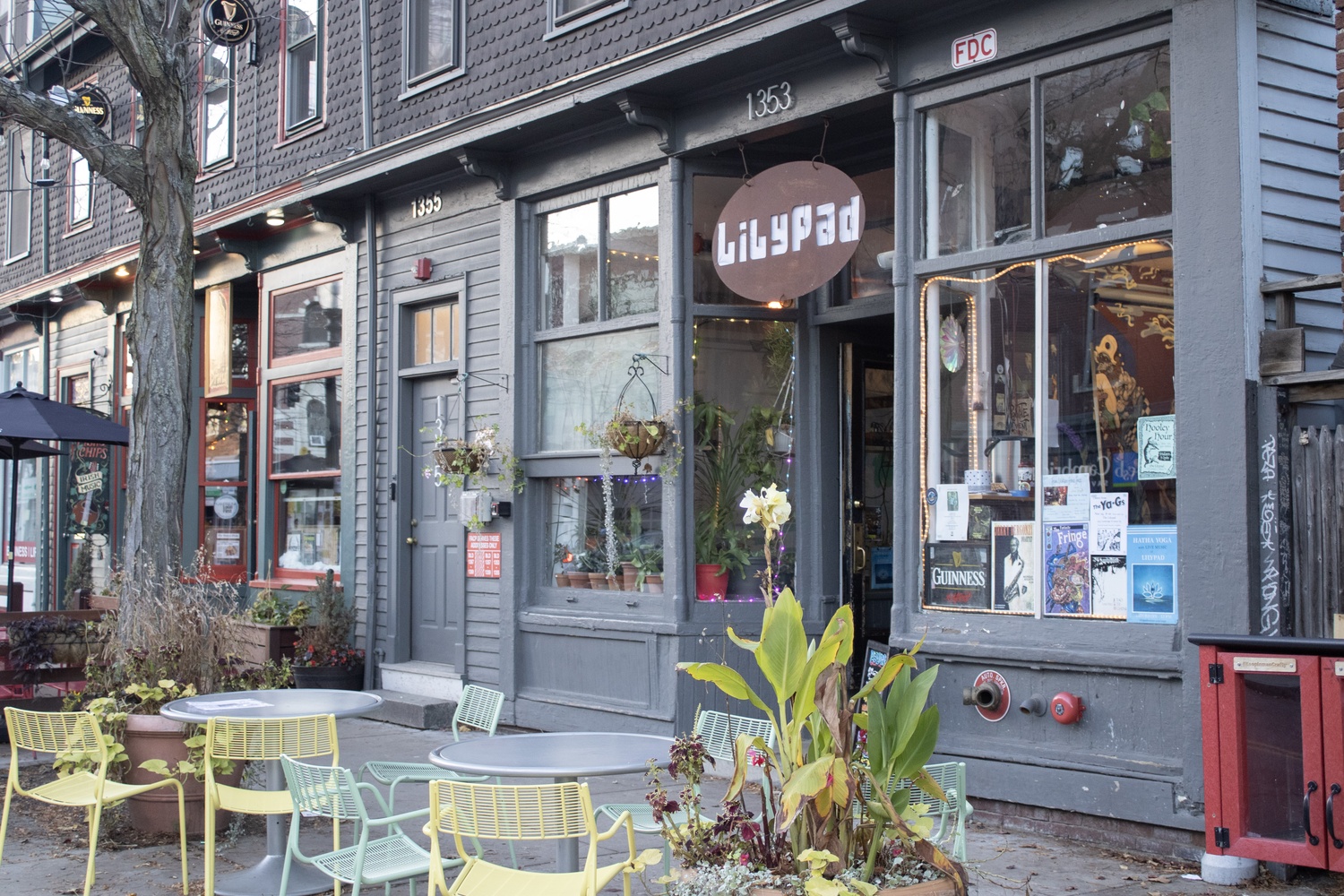
At 10:32 p.m. on Oct. 19, George Garzone — who had minutes ago been milling about the small space and chatting with old friends while his bandmates warmed up — began playing, his saxophone shining golden amidst the dark. Every Monday, Garzone — who, along with bassist John Lockwood and drummer Francisco Mela, makes up jazz trio The Fringe — performs at the Lilypad, a small music venue and event space. Through changes in venue and trio members, The Fringe’s weekly improvisational performances have been a cornerstone of Cambridge’s jazz scene for 45 years, gathering an audience of both devoted returners and first-time listeners.
In 1971, The Fringe was formed by Garzone, bassist Richard Appleman, and drummer Bob Gulloti. Appleman left in 1985 to pursue other ventures and was replaced by Lockwood. After Gulloti passed away in 2020, his position was filled by Cuban-born percussionist Mela. All three of today’s members of the avant-garde group have established renown in the local jazz scene, have performed with various jazz stars, and currently teach at Berklee College of Music.
“The thing about coming here is that it’s so rare, even in New York, to have a steady gig every week. We’ve been playing here since 2001,” Garzone said in an interview with the Crimson. “To have a steady gig anywhere and have a steady gig in Boston and play the way we play allows us to further our musical integrity.”
Despite the regularity of their gigs, every performance of theirs is undeniably singular. The Fringe’s free jazz style makes it so that every performance is unique. The three members improvised continuously on stage for an hour and a half, communicating nonverbally about where to drop out or re-enter, following each other as energy built, and shifting from loose time to an almost hip-hop-adjacent groove seamlessly.
“Change is the only game in town. If you don’t change, it’s boring. Change your reeds, change your monkeys, change the horns. The only thing that I don’t change is my wife,” Jerry Bergonzi, a jazz saxophonist and longtime friend of Garzone in the audience, said.
At one point, Garzone subtly stopped playing and wandered off the stage in search of a glass of water. Mela alternated between using sticks and brushes throughout, adding further variety while guiding the flow of the music.
Garzone, Lockwood, and Mela are not, however, simply making it up as they go. They are each equipped with a breadth of musical skill and jazz expertise that they are able to call on momentarily.
“Can I just say that this is really, extremely skilled, high quality traditional jazz. I can’t even believe I was invited to come here tonight accidentally,” Rebecca Demores, an audience member said.
Demores later said, “I was 17, I was your age and I was the hostess of a jazz bar where some of the greatest jazz musicians in the history of jazz performed. I was just there to make a dollar, but I learned. I saw the greatest jazz ever, and this combo is just shockingly great.”
The trio played for nearly the entire hour and a half, only stopping twice during that period to allow for brief applause and then promptly beginning again.
Bergonzi also explained that jazz is fundamentally tied to and influenced by what is happening in the surrounding world.
“Whatever’s going on in the world comes out with us. You watch the news, and it’s, like, John Coltrane in the 1965 civil rights movement,” he said.
One way in which the outside world entered the trio’s playing was by quoting well-known standards, eliciting delighted recognition from the audience. At the close of a classic jazz tune, Demores sang along with the familiar ending. When Garzone began referencing John Coltrane’s “A Love Supreme, Pt. I: Acknowledgement” — a fitting nod given Garzone shares a birthday with the jazz saxophone legend — the crowd began to softly sing along: “A love supreme, a love supreme.”
A group leaned against a wall, tapping their fingers against their mugs in time with the music. The space gathered patrons of various ages who knew each other and the band well; a Berklee student entered partway through with a whispered greeting and hug to the older men in the back. Though at the beginning, first-time audience members were tentative and quiet, Demores urged them into more active engagement. “C’mon, help her out,” Mela exclaimed at one point, tossing his sticks into the air grandly, “You can clap along!”
This community-centric ethos also shines through in the musicians’ commitment to teaching. Many of their students from Berklee attended the show.
“When you see the love and the work that goes into these kids, these kids that are in the front row,” Bergonzi said. “It reminds me of when I was in it. That’s all I did. It was music.”
Throughout the performance, Bergonzi whistled appreciatively when the trio played something particularly compelling, and called out encouragement.
Expressing her awe at having local access to the high-quality jazz that The Fringe has brought to the Cambridge area for nearly half a century, Demores tied the magic of the evening together neatly.
“I can’t even believe that I can just walk into this place at the invitation of a guy, and walk in on this level of incredible, really skilled musicianship in a tradition that’s uniquely American, and I grew up with it,” she said. “I’m so excited.”
Want to keep up with breaking news? Subscribe to our email newsletter
Have a tip for The Crimson? Share it confidentially