‘Wild Horse Nine’ Review: Laughing Alongside the Imperialists
Dir. Martin McDonagh — 3.5 Stars
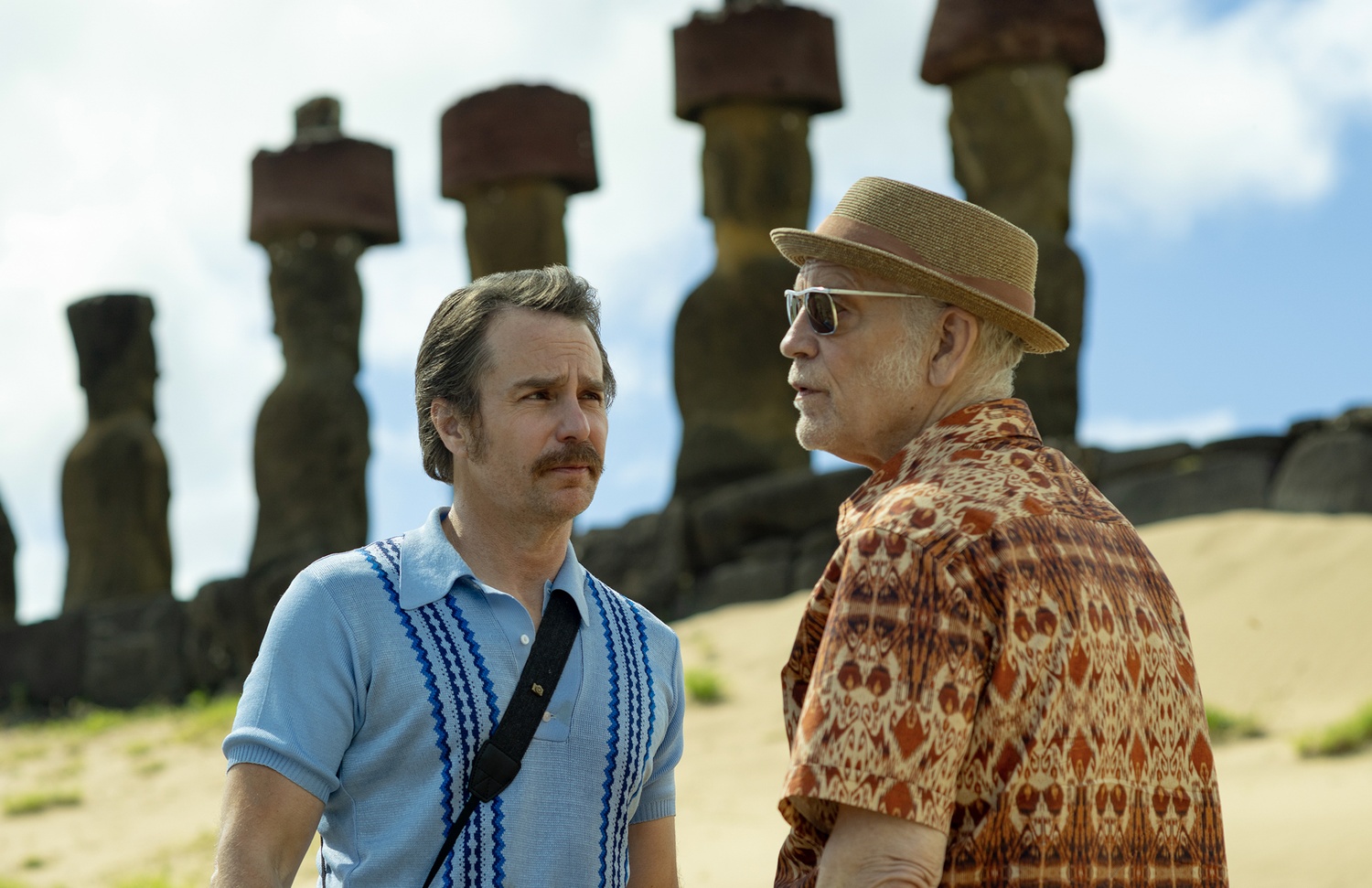
How do you make an audience laugh — and even root — for the men actively dismantling a democracy? For director Martin McDonagh, you strand them on one of the most remote islands on earth and let them bicker. Swapping out the cobblestone purgatory of “In Bruges” and the melancholic sprawl of “The Banshees of Inisherin,” McDonagh continues his career-long fascination with emotionally constipated, codependent men barreling toward moral reckoning. In “Wild Horse Nine,” McDonagh applies this signature formula to a far more volatile — yet deceptively peaceful — landscape.
Months before the 1973 Chilean coup that overthrew socialist president Salvador Allende and installed far-right dictator Augusto Pinochet, this pitch-black crime comedy follows two American CIA operatives — Chris Carlisle (John Malkovich) and Lee Chesterfield (Sam Rockwell) — as they trek to the stone-faced moai of Rapa Nui. Chris, a seasoned agent, is at his wit’s end, his nerves frayed by years of subterfuge and perhaps even a presidential assassination (which he neither confirms nor denies). He tasks his younger, jittery counterpart, Lee, with accompanying him on a week-long existential vacation.
McDonagh immediately thrusts the audience into the film’s heart: that being the devastating yet loving dynamic between Chris and Lee. The opening amateur-style interview of Chris — videographed by Lee — instantly delivers the keen, rapid-fire banter McDonagh is known for. Malkovich’s philosophical rambling ricochets against Rockwell’s charged exasperation. The two perform a tragicomic Abbott & Costello dynamic, pivoting from absurdity to poignancy in a heartbeat.
Malkovich expertly moves between deadpan dark comedy and sudden, chilling bursts of violence before quietly retreating into melancholy. Nowhere is this more apparent than in Chris and Lee’s increasingly tense airport scene, as Chris bickers with two Chilean college students about whether to call the island Rapa Nui or Easter Island. Loose-lipped from existential dread, Chris lets slip, “We came down here to destabilize our democracy, and it is going great.”
Through his reckless behavior, a sudden volatility pulses through Chris, shattering any sense of predictability from the film. Lee, meanwhile, is forced to anxiously play observer and reluctant confidant while juggling intrusive calls from his unfaithful wife, Marge (Parker Posey), and the hawkish oversight of the CIA’s South American bureau chief, MJ (Steve Buscemi).
Visually, “Wild Horse Nine” is a masterclass in stunning dissonance. Through sweeping, sun-drenched wide shots and crisp pans that evokes vintage National Geographic photography, Chris and Lee are cast as clueless Western invaders in the landscape — the towering, stone-faced statues looming over their petty squabbles and tender heart-to-hearts. The film’s meticulous color blocking and vast negative space trap the pair inside an isolated bubble, physically and emotionally segregated from the Rapa Nui community and the impact of their work.
Yet, as Chris’ indiscretion grows dangerous, the film’s fundamental flaw is exposed. McDonagh’s quintessential humor keeps the audience engaged, but the constant comedic whiplash often undercuts the more serious story beats. Just as the audience is invited to feel the crushing weight of Chris and Lee’s situation, an ill-timed quip swoops in to deflate the moment.
This tonal confusion ultimately lends itself to McDonagh’s unwavering affection for his antiheroes. McDonagh deliberately and overtly attempts to win the audience’s sympathy for Chris by giving him an unearned redemption arc. This transformation shifts Chris from a bumbling accomplice to the story’s unlikely hero, even though his actions don’t justify such a turnaround. Lee’s role, meanwhile, ventures past a mere straight man through Rockwell’s layered performance, but ultimately stalls as the audience’s interpreter. Between worried looks and on-the-nose claims of friendship, Lee turns Chris’ outbursts and guilt into something almost sympathetic. Ultimately, his real role in the story — making rooting for the bad guy seem like the empathetic choice — serves as the ultimate thesis of America’s Cold War foreign policy.
To his credit, McDonagh is in on the joke. He deliberately paints Chris and Lee as self-absorbed Westerners using a Pacific paradise as the backdrop to their personal melodrama — an attitude summed up by Chris’ stubborn insistence on calling the sacred moai statues “the big heads.” Despite the film’s self-aware winks at its imperialist-sympathizer lens, the camera never strays from its antiheros. Chilean characters, such as the two college students, Mónica (Mariana di Girolamo) and Alicia (Ailín Salas), are portrayed as reluctant foils to Chris’ supposed awakening. Meanwhile, the real victims of the coup are pushed to the margins of the story. The coup itself serves less as a story beat and more as a setup for a punchline. While understandable in terms of plot, the film ultimately asks us to feel for the oppressor’s remorse, rather than confronting the devastating realities endured by the oppressed.
Still, to harp on its flaws is to miss the film’s considerable strengths. “Wild Horse Nine” delivers whip-smart dialogue, unforgettable performances, and a narrative that, while occasionally imbalanced, ultimately lands on a bittersweet crescendo. Yet beneath its slick surface, “Wild Horse Nine” sometimes mistakes introspection for insight, inviting us to giggle along with the devil and then weep for him, too.
Want to keep up with breaking news? Subscribe to our email newsletter
Have a tip for The Crimson? Share it confidentially