Harvard Can’t Defend Democracy in Washington While Denying It in Cambridge
Last week, voters delivered a resounding message to the institutions that spent the past two years cutting deals with the president: You do not need to sacrifice your principles to survive. The midterm’s results — including the election of eleven candidates endorsed by the national American Association of University Professors — vindicated Harvard’s decision to follow our AAUP chapter in suing Trump.
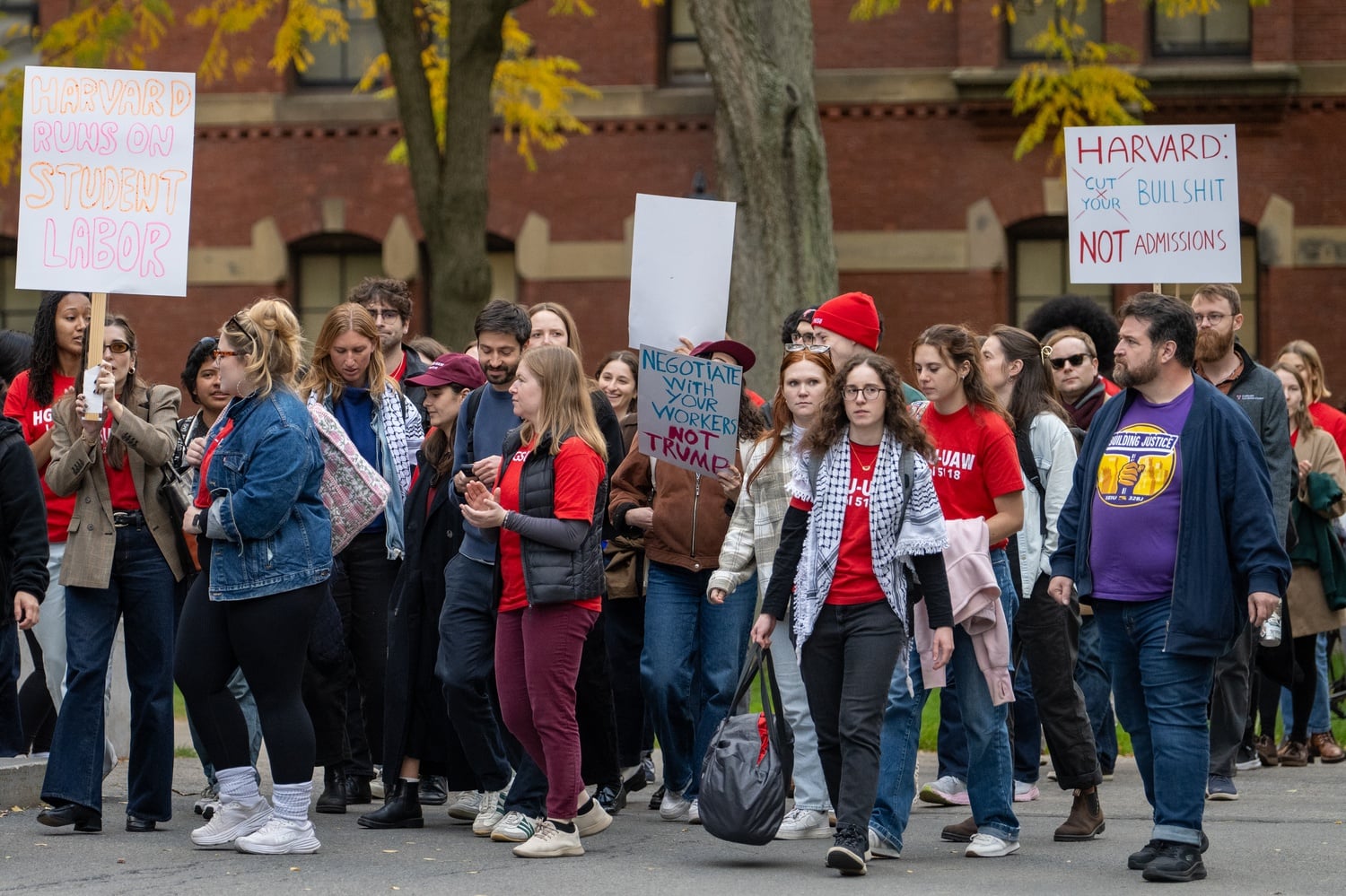
And yet for all the praise Harvard has rightly received for declaring the importance of democracy and academic freedom, three campus unions have voted overwhelmingly to authorize strikes this fall. Graduate student workers have been out on the picket line since Oct. 27, after over a year of ongoing contract negotiations. Non-tenure-track faculty went on strike this Tuesday, after 54 bargaining sessions and two years without a first contract. Dining workers authorized a strike on Oct. 20.
All three unions are asking an uncomfortable question of Harvard: whether it will treat the people who do its work as its citizens or its subjects.
Consider what these workers have asked for. Graduate workers and non-tenure-track faculty want Harvard to promise that it won’t let Immigration and Customs Enforcement agents into non-public campus spaces without a judicial warrant. To guard against federal pressure, both unions have also asked Harvard to write academic freedom into their contracts.
While Harvard has told the federal government that its conduct is unacceptable, it won’t make the same commitment to its own workers at the bargaining table.
Even worse, Harvard has bargained with its workers in a way that has treated the Trump administration as an ally. The National Labor Relations Board is the federal agency that decides which workers may unionize and strike with protection. Its members currently serve at the president’s pleasure, and Harvard has used the Board’s loyalties to its advantage. The day after the graduate union’s contract expired, it removed 800 students from the union, citing recent board rulings. In October, Harvard warned that a second strike could be “unprotected,” a theory that three of our colleagues who teach labor law have called a misreading of the law. It’s also a theory that arguably only today’s NLRB would accept.
Harvard has bargained with Harvard Academic Workers-United Auto Workers, which represents non-tenure-track faculty, the same way. Federal law requires an employer bargaining a first contract to leave working conditions alone until the parties agree to change them. But this spring, after Harvard reportedly told HAW-UAW there were no plans to cut budgets, it cut spending and increased the workload for the teachers of its intensive freshman writing course. This summer the union said Harvard withheld raises from unionized academic workers while paying them to others.
HAW-UAW filed unfair labor practice charges with the NLRB both times. But both Harvard and the union are almost certainly aware that those charges will be decided by people Trump can fire. Instead of treating its workers as citizens of the University, Harvard is changing the terms of their work and daring them to object to a board that answers to Trump.
The irony of Harvard’s reliance on the Trump administration is that the people going on strike are the ones actually paying for Harvard’s public stand against it. Harvard administrators have not been directly targeted in the current immigration crackdown; the unions represent noncitizen workers whose visas have been threatened. Federal cuts aren’t preventing Harvard from achieving another record-setting endowment; they’re preventing lecturers from keeping their jobs.
Having borne the cost of Harvard’s fight, our colleagues are asking for a say in what Harvard does next. For most of us who teach and research here, collective bargaining is the only vote we have about how we can navigate the crises our institution is facing.
Harvard’s reply is that a strike is unwarranted given its offers of raises and mediation. It adds that only a third of eligible graduate workers pay dues, so it disagrees with the HGSU’s request for agency fees. We take its position seriously. We also note that a teaching fellow in the later years of a Ph.D. currently makes about $26,000 for a full teaching load, that Title IX mediation is non-binding, and that while Harvard is denying agency fees to graduate and non-tenure-track workers, it has recognized them for other unions on campus.
After faculty asked at last Tuesday’s faculty meeting whether any of us faculty sit on Harvard’s bargaining team, a spokesperson wouldn’t say. We’re parties who have been denied a seat at the table. We teach the courses whose sections have stopped and advise the students whose funding ran out. We are workers, and subjects, too.
So we ask our colleagues to sign on in support of each union and to refuse to replace our striking colleagues’ labor. Harvard stood on the principles of democracy and academic freedom when the president demanded it give up its independence. Its workers are standing on the same principles now. The difference is that this time, Harvard is the one making the demand.
Nikolas Bowie is the Louis D. Brandeis Professor of Law at Harvard Law School. Adam L. Haber is an Associate Professor of Computational Biology and Environmental Health at the Harvard T.H. Chan School of Public Health. Martha Ann Selby is the Sangam Professor of South Asian Studies and Comparative Literature.
Want to keep up with breaking news? Subscribe to our email newsletter
Have a tip for The Crimson? Share it confidentially