‘Club Kid’ Review: Jordan Firstman’s Sparkling Debut Finds Heart in the Club
Dir. Jordan Firstman – 4.5 Stars
What happens when a nightclub promoter takes custody of a 10-year-old son he has never met? This is the plot of “Club Kid,” A24’s new film following Peter (Jordan Firstman, the film’s writer and director), a New York City club promoter and party organizer, as he takes on the responsibility of caring for 10-year-old Arlo (Reggie Absolom) after Arlo’s mother dies.
Peter and Arlo are both lost souls: Peter is deeply unhappy with life, finding solace in drugs and parties, while Arlo is navigating a world without his mother, the only parent he ever knew. The film balances the heavy plot with laugh-out-loud humor and deep tenderness, telling Peter and Arlo’s story through a dazzling showcase of cinematography and aesthetics.
The club — as the title suggests — plays a significant role in the film. The numerous scenes that happen directly in the club, both in the 2016 opening scene and the present-day scenes, are incredibly well done — almost sickeningly so. House music blares and lights flash, pulse, and occasionally cut out entirely, creating shots that disorient the viewer and immerse them completely in Firstman’s world. As the main characters keep slipping into the bathroom to do drugs, the disorientation only becomes more pronounced with claustrophobic close-ups of people’s faces as they sway unsteadily to the music.
By the time Arlo shows up in Peter’s living room, it’s hard to imagine Peter — the center of many of these drug-addled parties — shaping up to be anything like a functional parent. However, since the family friend who brought Arlo to New York City (a riotously funny Kirby Howell-Baptiste) has returned to London without notice, Peter has no choice but to figure it out.
Absolom plays Arlo perfectly, blending childhood innocence and bluntness while wholeheartedly embracing Peter’s nontraditional life. Firstman, for his part, portrays Peter’s party-animal-turned-father arc with sincerity and heart. His character truly comes to life in the second half of the film, going from a cycle of never-ending drug use — both during parties and to recover from them afterward — to an engaged dad cheering on his son at the skatepark.
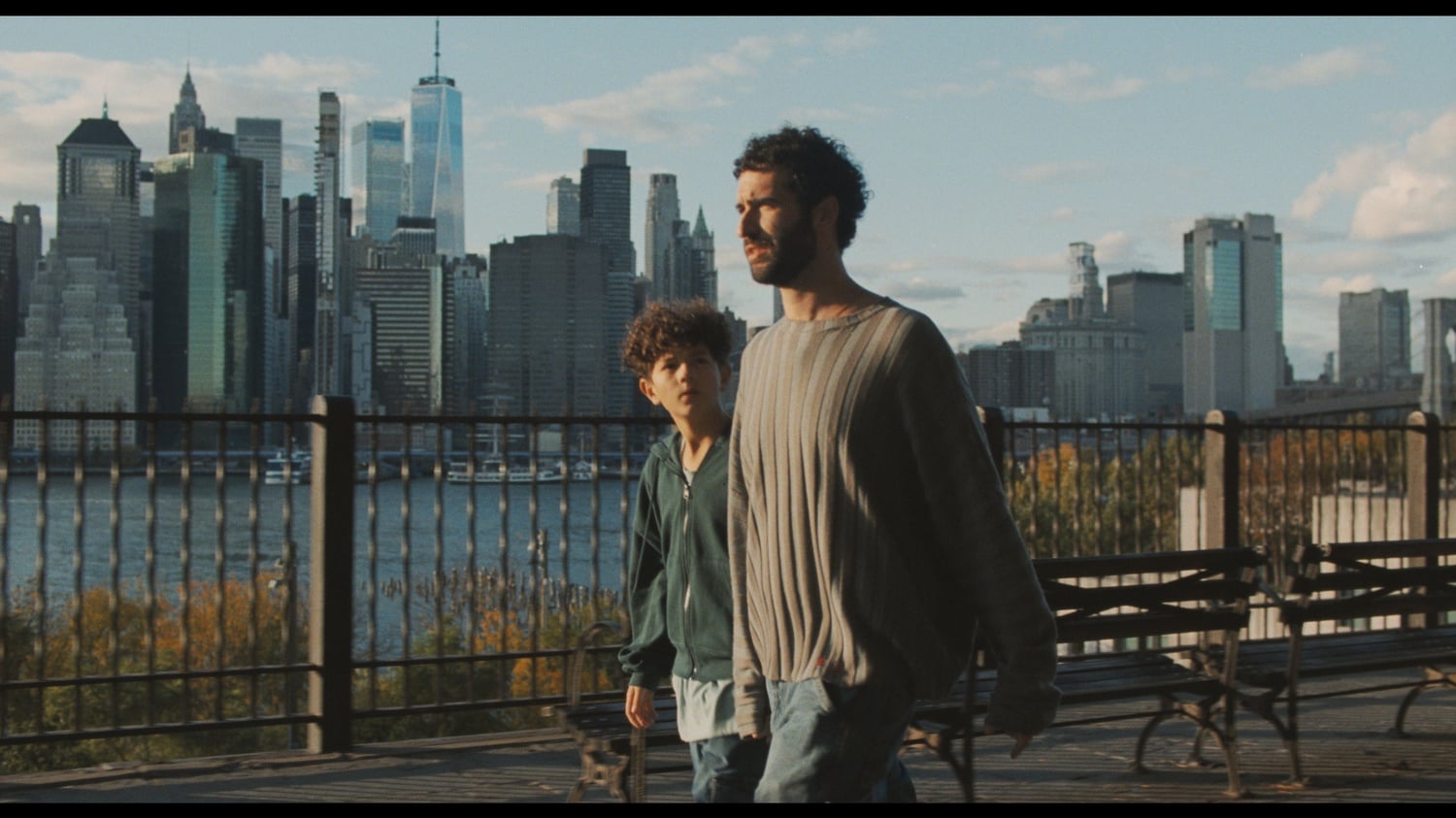
As Peter and Arlo get to know each other, Firstman uses New York City to create stunning backdrops for various vignettes of their new life together, from walking in Brooklyn with Manhattan’s skyline shimmering behind to popping around record stores and skateboarding in Seward Park.
Many shots are not only aesthetically pleasing but also deeply meaningful. At the beginning of the movie, Peter smokes on his fire escape as the sun comes up, exhausted from the night’s activities. This shot, taken from the inside of the apartment, perfectly contrasts a heartwarming scene later on, in which the camera pans out from the window of the apartment, looking inside at Arlo and Peter playing the piano together.
Still, Peter’s transition from relentless partying to attentive parenting feels unusually frictionless. After establishing how thoroughly drugs structure his daily life, the film gives little attention to the difficulty of changing those habits. The film also gives limited attention to Arlo’s grief following his mother’s death. His loss receives only one substantial conversation with Peter, leaving what could have been a thoughtful exploration of bereavement underdeveloped.
However, these small issues don’t detract from what is an overall strong work of art. In addition to the many successful creative choices, the film is also a heartfelt celebration of found family. Prior to Arlo’s arrival, Peter has a couple of close friends, many of whom are queer. Even after Peter pulls away from the club scene throughout the movie, his friends stay close — including Saffron (Saturn Risin9), a transgender DJ who eventually mentors Arlo in DJing. In an especially New York fashion, even Peter’s downstairs neighbor, Evelyn (Colleen Camp), plays a big role in his life, from babysitting Arlo to checking in on Peter as he walks by after a long night out.
Overall, the creative choices, as well as the genuine joy and love they help showcase, make “Club Kid” a huge success. Firstman’s film is a beautiful celebration of the people we love, the places we share with them, and the impact we have on one another’s lives.
—Staff Writer Francesca H. Vittorelli can be reached at [email protected].
Want to keep up with breaking news? Subscribe to our email newsletter
Have a tip for The Crimson? Share it confidentially