Deming Says College Did Not Make Extensive Contingency Plans Ahead of Academic Workers’ Strike
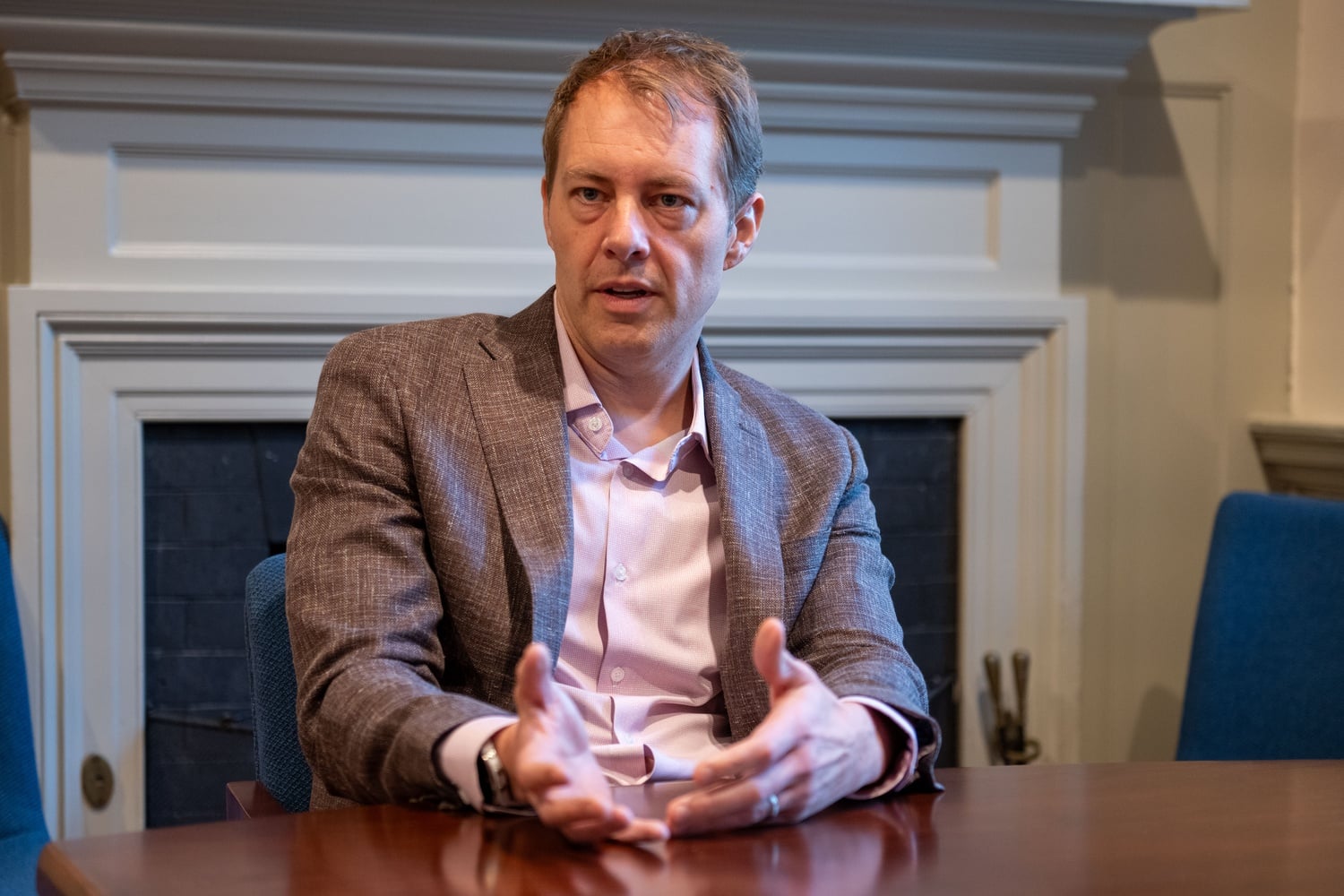
Harvard College did not develop extensive contingency plans ahead of the Harvard Academic Workers-United Auto Workers strike, College Dean David J. Deming said in a Tuesday interview, arguing that preparing too aggressively for a walkout could undermine good-faith negotiations.
“We didn’t stand up a whole bunch of parallel systems because I think that would sort of be inconsistent with the idea that parties are negotiating in good faith,” he said.
Harvard Graduate Student Union-United Auto Workers began its second strike of the year on Oct. 27. On Tuesday, HAW-UAW, which represents non-tenure-track faculty and researchers, walked out after failing to reach a deal with the University.
Workers in Harvard Undergraduate Dining Services also voted to authorize a strike in October after contract negotiations with the University stalled.
Deming said the College would respond to disruptions as they arose. He declined to detail contingency plans for a potential HUDS strike, but said the College would work with HUDS to prepare if a walkout appeared imminent.
The HAW-UAW strike could disrupt dozens of undergraduate courses, including Expository Writing, language, and introductory mathematics courses, which are predominantly taught by preceptors. Deming acknowledged Tuesday that maintaining academic continuity during the walkout would be difficult.
“It’s going to be really hard. These are courses that many of our students take, many are required to take, and many people who teach in those courses are members of the HAW and may be on strike,” Deming said. “It’s going to be hard for us to stand those courses up.”
Deming said the College would seek replacement instructors who were not participating in the strike and explore ways to support students outside the classrooms.
But he acknowledged that the College had not extensively discussed how it would respond to a prolonged HAW-UAW strike.
“I was hoping, and I still hope, that they’ll reach an agreement. My sense is they’re not that far apart, and so I haven’t really had a lot of conversations about what we’re going to do if this strike lasts a long time, because I really hope it doesn’t,” he said.
Get The Crimson in your inbox.
HAW-UAW bargaining committee member Jenya Mironava said she agreed with Deming’s assessment that the union and University were close to an agreement.
“I share Dean Deming’s concern. I guess I wish that the administration shared that concern,” Mironava said. “They could end this at any point while coming to the table if they sincerely care about student learning and learning continuity or program continuity, we’re willing to work with them to settle this.”
Mironava also acknowledged the impact that the strike would have on undergraduates, but said the union felt such an impact was merited.
“It is disruptive,” she said. “But after two years of negotiations, we feel that this is warranted. We must make this point. We must take this route.”
Deming described his approach as “react mode,” noting that he was not involved in day-to-day contract negotiations.
“I’m not apprised of the day-to-day, and so I look at it more as what is the problem we’re going to have to solve today,” he said. “We’ll address it as it comes.”
Despite the disruptions to undergraduate education, Deming said he had not asked University negotiators to make concessions to end the graduate student strike. Instead, he said he had not shared information with the bargaining team about its effects on students.
“My role in that case is to share that information to give them that perspective, not to intervene directly,” he said. “Not to force any particular outcome, but just to make them aware that it is having serious impacts on continuity of the academic experience.”
Deming has been increasingly vocal about the impact of the graduate student strike on undergraduate education. Last Thursday, he and Dean of Undergraduate Education Amanda Claybaugh criticized HGSU-UAW picketers who used megaphones and air horns outside a midterm exam for General Education 1116: “Medical Ethics and History.”
“We hope that everyone in our community can agree that students have the right to take their exams without disruption,” they wrote in a joint statement.
On Tuesday, Deming declined to say whether graduate students who participated in the picket should face disciplinary consequences. He also stopped short of defining what constituted unacceptable strike activity, instead urging union members to consider the effect of their actions on undergraduates.
“Is there a way to do it without hurting students?” he said. “If possible, I’d ask that they express themselves as they have a right to do, while leaving undergraduates out of the harmful impacts of it.”
Deming said he made a similar appeal directly to HGSU-UAW members during a recent conversation at Zimmer Hall, asking that they try to “leave students out of it.”
—Staff writer Sebastian B. Connolly can be reached at [email protected] or on Signal at sbc.23. Follow him on X @SebastianC4784.
—Staff writer Summer E. Rose can be reached at [email protected] or on Signal at ser.85. Follow her on X @summerellenrose.
Want to keep up with breaking news? Subscribe to our email newsletter
Have a tip for The Crimson? Share it confidentially