Excellence and Energy: Mozart Society Orchestra Presents Shostakovich and Tchaikovsky
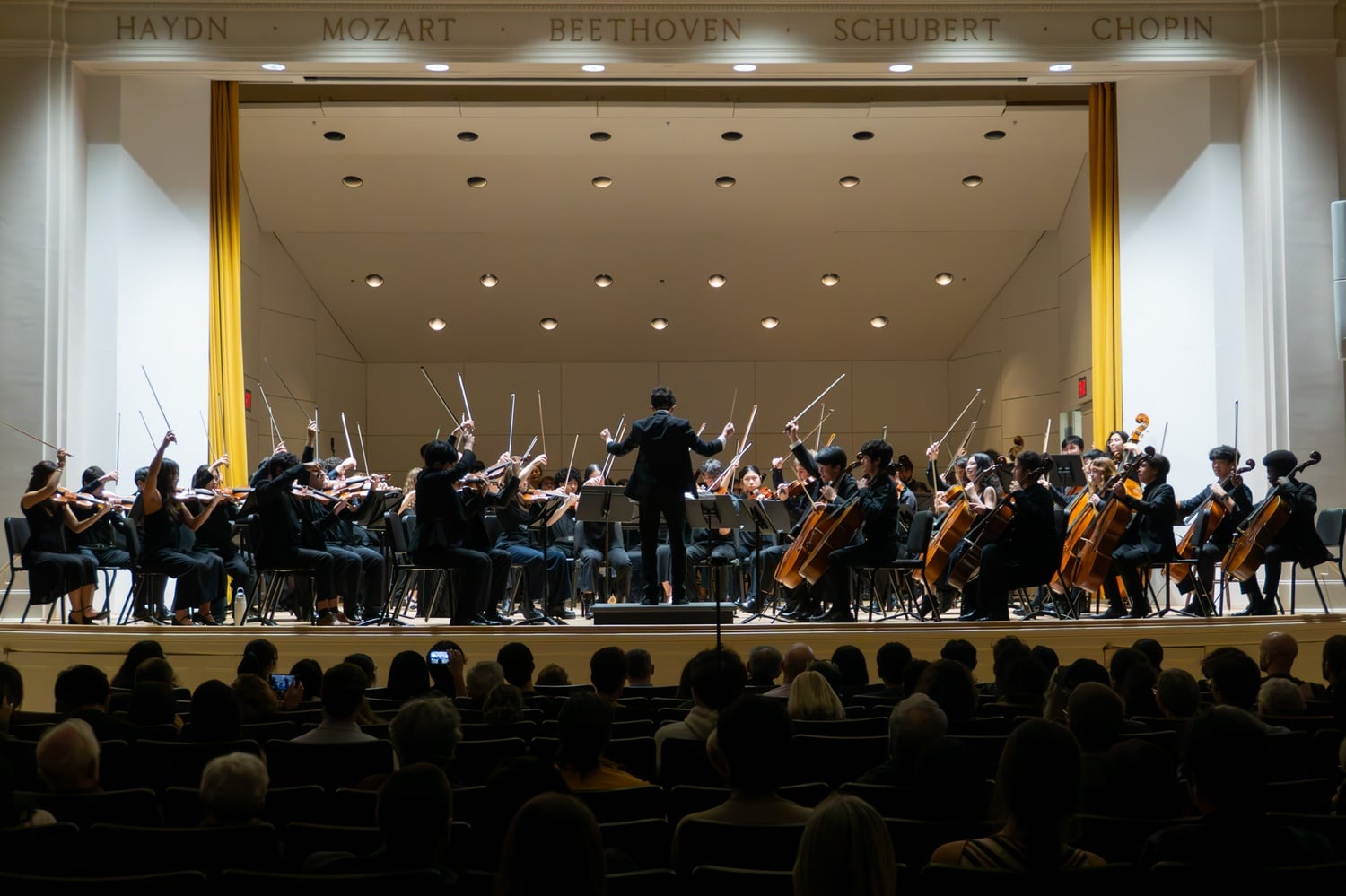
On Nov. 8, Harvard’s Mozart Society Orchestra delivered their Fall 2026 concert at Paine Hall, performing an impressive repertoire of true classical music staples. Now in its 43rd season, the student-led ensemble conveyed a sense of camaraderie even during their onstage warmup, as musicians laughed together and waved to familiar faces in the audience.
The group brought triumphant energy from the start with Dmitri Shostakovich’s “Festival Overture.” Written to celebrate the 37th anniversary of the October Revolution in Russia, this overture is not the most emotionally deep entry in his repertoire, but it excels in its easy-to-follow melodic line and accompanying harmonies. The lack of complexity in chord progression can be explained, if not fully excused, by the circumstances surrounding this piece: Shostakovich received this commission from the Bolshoi Theatre only three days before it was due.
Overall, each section of the orchestra worked harmoniously with one another, passing melodic lines from brass to woodwinds to strings. In particular, the woodwinds executed the opening melody — a passage both demanding and exposed, filled with notes and runs — with conviction and clarity, demonstrating true virtuosity. The strings were up to this challenge as well, matching the woodwinds’ brilliance when it was their turn with the melody. All of the performers brought out a rich tone in every range of their instrument, a truly admirable feat considering the level of difficulty of this overture. The only mishaps — a quick break in sound quality, a small adjustment of intonation, an occasional backwards bow stroke — were minor ones, and didn’t detract from the quality of the performance.
The entire orchestra struck the final chord with passion, and the note seemed to swell in both volume and power as assistant music director Jayden H. Lee ’29 conducted the cutoff. This jubilant end to the piece continued ringing through the hall long after the music ended, wrapping up an energy-packed start to the concert.
Next on the program was the first movement of Pyotr Ilyich Tchaikovsky’s Violin Concerto in D Major, Op. 35, one of the most difficult, yet beloved, works for solo violin and orchestra. Soloist Paloma So ’27 attacked the start of the piece with confidence. Her ability to project and shine as a soloist without overplaying was extremely impressive throughout.
On occasion, particularly in moments where the music pushed forward, the orchestra fell just a fraction behind So, resulting in some pizzicato notes landing out of time and downbeats not lining up. Some longer periods of orchestra-only play also lacked a sense of direction, leaving the music meandering without a clear intent. Nonetheless, the orchestra as a whole did a highly admirable job as a complement to So’s performance, and they shone beautifully in their own right during the A Major orchestral climax, soaring high to fill every inch of Paine Hall.
The pinnacle of So’s performance was in the cadenza, a portion of the concerto where the orchestra does not play, allowing the soloist to highlight both their technical abilities and their musical interpretation in free time. She showed immense finesse in her pizzicato, tremendous strength in her vibrato, and extraordinary patience to let good moments linger — and there were many of them.
Following the concerto, the orchestra took a short intermission before returning for the closing piece in the program — Tchaikovsky’s Fourth Symphony. This work is dark and intense from the start, and the musicians captured this energy well throughout the first movement. However, this movement’s composition failed to capture the orchestra’s strengths. The movement is full of extremely dense material, forcing the listener to search for a continuous melody amongst fragments jumping between sections of the orchestra, resulting in fewer opportunities to play in unison and command the audience’s attention. Where the entire orchestra clearly shined, though, was in the movement’s end, a stunningly devastating finish reminiscent of Tchaikovsky’s 1812 Overture in the battle between the strings’ tremolo and the brass’s triumphant interjections.
The second and third movements of the symphony are the absolute ideal for enjoyers of pizzicato, with upper string players opening the third movement with their bows balanced on their laps instead of in their usual hands. As always with these pizzicato-heavy pieces, it was fascinating to see whether musicians anchored the plucking hand’s thumb on the upper corner of the fingerboard or left the entire hand free — the overwhelming majority here opted for the first approach. Either way, the strings did an admirable job building and weaning dynamics through the pizzicato as well as matching articulation with the woodwinds’ short notes.
The concert closed with the fourth movement, a complete contrast in its celebratory tone. Despite it being the finale of a taxing symphony and concert as a whole, the orchestra had no lack of energy. The strings launched torrents of unforgiving cascades down the length of the fingerboard, the woodwinds did the same throughout their instruments’ range, and the brass carried the performance home with their enthusiasm and power. Most of all, however, this movement was an absolute masterclass in percussion, culminating in a complete onslaught of cymbals and timpani that perfectly capped off the concert.
The passion and preparation the orchestra put into this concert was unmistakable, and the audience knew it, rewarding the musicians with a lengthy ovation at the concert’s end. Student conductors Lee, Matthew K.J. Yar ’28, and Aquila N. Wolff ’27 must be thoroughly commended as well for commanding dozens of musicians with an ease and maturity that might only be expected from conductors many times their age. The musicians brought the sophistication of a professional orchestra but the spirit of a youth orchestra — quite the ideal combo for a college group.
Want to keep up with breaking news? Subscribe to our email newsletter
Have a tip for The Crimson? Share it confidentially