The Ivory Tower’s Class Struggle
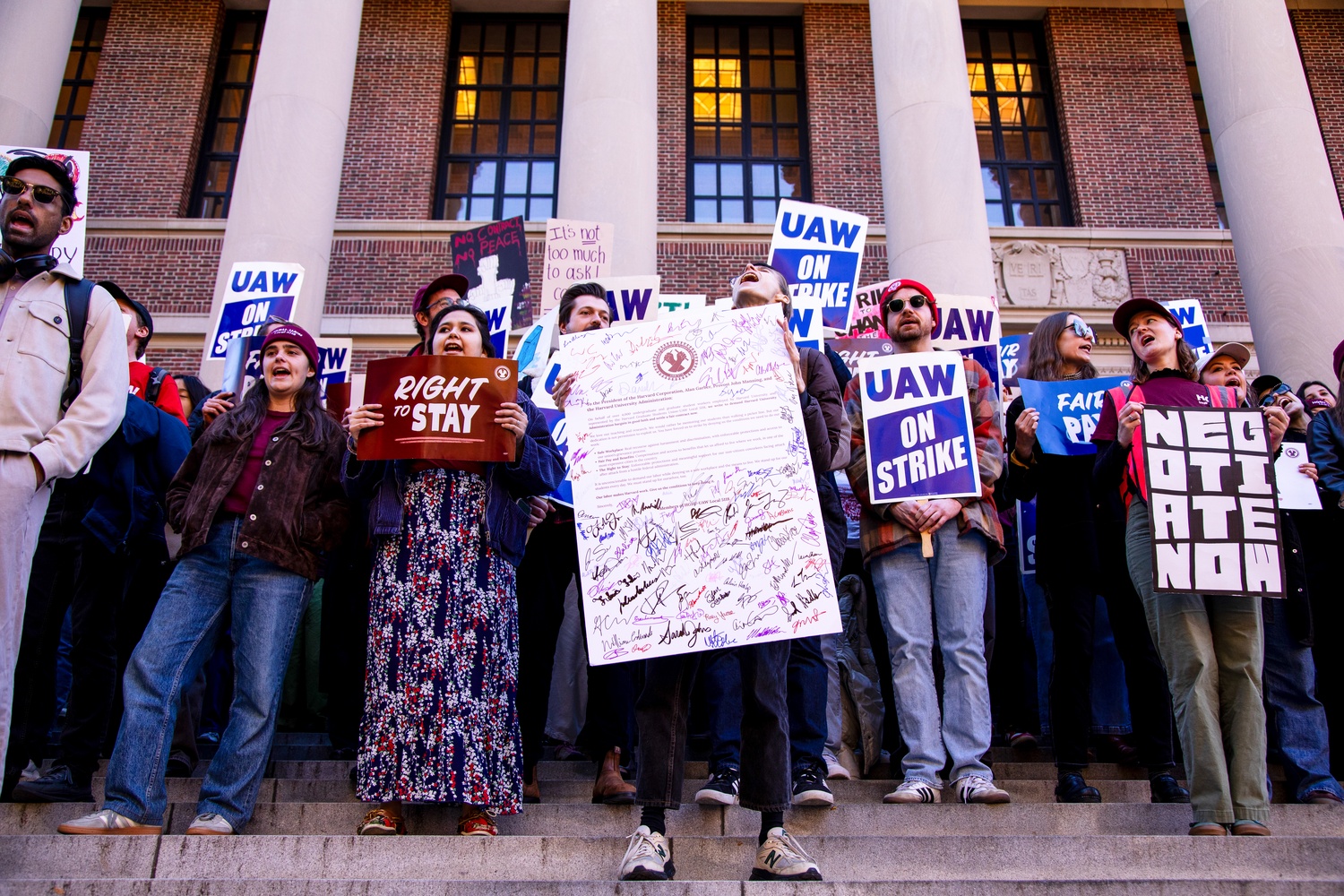
Do you feel it? The times they are a-changin’ on Harvard’s campus.
The Harvard Graduate Student Union-United Auto Workers is on week four of its strike, and was joined last week by the Harvard Academic Workers-United Auto Workers.
The unions are leaning into sweeping moral language, arguing that a fair contract is their fair due to avoid exploitation by the corporate behemoth. In a press release announcing their strike, HGSU vice president Evan R. Lemire states “Harvard’s endowment has grown to nearly $68 billion, yet workers are still fighting to afford rent and work without harassment.” HGSU strikers chant “no justice, no peace” in front of academic buildings. Can you hear the people sing?
Strikers have blared air horns and chanted outside a GenEd midterm, leaving students scrambling for earplugs and noise-canceling headphones. They picketed a panel event with Stephen Colbert and Yo-Yo Ma ’76 after they refused to move the event off campus rather than cross their picket line, and persuaded author John Green to deliver his Harvard lecture over Zoom instead.
The notion that one could move classrooms, or take to Zoom to avoid crossing the picket line reveals the absurdity of imposing the conventions of industrial labor disputes on the intellectual life of a university. But this perversion of the moral language of the mighty struggle between capital and labor belies a broader misunderstanding of the position and class circumstances of Harvard’s academic workers.
Claims about undercompensation, particularly by graduate students, overlook the substantial economic benefits of academic employment that don’t appear in a paycheck.
For starters, academic work is an unusually desirable occupation. The opportunity to spend one’s days reading, writing, and arguing about ideas was once the privilege of a leisured class. Today, Harvard pays people to do it. The competition for these positions is consequently fierce, with far more qualified aspirants than permanent openings. Academic workers necessarily accept relatively low wages and uncertain career prospects partly because of these benefits and the possibility of eventually securing tenure.
Graduate students enjoy an additional benefit: They’re paid to receive years of expensive education. Harvard’s graduate programs bundle two distinct transactions: Students receive education and faculty supervision, while the University purchases their labor as teaching fellows and research assistants. The net result of these countervailing transactions is an annual payment of around $50k to graduate students.
But bundling distorts incentives. Imagine you could only buy milk and eggs together. You’d either end up with more eggs than you wanted, less milk than you needed, or both. Likewise, tying graduate employment to educational funding risks Harvard hiring more teaching fellows than it needs, creating pedagogically dubious sections while excluding otherwise qualified instructors, including undergraduates.
The arrangement is also potentially regressive: Rather than subsidizing every Ph.D. student’s education equally, Harvard could charge tuition and distribute financial aid according to need.
More importantly, bundling obscured the substantial educational subsidies graduate students receive. If Harvard charged separately for doctoral education and purchased academic labor on the open market, these benefits would become apparent. Instead, students see only the relatively modest stipends in their bank accounts, as though those payments represented the full extent of Harvard’s investment in them.
Non-tenure-track faculty face different circumstances, but they, too, pursue a competitive profession whose rewards extend beyond monetary compensation. The result is a peculiar form of false class consciousness: Academic workers have come to see themselves as an exploited proletariat, rather than as highly educated professionals pursuing desirable careers.
Nor does the other side of this supposed class struggle look much like the capitalist class.
Proponents of the union often try to frame Harvard as a paragon of capitalism, pointing to the size of the endowment. But Harvard is a nonprofit university, not a corporation enriching shareholders through the appropriation of its workers’ labor. Even if you take a Marxist definition of exploitation — that an employer keeps the “surplus value” that the workers produced — the analogy doesn’t hold. A company profits from its workers’ productive labor, but the endowment grows through investment returns, not through teaching and research.
Money spent on higher salaries is money unavailable for financial aid, research, teaching, or other institutional priorities. Indeed, Harvard’s commitment to training future academics — many of whom will ultimately work elsewhere — helps explain why it maintains some of the very employment arrangements its workers condemn.
An ordinary disagreement over compensation differs from a moral struggle against capitalist exploitation. The strikers have mistaken one for the other.
Benjamin Isaac ’27, an Associate Editorial Editor, is a double concentrator in Government and Economics in Eliot House.
Want to keep up with breaking news? Subscribe to our email newsletter
Have a tip for The Crimson? Share it confidentially