City Council Backs Harvard Unions’ Strikes as Negotiations Continue
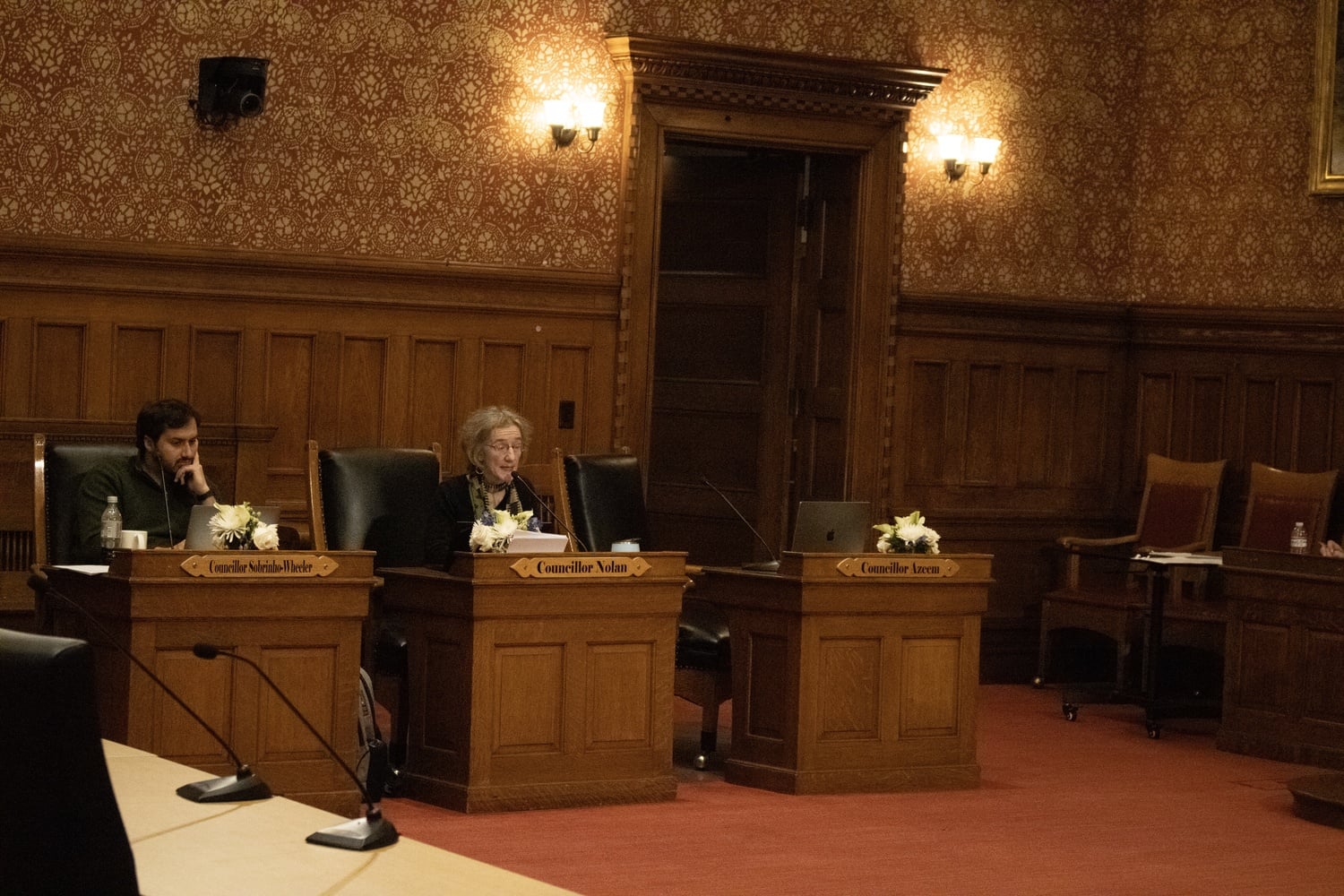
The Cambridge City Council unanimously voted last week to support strikes by the Harvard Graduate Students Union-United Auto Workers and Harvard Academic Workers-United Auto Workers — a day before HAW-UAW voted to end its work stoppage.
Councilor Ayah A. Al-Zubi ’23, the lead sponsor of the policy order, emphasized the urgency of passing the order ahead of both unions’ bargaining sessions the following day. HAW-UAW walked out on Nov. 10, launching the union’s first strike, while HGSU-UAW has been on strike since Oct. 27.
Both strikes centered on demands for higher wages, stronger protections against harassment and discrimination, and increased protections for international workers.
“We have essentially the wealthiest university in the world looking greedy, and it’s not a cute look,” Al-Zubi said at the Council meeting. “We should support workers’ dignity.”
At a Nov. 17 bargaining session, the University offered HAW-UAW a 7 percent across-the-board raise upon ratification — double the 3.5 percent raise offered a week earlier.
The union, which represents approximately 2,600 workers, has been negotiating its first contract since September 2024. Though other key demands remained unresolved and the union did not reach a contract, HAW-UAW members voted overwhelmingly to end the strike and returned to work on Nov. 18.
Councilor Marc C. McGovern, who co-sponsored the policy order, said he had reservations about HAW-UAW’s decision to end the strike without securing agreements on the union’s other demands.
Get The Crimson in your inbox.
“I would think having a contract and having some guarantees in writing is more secure than not, right?” McGovern said.
“Promises are great, but it’s not necessarily an agreement,” he added, “but if they’re satisfied with it, then that’s good enough for me.”
While HAW-UAW opted to end its strike, HGSU-UAW has remained on the picket line — continuing its second strike of the year after a 40-day work stoppage in the spring. McGovern said that regardless of which union was at the bargaining table, he wished “there was a little bit more willingness to kind of settle these things more quickly and get to an agreeable position more quickly.”
“The strike doesn’t help anybody, right? It’s not good for them, it’s not good for the institution, it’s not good for the city,” he said.
The Council has often thrown its weight behind Harvard’s workers — passing numerous policy orders over the last decade to back workers in strikes and other labor disputes with the University. The Council lent its support to dining hall workers ahead of their strike in 2016 and advocated for wage increases for clerical and technical staff in 2022.
The Council passed a resolution in April calling on the University to abolish time caps for non-tenure-track faculty and recognize academic workers’ rights to union representation. While Council resolutions carry no legal force, councilors have maintained that Cambridge has a vested interest in the working conditions of Harvard employees who live and work in the city.
—Staff writer Risha Sinha contributed reporting.
—Staff writer Maya Fu can be reached at [email protected].
Want to keep up with breaking news? Subscribe to our email newsletter
Have a tip for The Crimson? Share it confidentially