I REGRET THOTBOT!
It’s hard to lose yourself in a fiction that keeps pointing at your own reality.
As I was walking from Annenberg Hall to a math class in Zimmer Hall last March, a lime-green poster caught my eye. “IS YOUR THOTBOT GLITCHED?” it read, the edges scotch-taped to a light pole.
Based on the name (for those who, like my parents, don’t know: in Gen Z slang, thot stands for “that ho over there”) and the poster’s proximity to another flyer promoting a Harvard-specific dating app, I concluded that this must be a bizarre advertisement for some weird, sexual AI website and kept walking — not bothering to read the fine print.
But then, this October, the posters returned. Outside the Harvard Art Museums, the new variant was lime-green like the last, with tearable paper tabs on the bottom linking to a website. This one read: “DO YOU REGRET THOTBOT? YOU’RE NOT ALONE. WE CAN HELP.” Underneath, the page offered passersby that they could “ATTEND A REMEDIATION SESSION IN YOUR AREA.”
The fine print — “evoke memories,” “provoke emotions,” and “learn to GLITCH your ThotBot” — was nonsensical to me, but I figured that there must be some sort of drama in the ThotBot-subscribing community. I laughed to myself as I imagined a sort of Alcoholics Anonymous-esque meeting, with people sitting in a circle bemoaning the faults of their computer-generated girlfriends.
Curiosity got the better of me, and I ripped off a tab.
This is how I end up at a second-floor bar at Somerville’s Bow Market on Nov. 4. I am here to participate in “Remediation,” an immersive theatre experience set in a post-apocalyptic 1995, in a world where the government (“The ULTRA”) mandates that everyone undergo a procedure to implant a “ThotBot,” which erases memories and dulls emotions. (I had gathered, by now, that “thot” is a homophone of “thought.”)
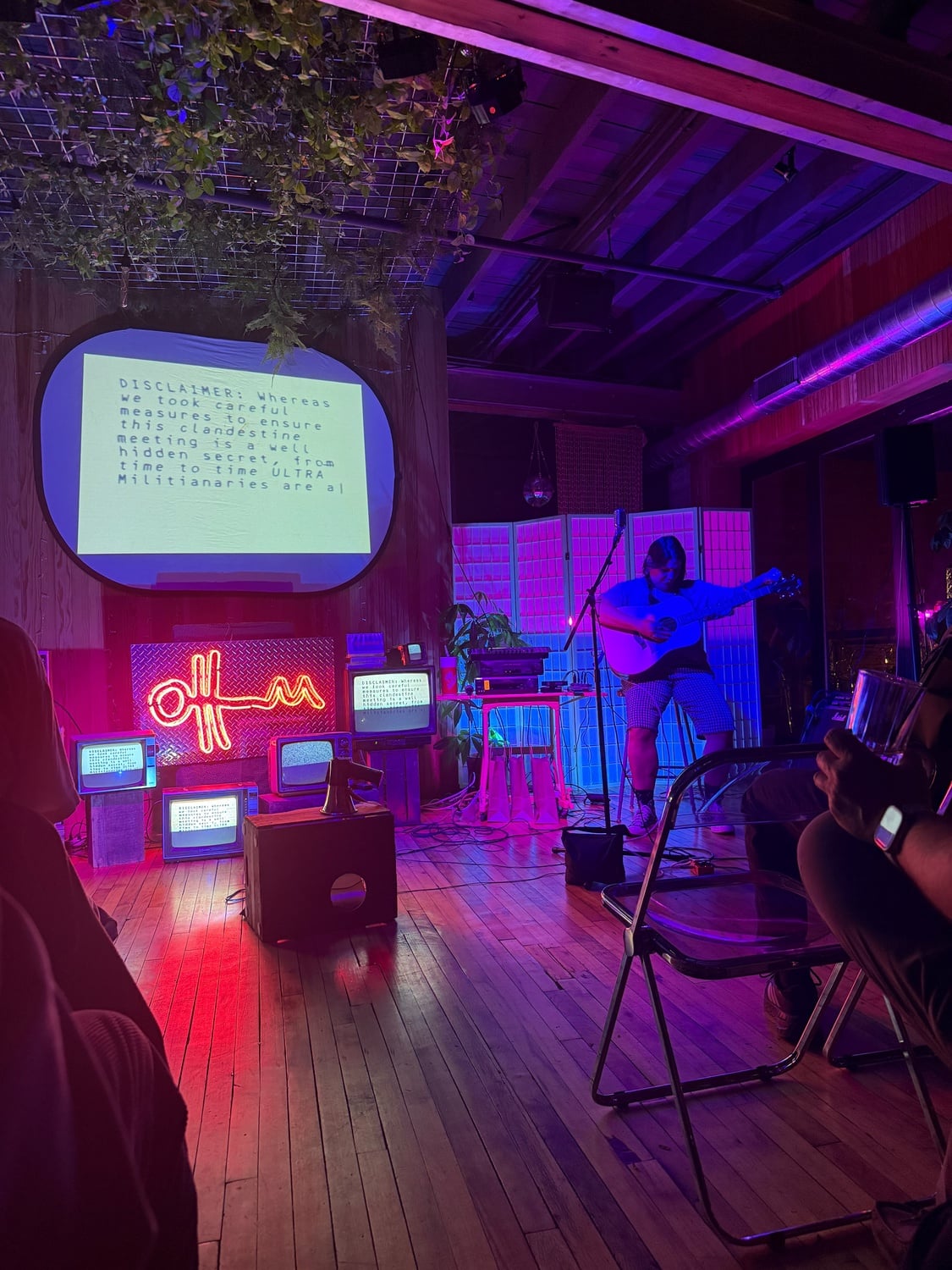
When I arrive, seven boxy monitors of varying sizes, stacked one on top of the next, are set up in front of the rows of plastic folding chairs. A neon sign reads “OHM,” its harsh pink glare standing in stark contrast to the indigo neon glow that illuminates the rest of the room. At the front of the room sits Rebecca Kopycinski, the inventor of ThotBot, and tonight, the star of the show.
Like in any good dystopic narrative, Kopycinski’s world has its own resistance group; at “Remediation,” the audience become members of OMEGA, an organization dedicated to unveiling the truth about the ULTRA and “glitching” our ThotBots via exposure to contraband — memory-evoking material like letters, books, and advertisements to shock you out of your ThotBot-induced amnesia.
“As you may know, ULTRA Militianaries have been known to raid our meetings in order to capture and eradicate OMEGA dragOHMflies,” reads an email sent to the audience before the performance. “With those dangers in mind, we encourage the glitch-curious to obscure their identities through creative face paint, masks, or any other way you can imagine.” True to form, many guests dress in costume — primarily all-black fits and an abundance of Covid-era face masks. One guy sitting behind me arrived in a neon-orange wrestling mask. (Effective at concealing his identity, yes, but certainly not an inconspicuous choice.)
Kopycinski’s complete ThotBot Storyworld spans three performances and a scripted podcast: “Reagan Esther Meyer,” a multimedia musical meant to introduce the audience to the story’s titular heroine (ThotBot’s Katniss Everdeen, if you will); “ThotBot Implementation Center,” an immersive installation followed by a multimedia concert, in which the audience get transported to, well, a ThotBot implementation center for their own government-mandated ThotBot procedures; “After Impact,” a six-episode fiction podcast meant to introduce the audience to Meyer and the ThotBot world immediately after the cataclysmic event (an “Impact” of some sort); and “Remediation.” That poster I saw back in March was for “Implementation Center,” and so I find myself now playing ThotBot catch-up.
When I found the “Remediation” flyer outside of the Harvard Art Museums, I was quickly hooked by the premise. Two aspects drew me to the show. First, the marketing is fascinating. With no context, the flyers are, at best, incomprehensible, and at worst, really creepy. Moreover, the accompanying links immediately thrust the audience into Kopycinski’s world; the tab I tore off the flyer brought me to what was purportedly the OMEGA’s website, and it wasn’t too long before I found myself deep scrolling through a second in-world page (this time, belonging to the ULTRA). If the seven audience members I talked to are any indication, this advertising tactic has been remarkably successful; every one I queried said that they first found ThotBot through the flyers.
As I continued down the rabbit hole, however, a second feature immediately captivated me: ThotBot’s messaging.
A clear theme is remembrance. The ThotBot dulls people into submission by wiping away the memory — and, by extension, trauma — of Impact. OMEGA offers a different, contrasting philosophy. “Where were you during Impact? Never forget,” a voice echoes at the beginning of the show, just before the audience learns just how quickly everyone did forget.
By extension, the main message of Remediation is arguably that ignorance is not bliss, and it is the bolder, better choice to allow oneself to remember, especially when it is hard. “Memories — you need them all, right?” Kopycinski tells me when I interview her before the show. “Because they are what makes you, you.”
That idea is inseparable from the show’s political messaging. Kopycinski conceived of the ThotBot Storyworld in 2016, when she imagined a nightmarish reality where President Donald Trump won the presidential election against Hillary Clinton. (Because how crazy and improbable does that sound?!) “I said, like, what if Trump became president?” Kopycinski says to me, laughing. “And everything awful about our world is blown out to the nth degree, right? Like climate change, class disparity, misogyny, racism.”
In the decade since she first conceived of her ThotBot dystopia, Kopycinski says she’s watched many of her predictions materialize. She appears to draw parallels between the ULTRA Militianaries and Immigration and Customs Enforcement officers, and between the “Great Island” — the last temperate place in the ThotBot world after the apocalyptic “Impact” — and Trump’s recent pursuit of Greenland.
In Kopycinski’s world — and ours, by extension — forgetting quickly becomes a tool of control. The ULTRA’s messaging is simple: “Comply, Add Value, Redeem.” That is, if citizens “Comply” with forgetting, their ThotBots track their “Value,” which they can later “Redeem” for food, employment, safe passage, or other desired commodities.
Kopycinski draws parallels here to the American Dream. “You do the things in life that you’re told to do, check all the boxes — get your education, get your job, get your income — and then you’re rewarded through that, and you get your house and you get married, and then everything should be a-okay,” Kopycinski says. In reality, she says, “the system is actually designed to keep you down.”
Still, Kopycinski insists that the politics aren’t the whole point. “There’s some big themes underneath,” Kopycinski adds. “But on the top, it’s just kind of entertaining and fun.”
Admittedly, I go into the show mostly seeking the latter. Not unlike those who chose complacency to ThotBot and the ULTRA, I decide that I’d like a night of distraction, a night to just forget about the pressures of my midterms and looming deadlines (and I definitely don’t need to be reminded of the current state of the world).
But true to its mission, “Remediation” will not let me forget — just not in the way it intends. I came for a night of ThotBot-style oblivion, and the show won’t give it to me.
What promises to be an “immersive” experience is anything but, and every crack in the illusion pulls me out of the resistance meeting and back into reality. Because there is no expectation that the audience knows anything about the ThotBot world coming in, Kopycinski spends most of the two-hour performance spoon-feeding the audience the ThotBot lore, like what a ThotBot is and does. But even if the real-world audience walks in completely blind, the premise casts us as ThotBot owners trying to glitch our implants; thus, our characters would already know the basics.
Other moments keep drawing me out of the world: the venue is located directly behind and above two bars, which means that we are subjected to ambient noise the whole time; throughout the show, Kopycinski sips water out of a bright red cup reading: “I <3 ARUBA”; someone drops and shatters a glass mid-performance. Granted, much of this is out of her control, and Kopycinski improvises through the mishaps without breaking character.
Moreover, as I watch Kopycinski’s performance, I find the messaging very on-the-nose.
At one moment in the show, an unnamed senator declares to her worried constituent that post-Impact, Fox News will be the only broadcaster permitted on air. Not very subtle, I think. I should have guessed – the ULTRA webpage advertised ThotBot by claiming that “it continues to unite the minds of citizens toward the common goal of making our society great again.” Every on-the-nose jab launches me out of the story and straight toward the world it’s about. It’s hard to lose yourself in a fiction that keeps pointing at your own reality.
The show ends with a bang when (spoiler alert!) Meyer is dragged away by two ULTRA Militianaries in white hazmat suits. The crowd is unsure whether to applaud, until Kopycinski returns to make her final bow. We slowly trickle out, joining the buzz of the patrons at Bow Market.
As I wait for my Lyft ride home, I call my parents to debrief what I’ve just watched. I am disappointed, because I did not enjoy the show as much as I thought I would. And yet, I am still chewing on the messages all the way back to Harvard.
I wonder, briefly, whether I am but another cog in the ULTRA’s machine, looking merely to “Comply, Add Value, Redeem.” Maybe I have conditioned myself to think like a ThotBot, hoping for a night of frivolous distraction with “Remediation.” Maybe there is a lot I am willing to forget.
As I return to campus, it occurs to me that maybe I’ve learned to glitch my ThotBot, after all.
—Magazine writer Sarit O. Greenwood can be reached at [email protected].
Want to keep up with breaking news? Subscribe to our email newsletter
Have a tip for The Crimson? Share it confidentially