Boston Plays ‘Connections’ Live With New York Times Editor Wyna Liu at Book Tour Stop
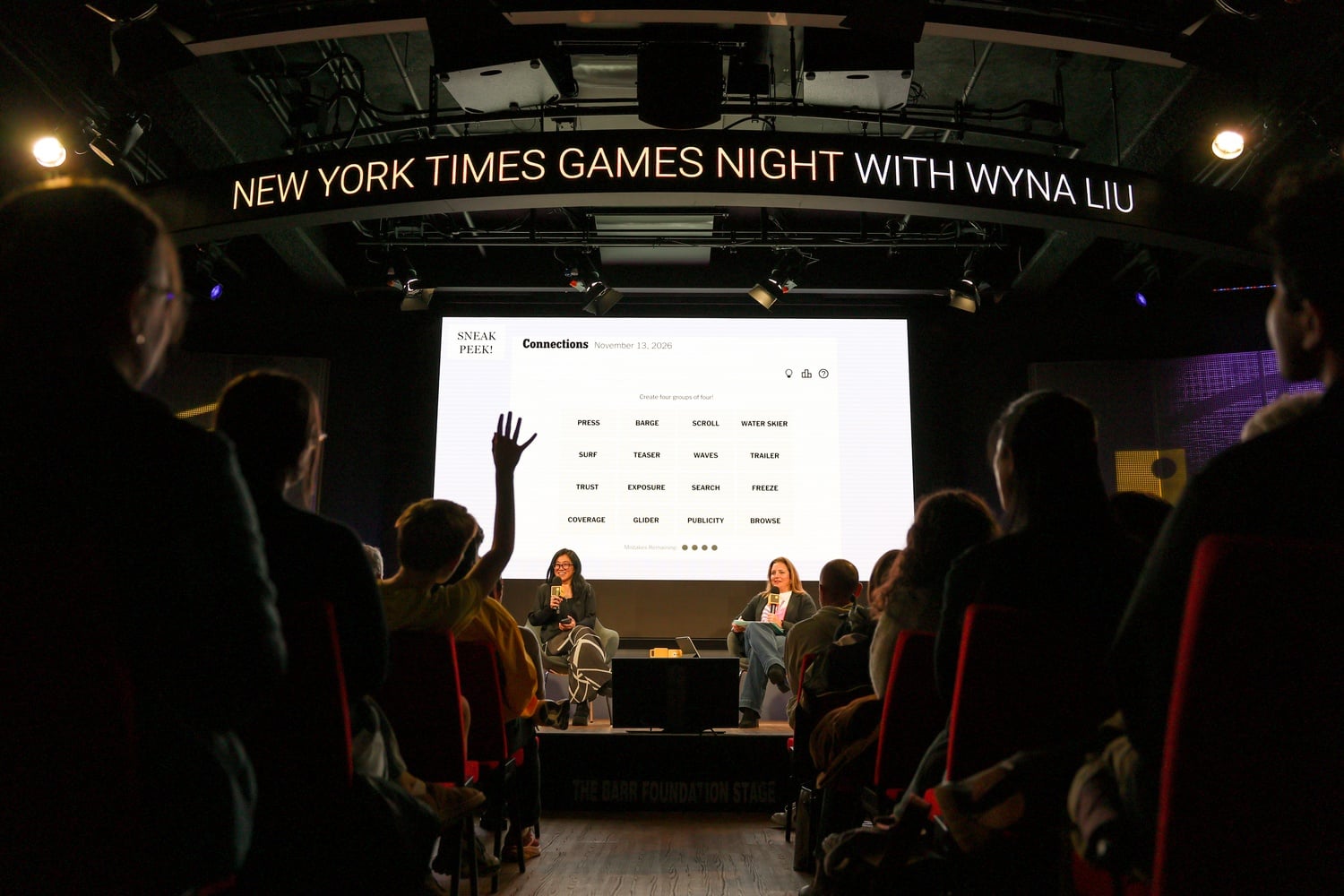
Boston residents experienced a night of witty wordplay on Nov. 12 as they guessed categories from The New York Times game Connections and heard behind-the-scenes details on how each puzzle is created from the game’s editor, Wyna Liu.
Liu — who devises the categories and words seen on each board — spoke about striking a balance between difficulty and playability at an event at WBUR CitySpace in collaboration with Lovestruck Books. Liu is currently on a tour for her analog rendition of the game, “Connections: Find the Common Threads in 100+ Puzzles of Wit and Wordplay,” which was published last month.
Connections is one of the many daily puzzle games offered by The New York Times. Players are given a board of 16 words and must select four connected by a common theme to reveal a category. The digital puzzle gives participants a maximum of four mistakes before the categories are revealed.
In an interview with the Crimson, Liu explained that she creates a week’s worth of Connections boards at a time. Before they appear on the website, she receives feedback from Wordle Editor Tracy Bennett to get insight on how a potential player may approach the puzzle.
“She’s extremely good at solving Connections, as you can imagine,” Liu said.
Currently, Liu creates the boards three weeks ahead of their release. Once the boards are created, they are distributed to testers, and Liu receives even more feedback. Often, there is no real unanimity on the caliber of the puzzles.
“Some people are like, ‘I hated this category,’ and some people are like, ‘I love this,’ and so I feel like there’s not always a consensus,” Liu said.
Members of the crowd also had questions about Liu’s game. One crowd member specifically asked about the messages that appear when a player makes a mistake, including the famous “one away” message displayed when three of the four words in a category are guessed correctly. While Liu’s job does not extend to the game’s web design, she did share backstage information on how she forms her puzzles.
Each board has four categories sorted by color; yellow is the easiest, then green, blue, and finally purple as the most challenging. According to Liu, category ranking is somewhat hard to gauge, as the perceived difficulty is different depending on the person. Her approach is more intuitive, as she shies away from being an arbiter of difficulty.
“I think it’s interesting because, to a certain extent, some things are subjective. But it’s very fun to see the things that people do agree and disagree on,” Liu said.
Generally, yellow and green are broader categories, encompassing more obvious connections like synonyms or parts of speech. Blue is primarily centered around trivia, and purple is most commonly wordplay.
“Some people are super puzzle-pilled, and they see it first, and they’re like, ‘That was easy,’” Liu said of the infamous purple category.
Besides playing rounds of Connections live with the audience, a section of the game night was dedicated to “guess the purple,” where audience members guessed the name of a purple category based on four selected words from a past board.
Cloe Axelson, senior editor of WBUR’s opinion page, Cognoscenti, and moderator of the event, described her relationship with Connections as her “daily interaction with low-stakes failure.”
The audience played through one of Liu’s hardest boards, which was specifically designed to stump the editors who usually test her games. The easiest category was “Fictional Detectives.” The hardest was “Starting With Number Homophones”: atrium, forest floor, toucan sam, and wonderful.
Liu even snuck an Easter egg into this puzzle — which an audience member noted — where four of the words included the names of The New York Times’ Games editors.
One of Liu’s favorite aspects of making boards is including “words that make you smile,” she said to the Crimson.
“There’s some words like bubble gum or Jacuzzi — just some word that evokes something fun,” Liu said.
Liu also disclosed the process of deciding which words and categories to include in each day’s board.
“It’s very much sometimes moments of inspiration, but more often, I would say it’s looking at lists. It’s really just trying a lot of stuff — a lot of trial and error.”
Adapting her game into a book made for an especially fun experience, as solving puzzles on paper is something Liu finds even more enjoyable than the typical digital format of The New York Times’ Games.
Before working on Connections, Liu began work at The New York Times as a crossword editor in 2020, when the publication offered significantly fewer daily games. Connections was added to the roster in 2023, and Liu — at the time the only games editor without her own puzzle to oversee — was tapped as the person to take over after it was fully developed.
Growing up, Liu loved doing puzzles and still considers herself an enthusiast. Before becoming a game editor, she didn’t even consider the job a possibility.
“I think that making stuff is my favorite way to understand the thing,” she said. “And puzzles especially. I got really into solving crossword puzzles, and then I realized that making puzzles scratches a very similar itch.”
Want to keep up with breaking news? Subscribe to our email newsletter
Have a tip for The Crimson? Share it confidentially