‘William Tell’ Review: Boston Lyric Opera’s Urgent, Dazzling Take on a Rossini Rarity
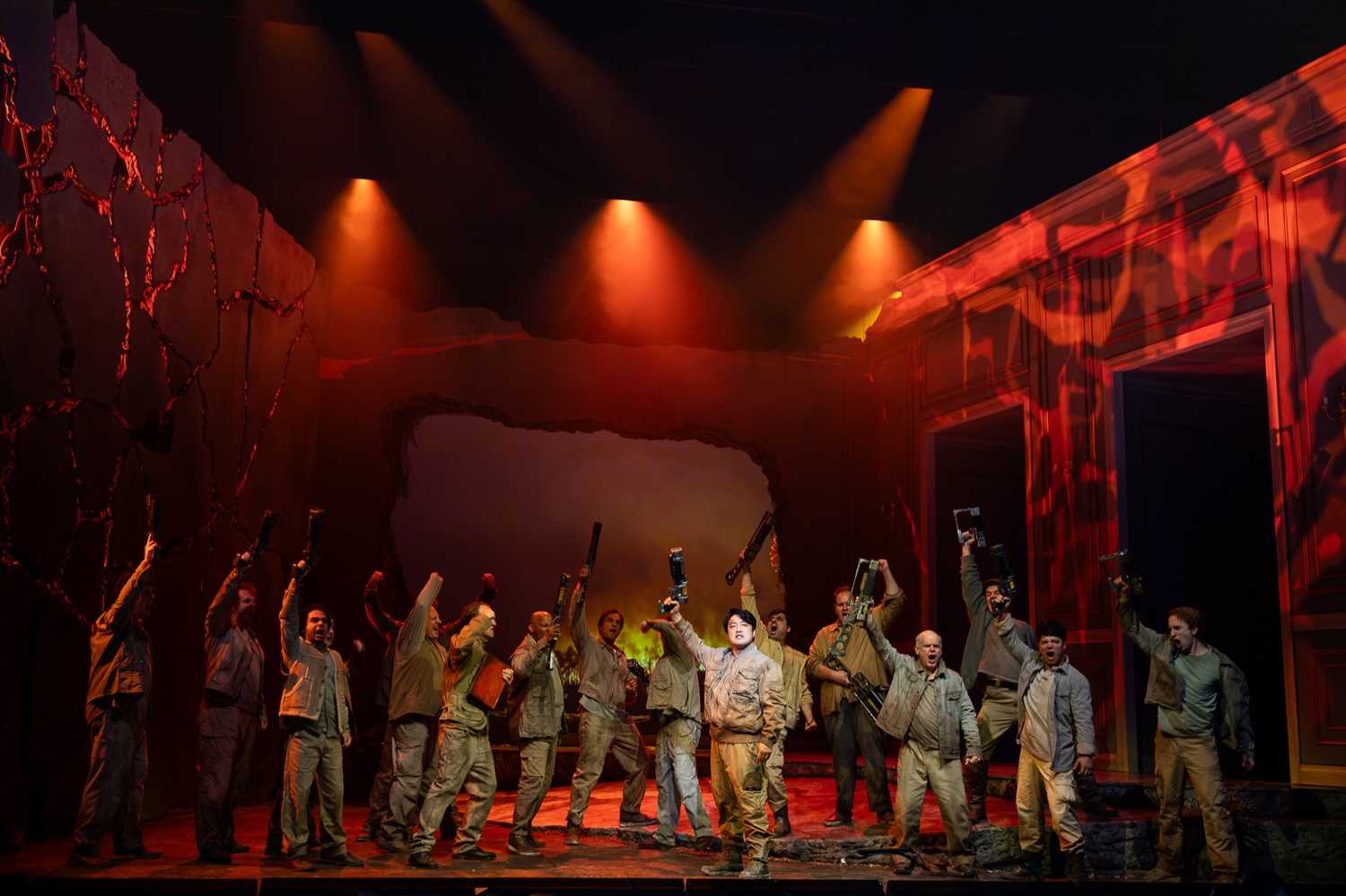
From Sept. 25 to Oct. 4, the Boston Lyric Opera opened its season with Gioachino Rossini’s “William Tell” at the Emerson Colonial Theatre. With a mighty cast and crew, the BLO’s production recast Rossini’s opera in a 21st-century context with political urgency and commentary, creating an impactful season opener for the company’s 50th anniversary.
Based on the folk tale of William Tell, the 14th-century Swiss freedom fighter, Rossini’s opera was most directly inspired by Friedrich Schiller’s 1825 play on the same figure, “Wilhelm Tell”. While the original opera is almost a whopping four hours in its entirety, it is unquestionably best known for its “overture,” or rather part of it; specifically, “March of the Swiss Soldiers,” whose theme has been immortalized in the American Lone Ranger franchise.
The opera’s real overture — significantly longer in full — was the audience’s first impression of this mysterious frontier world. Beginning with an extended cello movement, the BLO orchestra established its presence with lithe, sensitive phrasing under the baton of conductor David Angus. Due to the Emerson’s unique architecture, the pit was arranged unconventionally: Musicians were organized on the right side of the stage with Angus conducting from the other side. Thankfully, this setup hardly compromised the sound of the ensemble. Despite the theater’s dry acoustics, the orchestra consistently produced a full-bodied, resonant sound, retaining a sense of grand opéra grandeur even with the physical constraints on the ensemble’s size.
On the other hand, actual production and scenic design of this “William Tell” eschewed any sense of 19th-century grand opéra pageantry or historical realism. Choreographed to the overture was a long, drawn-out sequence of William Tell’s oppressed Helvetian compatriots being forced to film propaganda footage under the watchful eye of the totalitarian Allemanian regime. As the opera’s story goes, the Helvetians, who reside in the village Altdorf, are constantly surveilled, intimidated, and persecuted by the ruling Allemanians, and Tell’s insistence on standing up for the Helvetians makes him both a hero and the key target of the Allemanian security apparatus. Tell’s family and people endure trials and tribulations, including forbidden romances and community crises, and it is their solidarity that gets them through the throes of oppression.
Indeed, one could have been at a loss at how to transform the original William Tell folk tale — with its complicated European geopolitics and mythology — for a 21st-century American audience. To solve this problem, stage directors, scenic, costume, and projection designers Victoria Tzykun and David Adam Moore created a chimeric world that was both temporally and geographically ambiguous, yet at the same time strikingly American and contemporary. Throughout the production, the opera alternated between an eerily ageless dystopian aesthetic and a present-day authoritarian society, replete with cell-phones, facial recognition technology, and even a pseudo-Marilyn Monroe supernumerary doing a “Happy Birthday Mr. President” impression to Rossini’s music at the start of Act 3.
While this approach resulted in a somewhat heavy-handed and confused visual aesthetic, Tzykun’s and Moore’s directorial decisions rendered the tale powerful and moving. Certain scenes, such as the forest scene in Act 2 and Altdorf engulfed in flames at the beginning of Act 4 were well done with striking lighting design.
Tzykun and Moore, through effective stage direction — particularly of the chorus — delivered a powerful story of a community on the brink of hopelessness revived by Tell and his moral steadfastness. Hence, despite the production visuals being occasionally disharmonious, the opera’s dramatic core was starkly preserved.
In the directorial team’s words, the story is about “occupation” and culture’s refusal to vanish despite attempts to erase it. The opera demonstrates the price people are willing to pay to preserve their freedom.
The titular role of Tell was played by George Gagnidze, who commanded the stage with his resonant baritone voice. A regular favorite at the Metropolitan Opera (and a host of other renowned international venues), his voice never failed to impress with its presence and sensitive expression. Soprano Brianna J. Robinson — who played Tell’s daughter Jemmy — was angelic in her character’s innocence and optimism, but showed herself as a vocal force to reckon with. Mezzo-soprano and BLO Artistic Director Nina Yoshida Nelsen completed the Tell family as Hedwige — Tell’s wife — leading her community with the fortitude and authority of her rich mezzo.
The forbidden romantic pair of the opera, Arnold Melchtal (Konu Kim) — a lovesick young Helvetian and son of Melchtal — and Mathilde (Anya Matanovič) — an Allemanian woman — was a match made in vocal heaven. As Arnold, Kim was unquestionably the audience favourite of the evening, his robust tenor voice never tiring of Rossini’s punishingly high vocal writing. With extraordinary dynamic control even at the top of his range and a beautifully even vocal quality throughout the passaggio, Kim portrayed Arnold with Romantic flair and romantic passion. Soprano Anya Matanovič’s Mathilde was equally stunning, especially in the aria “Sombre forêt” where she laments her illicit love for her enemy. Their romantic duet in Act 2 was as titillating as it was musically gorgeous. The pair’s chemistry was palpable and unwavering throughout their characters’ trials and tribulations.
The rest of the ensemble complemented the lead singers superbly. Morgan Mastrangelo as Ruodi — who performed a quaint cavatina in Act 1 — showed off his lithe leggero tenor voice, while Sergio Martinez and Ilya Silchukou were energetic and committed companions to the weary Tell as Walter Furst and Leuthold. The tyrannical Allemanians, represented onstage by Yeghishe Manucharyan in the role of the Allemanian captain Rudolph, Hunter Enoch as Gessler, James Demler as Melchtal and a handful of supernumeraries, were also strong additions to the cast, embodying their moral repugnancy and bloodlust with swagger.
By moving away from the opera’s original context of a legendary story of Swiss nationalism, the BLO’s production of “William Tell” accomplished a bold new vision for Rossini’s work. Although not often performed due to its vocal difficulty and cultural esotericism, the BLO succeeded in mounting a production that felt both extremely human in its story and musically sublime.
BLO’s “William Tell” ran at the Emerson Colonial Theatre from Sept. 25 to Oct. 4.
—Staff writer Lara R. Tan can be reached at [email protected].
Want to keep up with breaking news? Subscribe to our email newsletter
Have a tip for The Crimson? Share it confidentially