Boston Book Festival Fiction Keynote: Authors Edwidge Danticat and Imbolo Mbue Discuss the Surprises of Storytelling to Packed House
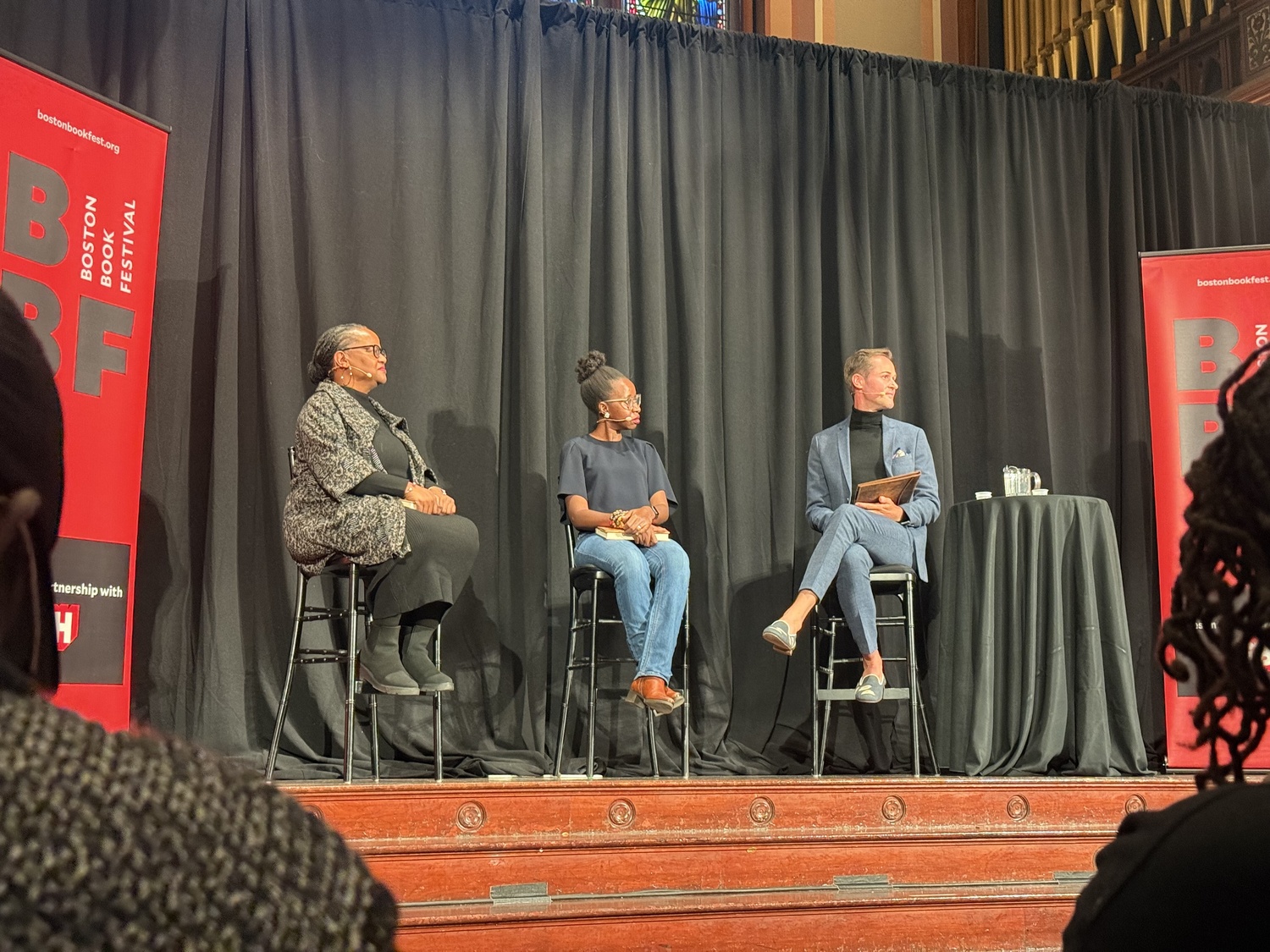
On Saturday, Oct. 17 in Old South Church, renowned Haitian author Edwidge Danticat and New York Times bestselling author Imbolo Mbue spoke at the 18th Boston Book Festival’s Fiction Keynote, entitled “Intersections of the Unexpected.” The event was moderated by “Tim Talks Books” podcast host Tim Ehrenberg.
The keynote address in Copley Square is one of the festival’s final events. To kick off the keynote, Boston’s At-Large City Councilor Ruthzee Louijeune, the first Haitian American in the role honored Danticat with an official resolution.
Within the span of an hour, Ehrenberg led the authors through a variety of topics, from how to invoke emotion during the writing process to the meaning stories hold for each individual reader.
“First of all, I think Tim is an incredible moderator. He is probably one of the best. He clearly does so much research and puts so much thought into his questions. And he has such a nice way of weaving in the books, and the writing process, and the author relationships, and then asking really poignant questions that get to deeper, larger questions about the craft of writing and novels in general,” Kate Brown, a BBF board member who attended the keynote, said.
A half hour prior, the entry line for the free, public event ran down the block alongside Boston’s historic Old South Church, which has been a staple of the community for over 350 years. Fiction Keynote audience members were also greeted by Board Chair Dawn Tripp, who gave remarks at the festival’s conclusion.
BBF volunteers ushered in attendees to hear Danticat and Mbue speak on their origin stories as writers, both of which stemmed from oral storytelling traditions passed down during their childhoods. Danticat explained how her aunts and grandmothers shared tales to entertain, even singing if listeners became bored.
“The stories they told, it was often the only time that adults and children were interacting in that way because the adults in my life were very stern,” Danticat said.
Mbue also grew up hearing stories from family, but she initially arrived in the United States wanting to become a lawyer or doctor. She didn’t consider becoming a writer until later in life.
“I just started writing as a hobby, and I spent many years writing as a hobby. I never thought about sharing my writing with everybody until one day I decided to, and this is how I end up,” Mbue said.
Danticat and Mbue discussed how they manage to evoke difficult emotions through their works. Mbue spoke on how she portrayed guilt in her book “Every Story is a Love Story,” in which the protagonist deals with feelings of responsibility for a tragic car accident death. Mbue drew from her experience injuring a man in a fight in her home country of Cameroon and the guilt she felt. Thinking of the scar she left and the perspective of the man’s mother, she was able to recreate her own guilt in her writing.
Later in the program, Ehrenberg called the live reading of excerpts by authors a “lost art” and requested both Danticat and Mbue recite the beginnings of their recent works. The moment gave audience members who haven’t read the novels a chance to hear the author’s words. Danticat narrated her description of the sounds of gunshots from the first chapter of her book, “Dèy.”
Mbue also shared the powerful opening of “Every Story is a Love Story.”
“The past is gone, long gone. I must free myself of it, and I will free myself of it the same, they say, because time heals,” Mbue read.
The panel centered around the unexpected. Danticat reported surprises coming not only from the writing process itself, but also from readers’ interpretations. She mentioned the joy of them discovering new connections or details she never thought of within her own story.
Although Danticat’s novel “Dèy” started out as nonfiction, fiction became its “landing place.” Similarly, Mbue described literature as a place to find refuge. Born and raised in Cameroon, Mbue discussed the concept of home. She talked about the joy of sharing her country’s culture with the outside world; however, she felt such portrayal needed to include both the good and bad.
“I had some Cameroonians not happy about certain portrayals in the Cameroonian community, but I also know that that is the beauty of it. Like, I can show us in our full complexity and allow the reader to decide for themselves,” Mbue said.
When Ehrenberg asked about parts of the writing process that the authors ran away from, Danticat expressed the exact opposite sentiment, instead running towards the joys and challenges of authorship.
“I feel like I want to be the freest that I am when I’m writing my stories,” Danticat said.
The authors also dived into the theme of hope. Danticat described her existence as a Haitian author as a source of hope and expressed her gratitude for the privilege of telling stories from her culture. Both authors reflected on drawing inspiration from people in their own lives. Danticat embraced the introspection of the character Magnolia while recalling her own move back to New York after living in Miami for 20 years and witnessing her daughters grow into adulthood. She also felt that hope comes from the support of crowds at events like BBF.
“When [Danticat] said that the hope really is just in the act of storytelling, I thought that that’s what I want you guys to put on the t-shirts for next year for Boston Book Festival. Because it’s such a beautiful sentiment for everyone in this church that they’re here because one of their stories resonated with them and that’s the hope. That’s the hope that we can cling to,” Ehrenberg said after listening to the panel.
Audience members seemed to deeply resonate with the writers and their stories, asking questions towards the conclusion of the panel and sharing their appreciation for the authors.
“Just as an immigrant myself, I feel such a distance from Haiti and being able to open up her work and get that intimacy again and get that homecoming again feels really nice,” Shiara Pyrrhus, a panel attendee, said.
The Boston Book Festival takes place annually, with this year’s festival held on Oct. 17 in Copley Square.
Want to keep up with breaking news? Subscribe to our email newsletter
Have a tip for The Crimson? Share it confidentially