‘To Kill a Mockingbird’ Review: Less is More in Maycomb
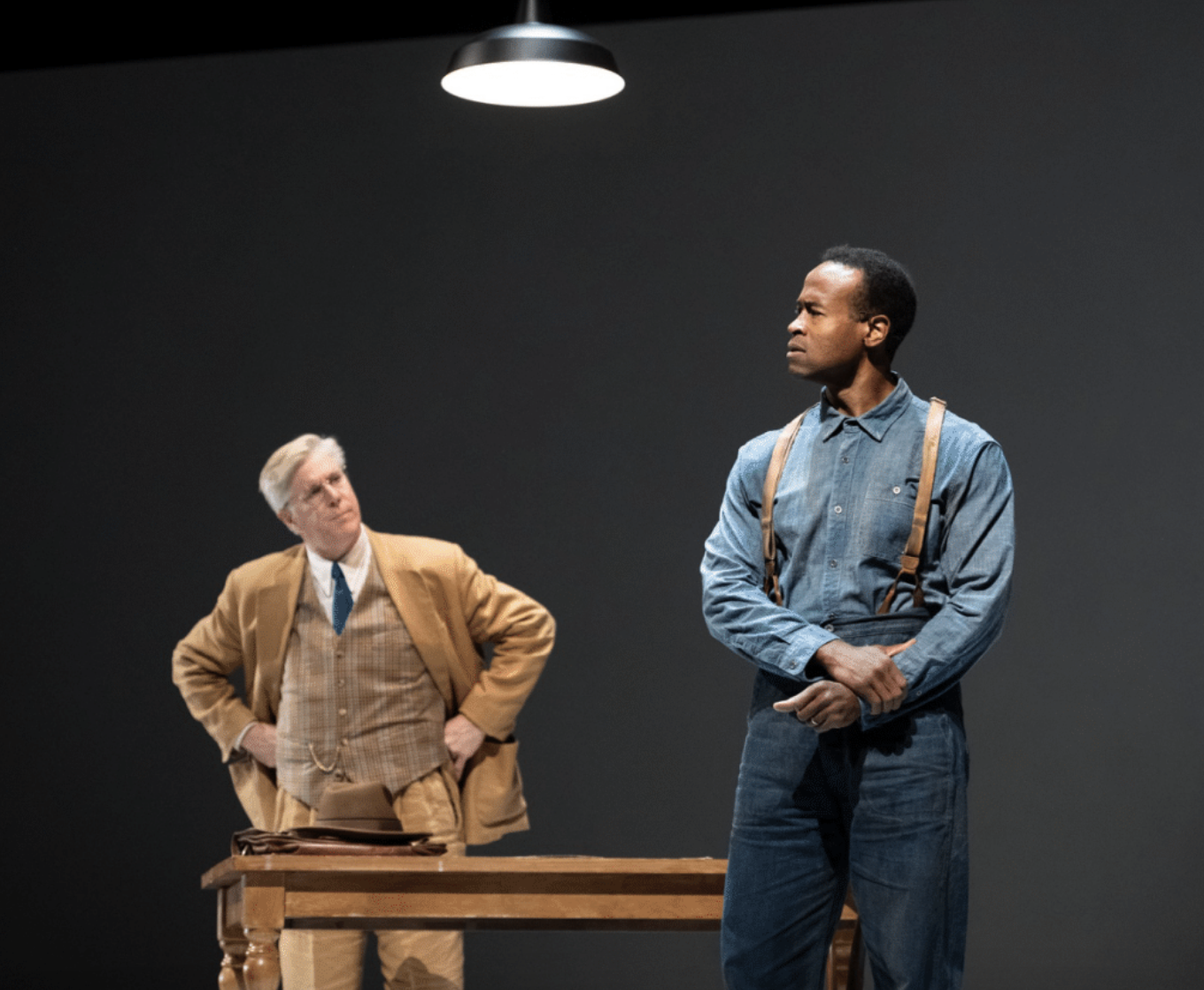
Aspiring attorneys, southern belles, and even those who fell asleep in their high school English class all owe themselves a night at The Huntington Theatre to see director Loretta Greco’s “To Kill a Mockingbird.”
The Huntington didn’t quite know what more to say about Aaron Sorkin’s stage adaptation of Harper Lee’s classic novel — and it didn’t need to. The production gracefully leans on its timeless subject matter to deliver an astonishingly timely two hours and forty five minutes of raw emotion.
The story follows a young girl — Scout Finch — as her attorney father Atticus Finch defends a Black man, Tom Robinson, in court after Robinson is falsely accused of sexually assaulting a white woman. Over the course of the trial, the community’s moral decay and racial prejudice is put on display.
The show triumphs most in the moments where it allows itself to breathe. It trusts the plot enough to simply let it play out. Greco chooses to strip away frivolous spectacle in favor of sober drama. When she stays true to this approach, an hour in The Huntington is as compelling as a courtroom confession.
Regrettably, Greco doesn’t always maintain that restraint. Cumbersome staging towards the end of the second act robs the main dramatic action of the attention it craves and deserves. At times, Sorkin sours his fierce script with gratuitous but inconsequential attempts at comedy. Greco shoehorns these ill-timed jokes at the end of one too many gorgeously directed emotional scenes. Even so, the crux of the show’s tender message is far too rich to be robbed fully.
Karl Kenzler’s performance as Atticus Finch is, most of the time, perfectly serviceable as a backdrop to the more exciting performances that surround him. He offers a steadfast yet unadventurous interpretation of the character. The eye of a thankful audience is much more drawn to the punchier depictions of Calpurnia, Mayella Ewell, and Bob Ewell (portrayed by Patrice Jean-Baptiste, Jackie Scholl, and Liam Craig, respectively). Scholl and Craig spew grotesquely convincing venom that grounds the production in the reality it deserves. Jean-Baptiste largely confines herself to stage right but manages to own the entirety of the theater by the conclusion of the show. What may have been drab courtroom scenes were bedazzled by flourishments of intricate ensemble work.
Kenzler gets a taste of his castmates’ heights during his delivery of the show’s title monologue. He soars as high as the mockingbird he speaks of, cementing this moment as his best performance in the production.
Stars speckle the underside of the mezzanine and auditorium’s sidewalls, offering a first glimpse into Maycomb, Alabama. Andrew Boyce’s scenic design employs the vital restraint that allows the actors to truly pop. Equipped with little more than an oak tree, hanging chair, courtroom seats, and the ingenuity to transform them into anything imaginable, Boyce’s understated design complements the show’s need for simplicity. Greco milks each piece for all its worth, leaving enough room for such a strong subject matter.
Ashley Frith is the first person to bless the stage, playing the violin. The melody is homey on its first pass and turns haunting when reprised before the final bows. Familiar rustic music serves as a neighborly reminder of setting and swells into the exclamation point of an already poignant script.
“To Kill a Mockingbird” needs no justification for its relevance to a modern theater audience. False accusations, the bitter grasp of racism on the justice system, and the practical value of truth are just as relevant to 2026 Boston as they were to 1934 Maycomb. Each scene Greco approaches with restraint is a scene that sings the themes of Lee’s original novel all the louder. Tom Robinson’s sorrows sting in The Huntington as painfully as they ever have before.
A dose of Loretta Greco’s “To Kill a Mockingbird” is sure to satisfy anyone’s thirst for a gut punch of a theatrical experience. The play is sure to scratch the itch of storytelling magic and linger in the mind for days to come.
“To Kill a Mockingbird” runs at the Huntington Theatre from Oct. 8 to Nov. 8.
Want to keep up with breaking news? Subscribe to our email newsletter
Have a tip for The Crimson? Share it confidentially