From New York Back to Boston: The Art of Taking It Slow
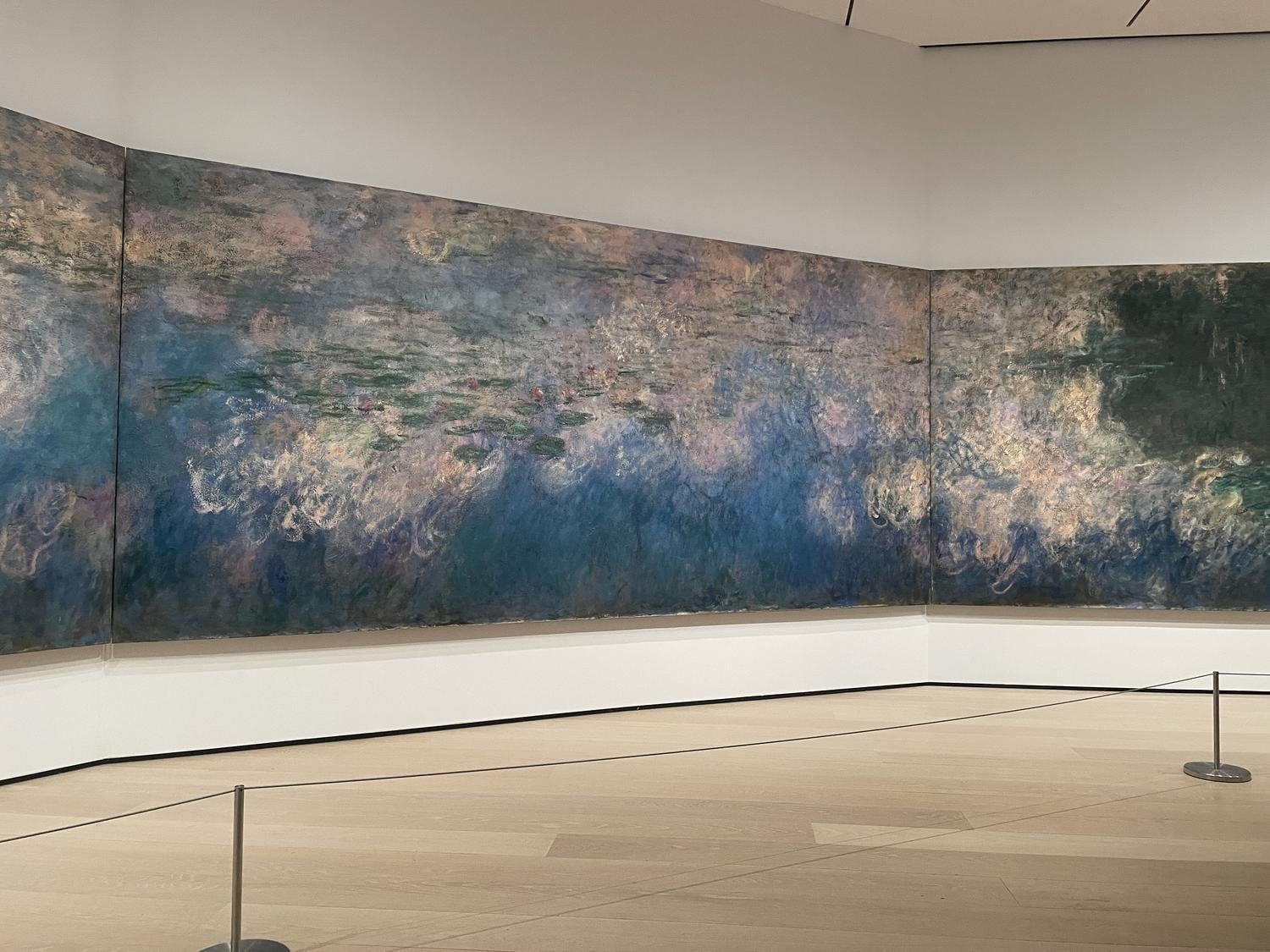
New York, New York, unique New York.
Two weeks ago, I had the privilege of returning to New York City to visit an old friend I hadn’t seen in far too long. The trip was very brief, but rather than trying to conquer all the famous landmarks of the Big Apple, time was devoted to a more deliberate pursuit: art museums.
What struck me most when I visited the art galleries of New York was not simply their prestige, but the experience of slowing down with art itself. In our time where so much of our lives are consumed by blue-light screens and quick Shorts or Reels, museums take away from that. Standing before a painting or a sculpture for a few minutes, taking in the small details, almost felt radical.
It took a trip a few hours away from Boston to remind me that this kind of experience isn’t just reserved for New York. Cambridge and Boston are filled with museums that also hold extraordinary art pieces. The difference is that, living so close to them, we forget to take advantage of what is in our own backyard.
The Metropolitan Museum of Art
There is something undeniably overwhelming about walking into the Metropolitan Museum of Art. The scale of its collections alone humbles you. You could spend multiple days there, even a whole week, and still leave knowing you have only skimmed the surface of what lies tucked behind its walls. My focus shifted to one of its great collections: the Ancient Greek and Roman section.
The marble sculptures are all in a grand room — a vast expanse, crowned with glass ceilings, where the soft sunlight filtered through the snow. The light settled on the shoulders of the marble statues and their curls of hair. The statues were, of course, motionless, yet seemed charged with a restrained movement: a bent knee or the flow of a silk shawl. With a slight shift to the left, the shadows reveal a new hidden detail you otherwise might not have noticed. Go entirely around the statue, and it tells a whole other story.
I was also fortunate enough to catch the final day of the Man Ray exhibition. The exhibition traced Man Ray’s role in Dada and Surrealism, exploring how he was able to transform everyday objects into dreamlike scenes. Photography is an art form I’ve long underestimated, but Man Ray’s surrealist compositions blurred the line between reality and imagination. In his images, musical instruments merged with bodies, or unconventional work tools were framed by fern leaves. You do not immediately understand what you are looking at, but there’s a sense of beauty behind it.
Neue Galerie New York
A short walk uptown brings you to the Neue Galerie, a small but wonderful collection of Secession art from Austria and Germany, featuring famous artists such as Gustav Klimt, Egon Schiele, and Oskar Kokoschka.
Yet, what strikes you first is not a painting, but the interior of the building itself. Ornate ceiling reliefs curve overhead, as a winding staircase coils upward with elegance towards the art gallery. Even the rooms with the artwork and furniture are covered in marble with gold-plated accents.
The undisputed jewel of the gallery is Klimt’s “Portrait of Adele Bloch-Bauer I,” often known as the “Woman in Gold.” At first glance, the presence of so much gold in the painting takes you aback. But the longer you sit — and we did sit for a while — the more the painting transforms. The gold begins to recede, and the various repeating patterns of circles and triangles begin to stand out more. The woman’s hands, delicately intertwined in a slightly awkward manner, command attention. Subtle blues and blacks interrupt the gold, which puts the painting in a completely new perspective. The painting rewards patience and close observation.
The Museum of Modern Art
At the Museum of Modern Art, crowds of tourists gathered round “The Starry Night” by Vincent Van Gogh — phones raised, as children tried to peek at the masterpiece through a crowd of giants. Still, the painting — while smaller than some may expect — is in fact undeniably amazing. The closer you look, the swirls of the yellow stars emerge from the great cobalt sky.
Elsewhere in the museum, the works of Pablo Picasso unfold across decades — the fractured faces and multiple perspectives challenge your initial perceptions. As an ardent admirer of Impressionism, with its light soft brushstrokes and atmospheric moments, it is hard for me to grasp modern art, but the greatness in Picasso’s paintings is undeniable.
I had hoped to encounter more works by Mark Rothko, though the museum rotates its collections. The Rothkos that were on view still held that unexplainable magnetic pull. They appear to be deceptively simple — a blend of colors constrained by a rectangle. But stand before the paintings long enough, and they begin to speak. It becomes less about what’s actually on the canvas, but the atmosphere the painting brings forth.
Homecoming
Now back in Cambridge, I’m left longing for the feeling the museums gave me — that small joy of observing and truly understanding a work of art.
In an age of distraction, museums teach attention. It’s hard to resist the urge to document one’s experience with a famous painting or sculpture, but truly experiencing a museum without sticking a phone in front of each Monet and Van Gogh creates a special encounter. One should take the time to observe the painting from different angles and distances.
New York may have some of the best art museums and galleries in the world, but Boston offers its own treasures. The Museum of Fine Arts houses numerous collections spanning from ancient civilizations to contemporary works. The Institute of Contemporary Art has a small but intriguing collection of cutting-edge exhibitions, always something new to see. And the Isabella Stewart Gardener Museum presents art in a Venetian-style house, where paintings from the Renaissance, tapestries, and marble sculptures are arranged in lavish rooms around a lush courtyard.
Even closer to home are the Harvard Art Museums, which displays works by artists like Monet, Renoir, Degas, and Van Gogh — reminders that great art exists close by and not four hours away by train.
Sometimes, when we spend long stretches of time on campus, we forget that these spaces exist. Art can serve as a reminder that centuries ago, in the midst of dark times like ours, there existed periods of great inspiration that led to great art and sculpture.
That is reason enough to visit the museums of Boston more often.
—Staff writer Anastasia Poliakova can be reached at [email protected].
Want to keep up with breaking news? Subscribe to our email newsletter
Have a tip for The Crimson? Share it confidentially