Weeks After Becoming Cambridge’s Vice Mayor, Burhan Azeem Wants to Jump to Beacon Hill
As a city councilor, Burhan Azeem spent years pushing to overhaul Cambridge’s housing policies. Now, he’s betting on his local track record to secure a seat in the state legislature.
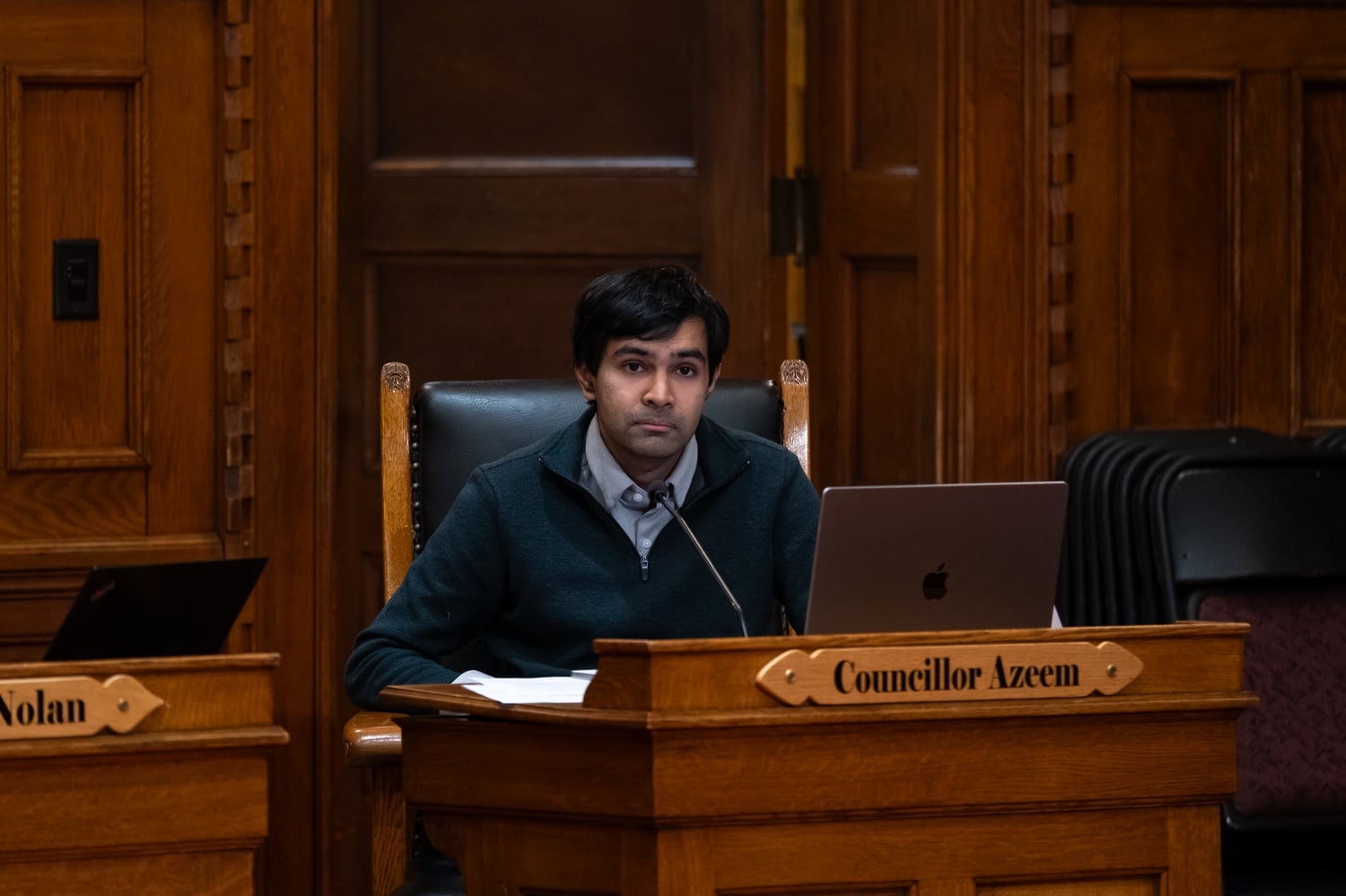
Every April Fools’ Day, Cambridge Vice Mayor Burhan Azeem resurfaces a familiar joke: a mock proposal to annex Boston and Somerville into a sprawling “MegaCambridge.”
Last week, the joke hardened into a campaign. The 29-year-old entered the race for the Massachusetts State Senate seat representing parts of Cambridge, Somerville, Medford, and Winchester — a district that already stretches well beyond the city he now helps govern.
Azeem jumped into the contest after incumbent Patricia D. Jehlen announced she would not seek reelection, setting off a crowded race that includes Somerville City Councilor Matt McLaughlin, Winchester School Committee member Tom Hopcroft, and 34th Middlesex State Rep. Christine P. Barber.
Until recently, politics was not an obvious destination for Azeem. As an MIT undergraduate, he built his career in the Kendall Square startup ecosystem. But in 2019, shortly after graduating, Azeem made an abrupt pivot, running for Cambridge City Council at the encouragement of then-Mayor Marc C. McGovern. He lost. Two years later, he ran again — and won.
At 24, Azeem became the youngest City Councilor in Cambridge’s history at the time. In the two terms since, he has helped pass legislation spanning education, climate, and clean energy, but his tenure has become most closely associated with housing — and with a willingness to upend long-standing zoning rules to address the city’s worsening shortage.
In his first term, Azeem championed amendments to the Affordable Housing Overlay, clearing the way for fully affordable developments to rise 12 to 15 stories along high-traffic corridors and squares. Last year, he emerged as one of the Council’s most vocal advocates for legalizing multifamily housing citywide.
The ordinance, which passed last February by an 8-1 vote, overturned decades-old zoning restrictions that had made it illegal to build multifamily housing on nearly one-third of Cambridge’s residential land — a move supporters hailed as one of the most ambitious zoning reforms in Greater Boston.
“These are policies that, when we started A Better Cambridge back in 2012, I never would have imagined being adopted in Cambridge,” said Jesse Kanson-Benanav, executive director of Abundant Housing Massachusetts, a nonprofit Azeem co-founded in 2020.
“So fast forwarding to the last few years, to see Burhan have this record of success is really notable,” he added.
During Azeem’s tenure, the Council also approved a slate of affordability measures, including free preschool for all four-year-olds and some three-year-olds and the elimination of mandatory minimum parking requirements for new construction. In interviews and campaign materials, Azeem has credited himself with pushing many of those long-stalled ideas across the finish line.
Get The Crimson in your inbox.
“A lot of those conversations are ones like parking minimums that have been going on for a long time, but just never gone anywhere,” Azeem said in a Monday interview with The Crimson. “Since I’ve gotten elected, there’s been a steady process of legislation that’s been able to make it to the finish line.”
But not everyone agrees with the direction — or the economics.
Longtime Cambridge resident Heather M. Hoffman said she opposed many of Azeem’s housing initiatives.
“He didn’t get an engineering degree from MIT without being able to do arithmetic and math, but he doesn’t appear to feel the need to use it in his current job,” she said. “He goes on and on about how building million dollar apartments everywhere is suddenly going to make things cheaper? No, it isn’t.”
Under Cambridge’s inclusionary zoning law, residential developments with more than 10 units — including market-rate and luxury projects — must reserve 20 percent of units as income-restricted affordable housing. In a Tuesday statement, Azeem wrote that the policy supports affordable development “even if you don’t believe in supply and demand.”
Some of Azeem’s colleagues have also cautioned against overstating his role in the city’s housing overhaul.
City Councilor Patricia M. Nolan ’80 said that much of the groundwork for zoning reform predates Azeem’s first election.
“Jivan Sobrino-Wheeler and I were the first ones to propose letting multifamily zoning happen everywhere across the city and not have single-family only zones,” she said in a Monday interview. “It was something that Burhan then picked up and followed up on.”
Azeem acknowledged that history, writing that “no policy gets passed without it being a team effort,” and pointing to multiple failed attempts in earlier years to legalize multifamily zoning in his Tuesday statement.
Eight of Azeem’s friends and mentors said his influence lies less in authorship than in execution — and a collaborative instinct evident long before City Hall.
Mark D. Erlenwein, Azeem’s high school principal, said he was “an integral part of the life force” of his robotics team.
At MIT, Azeem co-founded an online learning startup through a highly competitive entrepreneurship program. Bill Aulet, the managing director of the center that runs the program, said Azeem and his teammates stood out.
“He’s a terrific guy – selfless,” Aulet said. “He’s a leader of people.”
After graduation, Azeem worked at two startups founded by Prem Sharma, first as an AI engineer at a healthcare company that was sold in 2022, and later at Tandem, a veterinary technology startup, until last March.
Elizabeth Bisio, who worked with Azeem at Tandem before launching her own City Council campaign last year, said the transition from startups to politics made sense.
“I’m a firm believer that there’s a lot of similarities between getting a grassroots campaign up and running and a startup,” Bisio said.
“When you’re building companies, you have to show up 100 percent every day. And I think that’s the same with politics — that you have to show up for your constituents and prove why you deserve to have their vote,” she added.
Azeem, though, said he now sees Cambridge as too small a stage. Winning a state senate seat would let him push the policies that have defined his Council tenure to a level where they could reach more people.
“I think that there’s a lot of issues on transportation, on climate and clean energy, child care, where we’ve, to some extent, done what we can in Cambridge,” he said. “But the power you have at the state is much, much greater to be able to affect change.”
His campaign launch followed a tense internal vote that elevated him to vice mayor in January. Azeem secured the post by a 5-4 margin, narrowly defeating Nolan. Councilor Timothy R. Flaherty, who cast the deciding vote despite frequent disagreements with Azeem on housing, said he was persuaded by Azeem’s openness.
“I came to appreciate his ability to work with every member of the City Council to keep an open mind,” Flaherty said.
Nolan said she hopes Azeem broadens his focus if elected.
“I do think it’s really important to have a broad sense of the entire community, which I hope and expect that he would develop,” she said. “I think that’s going to be very challenging to do, given that there really is no track record of actual effectiveness on issues other than some zoning reform — which, by the way, was pretty controversial and pretty divisive within the community.”
Azeem is not the first Cambridge City Councilor to set his sights on Beacon Hill. State Rep. Marjorie C. Decker first ran for her seat while serving on the Council in 2012, holding both offices until the end of 2013. Former Councilor Timothy J. Toomey Jr., a fixture in City Hall for more than three decades, concurrently served as a state representative from 1993 to 2017.
Azeem said he would take a different approach.
“I have no intention of serving both in City Council and on the State Senate,” he said.
—Staff writer Maya Fu can be reached at [email protected].
—Staff writer Risha Sinha can be reached at [email protected].
Want to keep up with breaking news? Subscribe to our email newsletter
Have a tip for The Crimson? Share it confidentially