Overseer Candidate Alfredo Gutiérrez Ortiz Mena Urges Harvard to Stay ‘True To Its Mission’
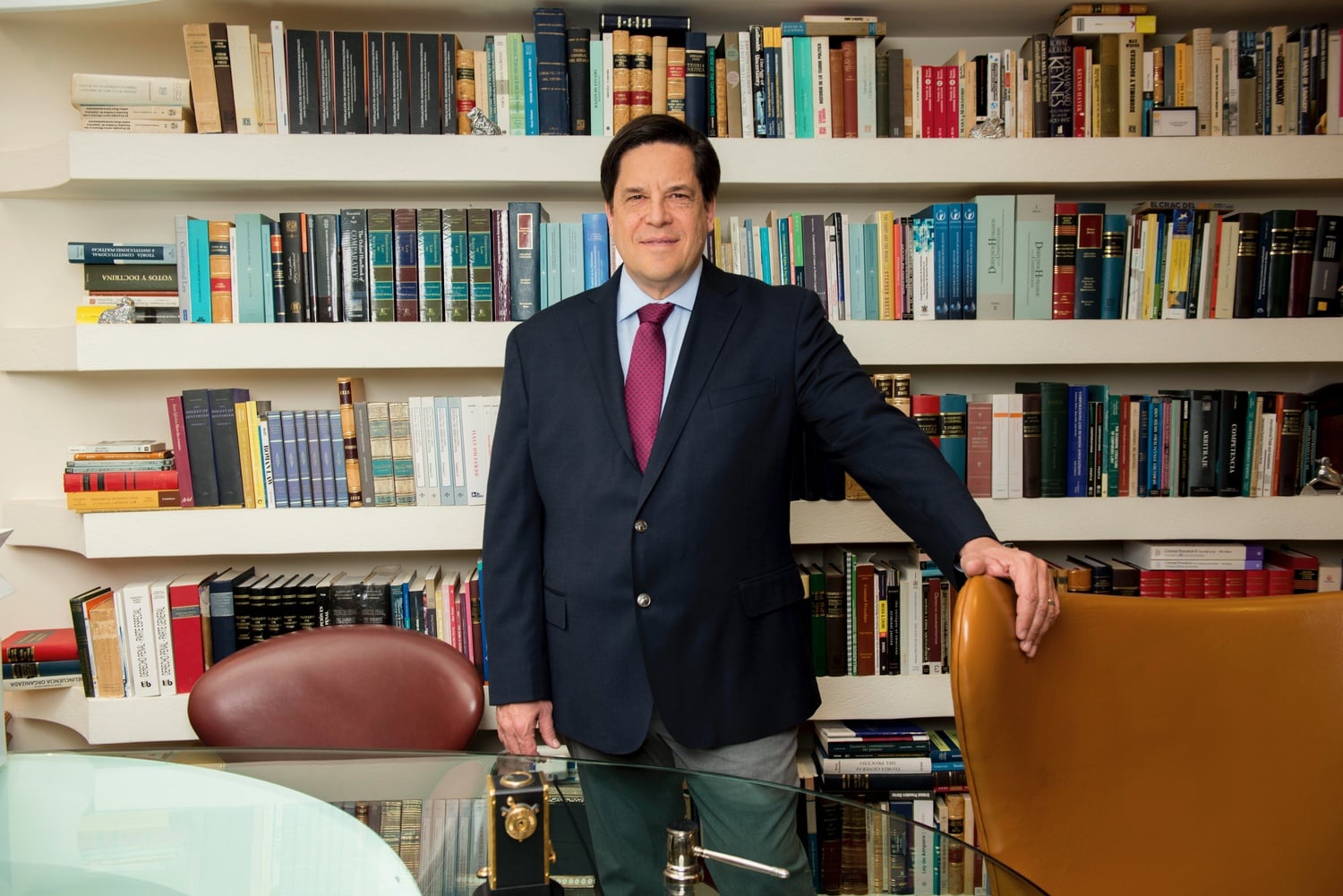
Alfredo Gutiérrez Ortiz Mena said Harvard should respond to intensifying political and legal scrutiny by staying “true to its mission” — and that the University’s governing boards should focus on the institution’s long-term strength rather than advancing individual policy agendas.
The former Mexican Supreme Court justice, nominated last month as one of nine candidates for six open seats on the Board of Overseers, said the body’s authority lies in restraint: providing oversight and guidance without intervening in management.
“Overseers advise and oversee,” Gutiérrez Ortiz Mena said. “They don’t manage and they don’t freelance.”
Clear limits, he added, are what preserve trust between University leadership and the broader Harvard community.
Gutiérrez Ortiz Mena said that approach also shapes how he thinks Overseers should engage publicly. He argued that the group is not meant to comment on individual University decisions, but rather to safeguard Harvard’s long-term values — particularly access and diversity — within existing legal constraints.
“Harvard should pursue scalable diversity strategies and measure whether they work after the Supreme Court’s admission decision,” he said. “Harvard has to build a pathway to diversity at scale — and I don’t think they should accept racial and socioeconomic restratification.”
Gutiérrez Ortiz Mena studied law at the Universidad Nacional Autónoma de México before receiving an LL.M. from Harvard Law School in 1998. He said that his prior educational background reinforced his view of access as an institutional obligation rather than a concession.
“I know what access looks like when institutions treat it as a mission rather than a concession,” he said. “The board’s job is to ensure that the path is real.”
Among the steps he suggested were audits of diversity initiatives and improved training for alumni interviews to “capture obstacles overcome, responsibilities shouldered, and achievement in context.”
“Harvard is not Harvard without its international community,” he said. “Harvard is not Harvard if it’s not looking for a diverse student body.”
Get The Crimson in your inbox.
As a law student, Gutiérrez Ortiz Mena described himself as a “nerd through and through,” gravitating toward tax law and throwing himself into his studies. He cited a course taught by HLS Professor Emeritus Alvin C. Warren Jr. as particularly influential, shaping his later career as a senior tax official in Mexico.
“I used to enjoy the weekends because I used to think that the weekends were the time where classes wouldn’t interfere with my reading,” he said.
That experience, he said, drew him back to campus last fall as a visiting lecturer at the Law School, where he taught classes on constitutional erosion and human rights.
“It was really something that I had always dreamed about returning to the Harvard classroom,” he said.
Drawing on that experience, Gutiérrez Ortiz Mena emphasized the importance of protecting free inquiry and debate in the classroom. He said Harvard “should be attempting to preserve” spaces for conscientious debate and open dialogue across differences.
“It's one of the strongest designs,” he said. “Harvard is a global institution by design, and you need this academic freedom in the classroom to allow the free flow of ideas and disagreement.”
Colleagues and students said Gutiérrez Ortiz Mena brings that commitment into his teaching, describing his classroom presence as “inspirational.”
“He has this very inspirational but very — I don’t want to keep saying ‘down to Earth’ — but really sort of soft spoken way of getting students to find inspiration,” said Alicia E. Yamin ’87, a lecturer at the Law School.
His former student Eden S. Miller recalled emailing Gutiérrez Ortiz Mena after class with a question about a concept discussed in lecture.
“He responded comprehensively — in about 1600 words — and offered clear guidance on how I might explore the concept further in my own writing,” she wrote in a statement to The Crimson.
Miller added that Gutiérrez Ortiz Mena regularly integrated his experience across legal systems into the classroom, drawing together comparative constitutionalism, judicial practice, and political philosophy.
At his core, Yamin said, his demeanor sets him apart.
“Despite all he has done in his life and being a Supreme Court justice,” she said, “he’s actually really kind of down to earth and has great humility.”
—Staff writer Hugo C. Chiasson can be reached at [email protected] or on Signal at hcc.35. Follow him on X @HugoChiassonn.
Want to keep up with breaking news? Subscribe to our email newsletter
Have a tip for The Crimson? Share it confidentially