‘The Bald Soprano’ & ‘The Lesson’ Review: Muddied Communication and Missed Opportunities
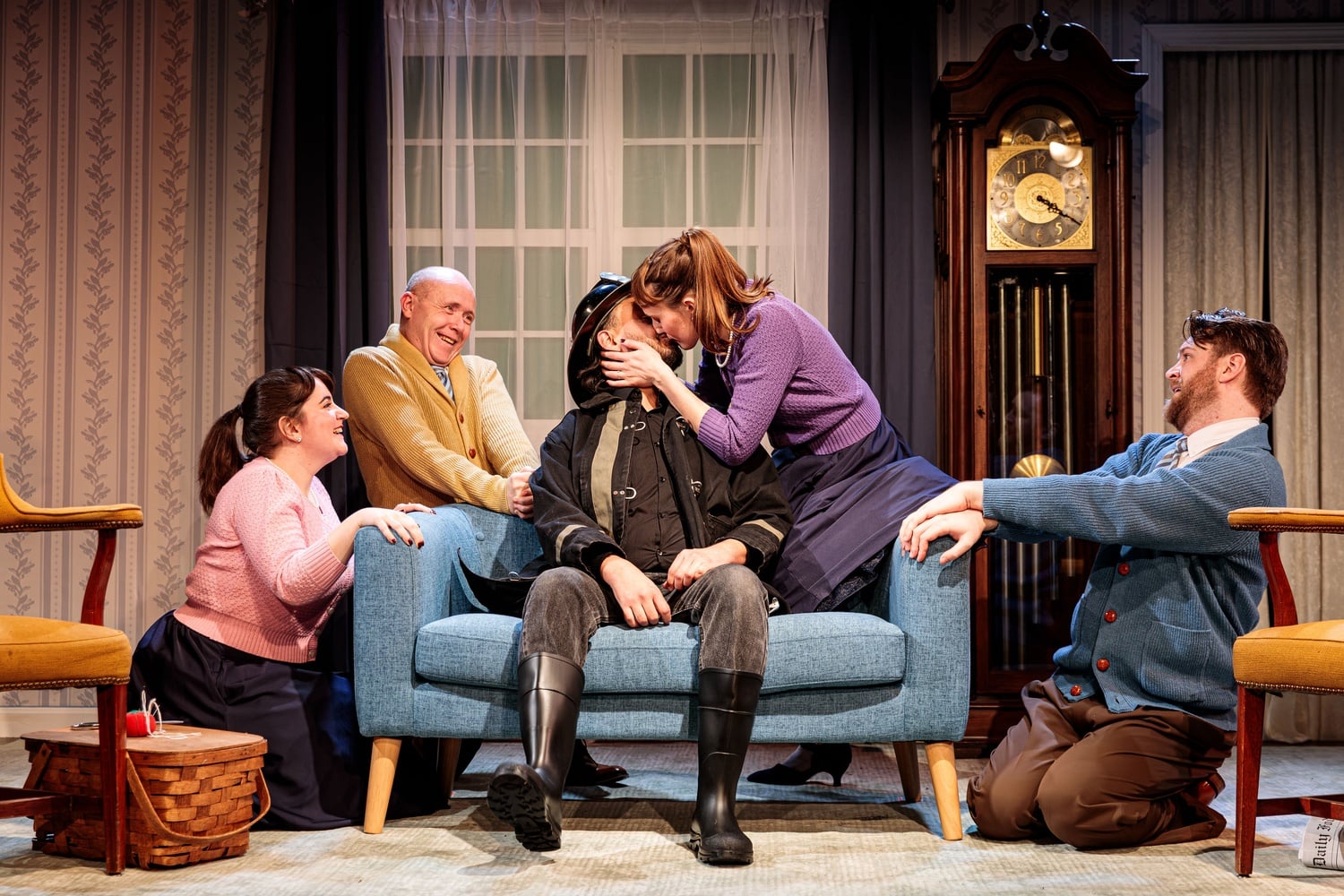
A man and a woman sit in a living room, trying to figure out how they know each other. They have just come over for dinner. They realize, in time, that they are husband and wife. “How bizarre! What a strange coincidence!” the woman exclaims. The only issue is that they aren’t really married.
This interaction in the Romanian-born French playwright Eugène Ionesco’s “The Bald Soprano” — currently playing alongside “The Lesson” by the Hub Theatre Company of Boston at the Boston Center for the Arts Plaza Black Box Theatre — comes near the beginning of the one-act absurdist masterwork.
The production, directed by Bryn Boice, highlights some of Ionesco’s most poignant themes of familial unsteadiness, shifting notions of gender and sexuality, and the pointlessness of worrying about small disasters. Guided by Boice’s tight and highly structured direction, “The Bald Soprano” dissects the facade of a perfect suburban life, critiques gender roles, and uncovers the absurd challenge of the mundane, creating an immersive 1950s world that simultaneously shuts out and confronts modern realities.
From the jump, “The Bald Soprano”’s set catches the eye, with a flat attached to the front of the stage designed to look like an old-school television, complete with moveable dials. The set establishes the perfect environment for the purposefully stilted performances and turns them into a reflection of what one might consider normal, domestic life.
The dinner party which is doomed to devolve into an absurd jumble of language, presents boundless chances for a laugh. In a particularly excellent showing, the two main couples, including Mrs. Smith (Siobhán Carroll) and Mr. Martin (Brooks Reeves), bring the comedy in each moment to the forefront while simultaneously heightening the sensation that nothing is quite as it seems.
The play hints at this uncertainty early on. The ringing of the grandfather clock provides a unique sense of dread towards the start of the play, which only heightens in intensity as the one-act continues to chart its course.
The presence of the television-esque flat covering the front of the stage allows Boice to play with Ionesco’s characters, effectively developing the sense that they are performing an idealized idea of suburbia. The direction turns the original critique of forced mundanity’s absurdity in the wake of World War II into a reflection on a perfect on-screen life.
For example, as the maid — played by a delightful Lauren R. Elias — tells a story about fire to the two couples and the town fire chief, she steps out of the world of the television, and effectively into the realm of reality. In a terrifying display, the earlier dread of the clock is replaced by the harshness of fire, and the maid is dragged away, still screaming.
At once, the play starts to descend toward certain doom. Words, phrases, and ideas all jumble together, each character jumping in to finish each others’ thoughts and spouting phrases which have the ring of truth but are nothing more than empty air. Here, Boice makes an addition to Ionesco’s original script: lyrics to existing songs. This decision is a curious one, at once almost brilliant and entirely confounding. It serves both as a reflection of the word-association in the original text and as a stark departure from the written material. As a crowd of people scrambles and tries their best to approach the truth, they simultaneously reconcile with the absurdity of attempting to communicate. This newfound chaos coincides with a dream ballet sequence in which each character dons a tutu. It is funny. It is anxiety-inducing. It is remarkably successful.
The play’s ending showcases some truly exquisite work from lighting designer Nars Kelliher, whose subtle designs paired with smart directorial decisions leave the audience in a wonderful mix of surprise, bewilderment, and fascination.
It is a sharp close to the first of the evening’s two one-acts. The same cannot be said of the latter.
“The Lesson” — following a tutoring session between an aging professor and his young pupil — offers distinct opportunities to draw out subtler themes. However, Boice’s direction falls short. Her direction ignores subtleties, instead opting to resolve its spat between professor and pupil by “telling” and not “showing” the audience how to interpret its conclusion.
While the at the end of the play provides a well-executed shocking moment, it feels too straightforward for a play with as much to say as it does.
The costume elements that the professor wears as the lights dim to black, which was selected by designer Marissa Wolf, make Boice’s intended message crystal clear. The garments are surprising to see on stage, but they reduce the moment to a contemporary lesson, rather than a timeless one. Though Kelliher makes an inspired design choice to reveal a back room, whose contents are rendered clinically from the cold rays emanating from a single pull-cord light, the shock undercuts the overarching complexities of the original text.
Reeves’ performance as the professor is a standout in “The Lesson,” where he displays a fantastic command of language. He plays each moment with precision and clarity. Despite his magnetic quality and sharp faculty of language, though, the directorial choices undermine the chance to draw one’s own conclusions about the piece.
“The Bald Soprano” challenges its audience with its text. “The Lesson” has the potential to do the same, to unearth undercurrents of gender dynamics, the disposability of the young, indoctrination, and much more.
While Boice meets the challenge of producing Ionesco in 2026 with “The Bald Soprano” in a fresh, smart rendition of the playwright’s most famous work, her take on “The Lesson” falls short of the task.
—Staff writer Hugo C. Chiasson can be reached at [email protected] or on Signal at hcc.35. Follow him on X @HugoChiassonn.
Want to keep up with breaking news? Subscribe to our email newsletter
Have a tip for The Crimson? Share it confidentially