When Harvard Cuts Costs, It Cuts Critics
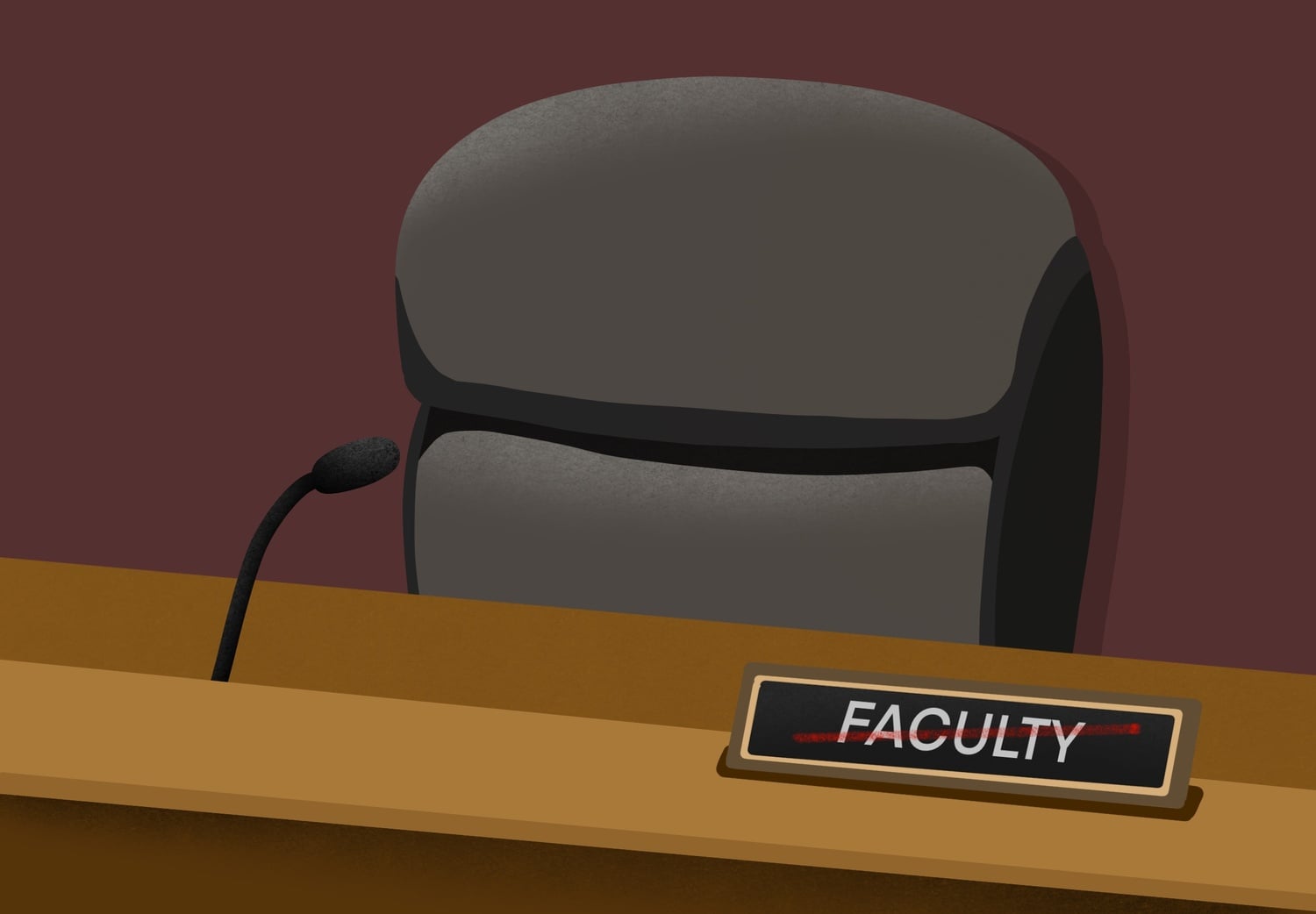
When financial pressures come knocking, Harvard consults faculty. But it’s all for show.
In January, Dean of Science Jeff W. Lichtman was pushed out following months of disputes with Faculty of Arts and Sciences Dean Hopi E. Hoekstra over Ph.D. admissions cuts. It was an extraordinary step, but it wasn’t abnormal: Harvard’s financial decisions, especially during budget restrictions, are often implemented top-down with minimal faculty deliberation. Lichtman’s dismissal — which four people have described as a firing — is the sharpening of this well-used knife.
The important question concerning recent budget cuts isn’t whether they happen, but where they happen. At a university, financial decisions are also academic and pedagogical ones, so faculty deserve a legitimate say — not just ceremonial consultation. So far, the message to them has been clear: Here’s what’s happening, now deal with it.
Of course, structured faculty input won’t eliminate financial pressures. Nor will it protect Ph.D. students and academic workers from budget squeezes. But it could help ensure that Harvard doesn’t always cut from the bottom to save the top.
Lichtman didn’t wage a war against top administrators; he simply argued that Ph.D. admissions cuts shouldn’t be as aggressive as in Hoekstra’s proposals and called for greater faculty consultation. For trying to contest administrative decisions, it seems, he was pushed out.
In the past three fiscal crises — 2008, 2020, and 2025 — a similar pattern has played out. The result? Decisions that threaten academics and teaching quality.
During the 2008 financial crisis, the Faculty of Arts and Sciences had to cut its annual operating costs by at least $100 million, even after instituting salary freezes, job search cancellations, and restrictions on hiring new staff. Faculty had little meaningful opportunity to contest these policies.
We saw the same story in 2020: Harvard announced University-wide salary and hiring freezes, accompanied by indefinite pauses on faculty searches and capital projects. There appears to be no public evidence that these followed any consultation with faculty, or that faculty could meaningfully dispute policies after they were announced. They just had to take the hit.
But the most recent budget cuts represent a dramatic escalation in Harvard’s suppression of faculty voices. Many FAS graduate students report their departments only recently recovered from pandemic-era cuts, but Harvard still reduced Ph.D. admissions by more than half for the next two years. Harvard didn’t kick them while they were down — it kicked them just as they were getting back up. And in the case of the Science Division, the FAS didn’t just impose harsh cuts; it was apparently hostile to Lichtman simply for suggesting a more deliberate process.
That’s where Harvard is unusual among its peers: Faculty have no collective, University-wide representation in a recognized deliberative body.
Other schools like Yale have a faculty senate, an elected representative body that articulates collective faculty positions and maintains structured, ongoing consultation with senior administrators. Lately, Harvard faculty have called for a similar system to be implemented here. But as the Editorial Board has noted, such a body may have little concrete, administrative power. To defend faculty interests, it would need at least some legislative teeth — even if it didn’t have the final say.
Harvard still provides some channels for faculty consultation. Last year, Hoekstra announced the establishment of the Research Continuity Committee (first called the Funding Priority Committee) which consulted department chairs, faculty, and researchers on distributing finite research funding. But unlike Yale’s faculty senate, the RCC is an ad-hoc committee created at the University’s discretion, with the role of faculty far less deliberative than it would be under a formal senate. Although professors and researchers got to have their say, their voices seemed to have little bearing on final decisions, which were left purely to administrators.
Even more worrying is Harvard’s recent hiring of McKinsey & Company, one of the most expensive consulting firms in the world, to advise the FAS on budget cuts. The important question is this: Why did Harvard turn to a consulting firm before it gave faculty legitimate influence?
The move only reaffirms Harvard’s corporate style of governance. Historically, McKinsey has advised its clients to cut costs aggressively, contributing to a corporate culture where executive pay explodes while that of workers stagnates. This isn’t a firm renowned for ethical or values-driven fiscal advice, but that’s precisely what Harvard needs.
Faculty know Harvard’s pedagogical needs best. And when a dean is pushed out after contesting top-down decisionmaking, the message to faculty is clear: Dissent is unwelcome. The result will only be the prioritization of administrators’ interests at the expense of professors, researchers, and students.
Luke D. O’Brien ’27, a Crimson Editorial editor, is a Social Studies concentrator in Eliot House.
Want to keep up with breaking news? Subscribe to our email newsletter
Have a tip for The Crimson? Share it confidentially