‘HPT 177: Salooney Tunes’ Review: This Town Ain’t Big Enough For All These Puns
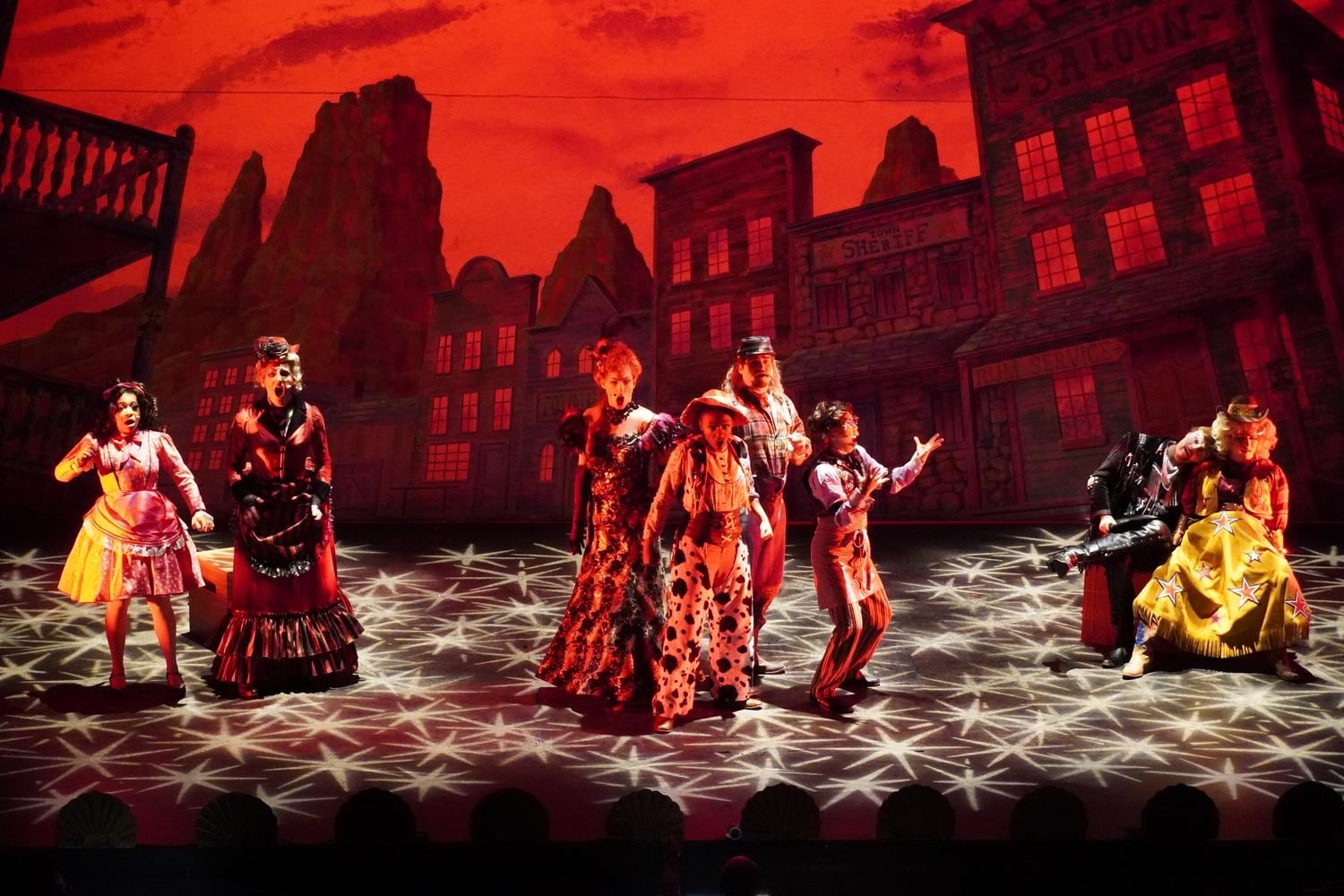
From the moment the crimson curtains rose on “HPT 177: Salooney Tunes,” the Hasty Pudding Theatricals launched into their signature annual extravaganza in front of a sold-out Farkas Hall: a riotous, pun-laden Wild West musical, brimming with clever humour, strong performances, and a theatrical flair on par with Broadway’s.
The two-hour show, split into two acts, ran from Feb. 6 to March 8 in Farkas Hall and toured in New York from March 13 to March 14 and Bermuda from March 18 to March 20. The production exemplified the HPT’s tried-and-true formula: charm, comedy, and chaos wrapped in a fully student-produced package.
The show takes place in the fictional town of Goldendamaire Hills, where two inept outlaws — Robin Yablind (Will W. Jevon ’27) and his inconsequential sidekick Wyatt Aintme (Amelia Sipkin ’29) — attempt a saloon heist to achieve notoriety. Their efforts are predictably disastrous, triggering the ire of the corrupt mayor Gerri Mandarin (Brady M. Rafferty ’27), who has her eyes on the town’s wealth. The determined — and very pregnant — sheriff Carrie N Twins (Daniel O. Denenberg ’26) is tasked with capturing the bandits, while the townspeople, sent on a false gold rush by the mayor, stumble upon an unexpected treasure that the mayor is quick to covet.
The ensemble of eccentric characters — including the saloon singer Sarah Problem (Bernardo de Moura Sequeira ’26) and the mayor’s daughter Anna Fivesix-Fivesixseveneight (Isabel W. S. Wilson ’26) — each contribute their own comedy-filled subplot to the kaleidoscope of chaos that defines the show.
The comedy in “Salooney Tunes” is witty and endlessly punny. The show’s writers — Benjamin D. Langman ’26 and Gunnar Sizemore ’27 — expertly blended modern jokes into an 1860s setting with quips ranging from Tinder to current politics. Sex jokes landed without being vulgar and performers broke the fourth wall to throw some harmless jokes at the tech crew and orchestra — comedically folding the offstage crew into the humor of the show.
Each of the production’s nine characters had distinct personalities, speaking styles (some with a very natural Southern accent), and signature expressions that shone best in their own dedicated songs. Particularly impressive was Wilson’s smooth portrayal of 12-year-old Anna Fivesix-Fivesixseveneight, the mayor’s daughter. At the same time, the cast pulled off more mature pursuits. In a particularly memorable scene, a couple daydreams while writing love letters, with their friends posing motionless on stage as if frozen in time.
Vocally, the cast was exceptionally strong, with impressive range and breath control — even during commanding choreography. The songs — written by Olivia F. Data ’26 — were integrated thoughtfully into the narrative, revealing context and advancing the plot rather than serving as filler. The title number, “Salooney Tunes,” took the crown for being catchy and upbeat.
The dancing was equally flawless, with formations and stage usage that kept the spectacle visually engaging. Much of the choreography by show’s director and choreographer Larry Sousa paid homage to the plot’s Wild West theme. Apart from accompanying the songs, the orchestra helped open and close each of the acts with impressive compositions by Christian Liu ’26. The trumpets were even used creatively to censor Sarah Problem’s cursing.
While the production was nearly flawless, the set had minor missteps. The stage, lined with seashell-like decorations, felt unrelated to the plot, and the curtain prominently displayed 11 large sponsor logos, which harmed first impressions. However, the intentionally thin fabric in the middle to illuminate the show logo helped provide a distraction.
While the set changes during the performance were abnormally fast, backdrops were used creatively, and lighting was used not just to highlight expressions, but also to signal the time of day. Whenever a character’s punny surname was introduced, a blue tinge and characteristic “ting” sound cues helped land the joke. The gold discovery scene was particularly striking, bathing the cast’s faces in warm, golden light to give the illusion of the prop actually shining.
The costumes, designed by Gail Buckley, were period-appropriate yet whimsical, including highlights like Sarah’s long gown and Tilda Cowscomehome’s (Hannah E. Alexis ’27) cow-patterned cowgirl outfit. The headlights in the miners’ outfits were also cleverly used as part of the choreography for the final number.
After the plot concludes, the show transitioned into a pageant-like kickline finale. Though slightly long, it delivered a classic outro by bringing all nine characters onstage. While the show attempted to entice shock and laughter, beneath the comedy, it effectively communicated the greed, corruption, and deceptive nature of politicians.
“Salooney Tunes” is a wonderful addition to the HPT’s 177-year legacy through its excellent production, witty humor, and the charm of classic cross-dressing traditions, and is definitely a show worth watching.
“HPT 177: Salooney Tunes” ran at Farkas Hall from Feb. 6 to March 8.
—Staff writer Mahpara Faatin can be reached at [email protected]. Follow her on Twitter @mahparafaatin.
Want to keep up with breaking news? Subscribe to our email newsletter
Have a tip for The Crimson? Share it confidentially