To the Editor: Two Free Speech Principles in Tension
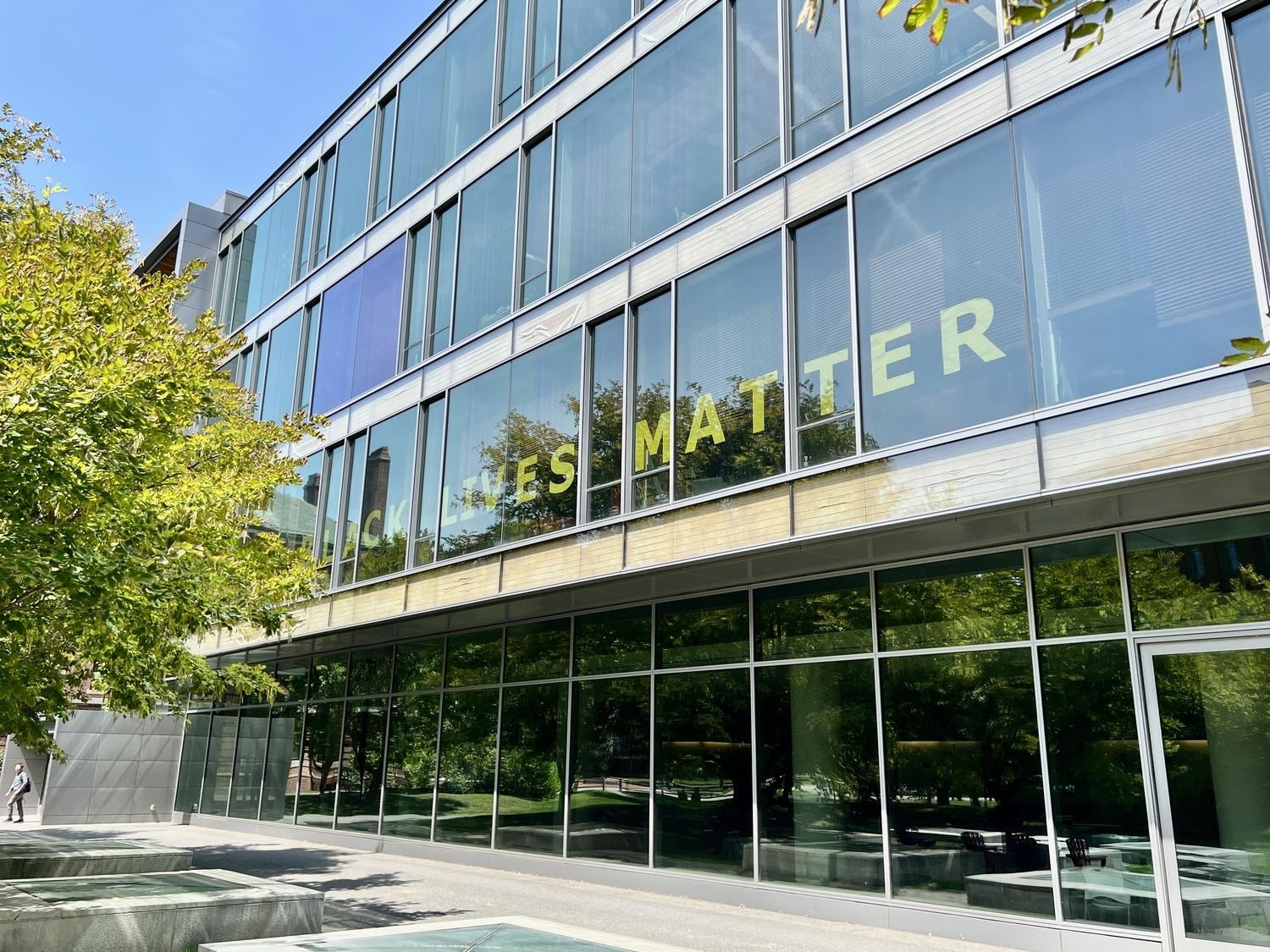
The Editorial Board unreservedly applauds the Faculty of Arts and Sciences rule change that would now allow two biology professors to once again display signs spelling out “Black Lives Matter” in their office windows in the Northwest Science Building. As members of Harvard’s Council on Academic Freedom, we are sympathetic to the principle that faculty and student speech deserve vigorous protection. But we don’t wish to take sides on the wisdom of this policy reversal.
Instead we write to point out that the editorial ignores an important principle involved in this case (and possibly decisive in future cases): institutional neutrality.
The coordinated display was so large and prominent (it took up a significant amount of the building’s side) that it appeared to be part of the building signage. Consequently, onlookers might well have attributed the political slogan to Harvard or one of its schools or departments, not just the individual professors. The University’s “Institutional Voice” policy specifically prohibits Harvard from making statements on political matters not bearing on its core functions, and for good reason — to act otherwise would deter faculty and students from expressing dissenting views, interfering with their freedom of expression.
We note as well that any policy pertaining to the time, place, or manner of expression must be viewpoint-neutral. Those who endorse the policy reversal this time must be just as committed to the right of two professors to display equally prominent signs spelling out “Make America Great Again.”
So, the FAS’s recent reversal of policy was a judgment call, hinging on perception of the sign, and not unambiguously the right move. Two worthy principles, both protecting academic freedom, are in tension. Faculty and students have the right to express their opinions. They don’t have the right to give the impression their opinions are endorsed by Harvard University.
— Jeffrey S. Flier, Higginson Professor of Medicine and Neurobiology, dean of Harvard Medical School from 2007 to 2016, and co-president of the Council on Academic Freedom at Harvard;
Richard M. Losick, Maria Moors Cabot Research Professor of Biology emeritus and member of CAFH;
Eric S. Maskin ’72, the Adams University Professor, a professor of Economics and Mathematics, and co-president of CAFH;
Jason Nemirow, director of the Program on Higher Education Research at the Institute for Quantitative Social Science and director of CAFH;
and Steven A. Pinker, the Johnstone Family Professor of Psychology and co-president of CAFH.
The views expressed are those of the writers alone.
Letters to the Editor must respond directly and explicitly to either an opinion piece recently published on the Editorial page, or else to The Crimson’s manner of coverage within any section of the newspaper. Letters that respond to the subject matter of a non-opinion Crimson article, rather than The Crimson’s coverage of that matter, will not be accepted.
Letters to the Editor are evaluated at the discretion of the Editorial Chairs. They should be submitted to [email protected] and should run between 150 and 350 words. We require Letters to the Editor to be signed, with the signatures appearing on the page or as a hyperlinked list at the discretion of the Editorial Chairs. We do not accept Letters to the Editor from organizations or anonymous writers.
Want to keep up with breaking news? Subscribe to our email newsletter
Have a tip for The Crimson? Share it confidentially