‘We Had a World’ Review: Joshua Harmon’s Intimate Masterwork Soars at The Huntington Theatre
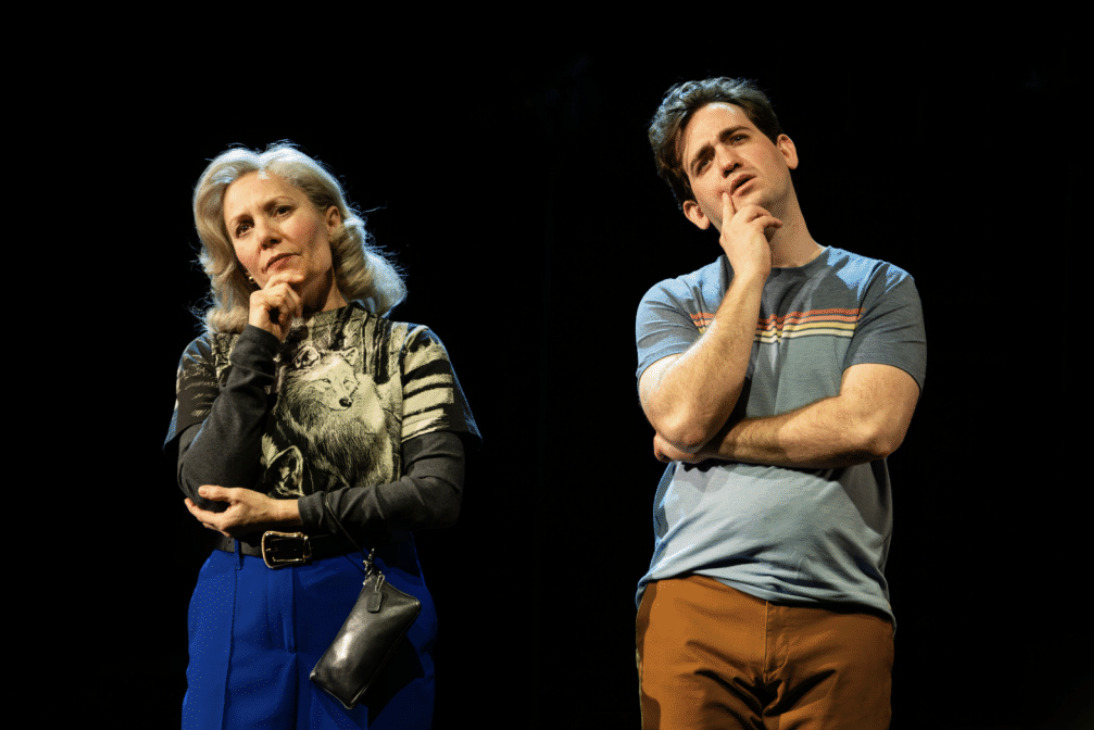
“It was all too beautiful to last,” Joshua (Will Conard) says at the end of Joshua Harmon’s autobiographical play “We Had a World,” which played at The Huntington Calderwood Pavilion through March 15. It takes a playwright as skilled as Harmon to present an intense, 30-year family drama, culminating in Joshua’s nonagenarian grandmother physically beating his mother, to still manage to induce sobs with that penultimate declaration. The play’s director, Keira Fromm, skillfully walked its emotional balance beam, bringing Harmon’s powerful play to life on an expansive stage.
“We Had a World” premiered last year at New York City Center Stage II, a 150-seat theater with the audience seated on three sides. There, the character of Joshua, and his often warring mother Ellen and grandmother Renee — each vividly drawn and deeply human — took on an immediate intimacy, including the audience in their small universe. In the 370-seat Pavilion, the epic elements of Harmon’s tale come to the forefront.
Courtney O’Neill’s set design artfully reflected the world outside. While the amount of empty space sometimes dwarfed the actors, Conard, Amy Resnick, and Eva Kaminsky — who play Renee and Ellen, respectively — were more than powerful enough to draw attention. Occasionally, Fromm and O’Neill pulled off a gasp-worthy coup de théâtre when a set piece or prop suddenly dropped in from the ceiling. More often, the set simply emphasized the universality of Harmon’s familial saga, in which enough was left to the imagination that one could fill in the details of their own childhood homes.
The play unfolds in a non-linear manner, leaving some room for surprise. When the source of some of his grandmother’s bad behavior is revealed, Joshua’s shock is palpable. Some scenes are rich in narrative, while others break the fourth wall to provide a direct look into the inner lives of the characters. No detail in the play felt exaggerated, and Harmon has enough perspective on the women who shaped his life to write about them with clarity.
One of the most salient themes in the piece is climate anxiety, which has a highly personal function in “We Had a World.” For Joshua, the idea that his larger-than-life grandmother would disappear along with icecaps, rainforests, and natural reserves across the globe seems to make some kind of cosmic sense. In part, he cites hot-button issues as a self-conscious reminder that his problems are not the worst in the world. However, Harmon’s writing is so skillful that by the end of the play, Ellen and Renee become their own, powerful but equally destructible forces of nature.
Harmon touches on his gay identity in “We Had a World,” but it is mostly relegated to the sidelines. Beyond a tacky declaration of “Reader, I married him,” the play only mentions Joshua’s boyfriend as he intersects with members of the family, and his initial coming out also seems to be a non-event.
The discussion of religion in the piece is refreshingly honest. Renee is described as rejecting her Jewish identity as much as possible, likely due to the internalized antisemitism that nags at many people of her generation. Ellen, meanwhile, has rebelled against her mother by embracing religious tradition. Harmon lovingly embraces these uniquely Jewish quirks without ever sliding into stereotypes.
Much of the play transcends discussions of identity and background — what mother in the audience can’t relate to Ellen’s emotional declaration that everyone else’s needs are constantly being placed before her own? However, some of the specificity of the piece was lost in this production. The section in which Joshua remembers all of the cultural touchstones his grandmother introduced him to fell slightly flat due to a lack of audience recognition. Names of stage veterans like Cherry Jones and Diana Rigg, which hold enormous cultural importance for New York theater lovers, were met with apathetic silence from Boston audiences.
Any moments that didn’t land were quickly smoothed over by Conard, who served as a charming narrator throughout the show. His pain at being placed in the middle of two powerful women at odds with each other was palpable. The relationships Conard built as Josh with his mother and grandmother were distinct and sensitive, and Conard’s striking physical similarity to Harmon worked in his favor.
Ellen could easily be an unlikeable character; her nagging and guilt-tripping behavior towards her son was sometimes difficult to watch. However, Kaminsky lended the character a levelheadedness and an endearing balabusta quality that made her foibles understandable and assured the audience that she could — and would — do anything for her son.
Resnick was given a Herculean task with the role of Renee, a woman who values her grandson more than anything and still harbors resentment against him decades later for not taking her out to dinner. Not only did Resnick show the process of aging with physical and vocal acuity, but she ran the emotional gamut from self-deprecation to narcissism with aplomb. Throughout her performance, it becomes clear why Joshua loves his grandmother so much, and that relationship makes her personal failings all the more bitter.
“We Had a World” was a successful tearjerker, and a universal tale in which anyone could easily take the place of the grandson, mother, or grandmother depicted onstage. Harmon’s unique experiences are broadly resonant. A play’s success depends on its ability to survive through time, and The Huntington’s compelling production proves that “We Had a World” is universal.
“We Had a World” ran at the Huntington Calderwood Pavilion from Feb. 12 to March 15.
—Staff writer Charles E. Kirsch can be reached at [email protected].
Want to keep up with breaking news? Subscribe to our email newsletter
Have a tip for The Crimson? Share it confidentially