Filmmaker Ken Burns Says America Has Been ‘Way More Divided’ Than Today at IOP Forum
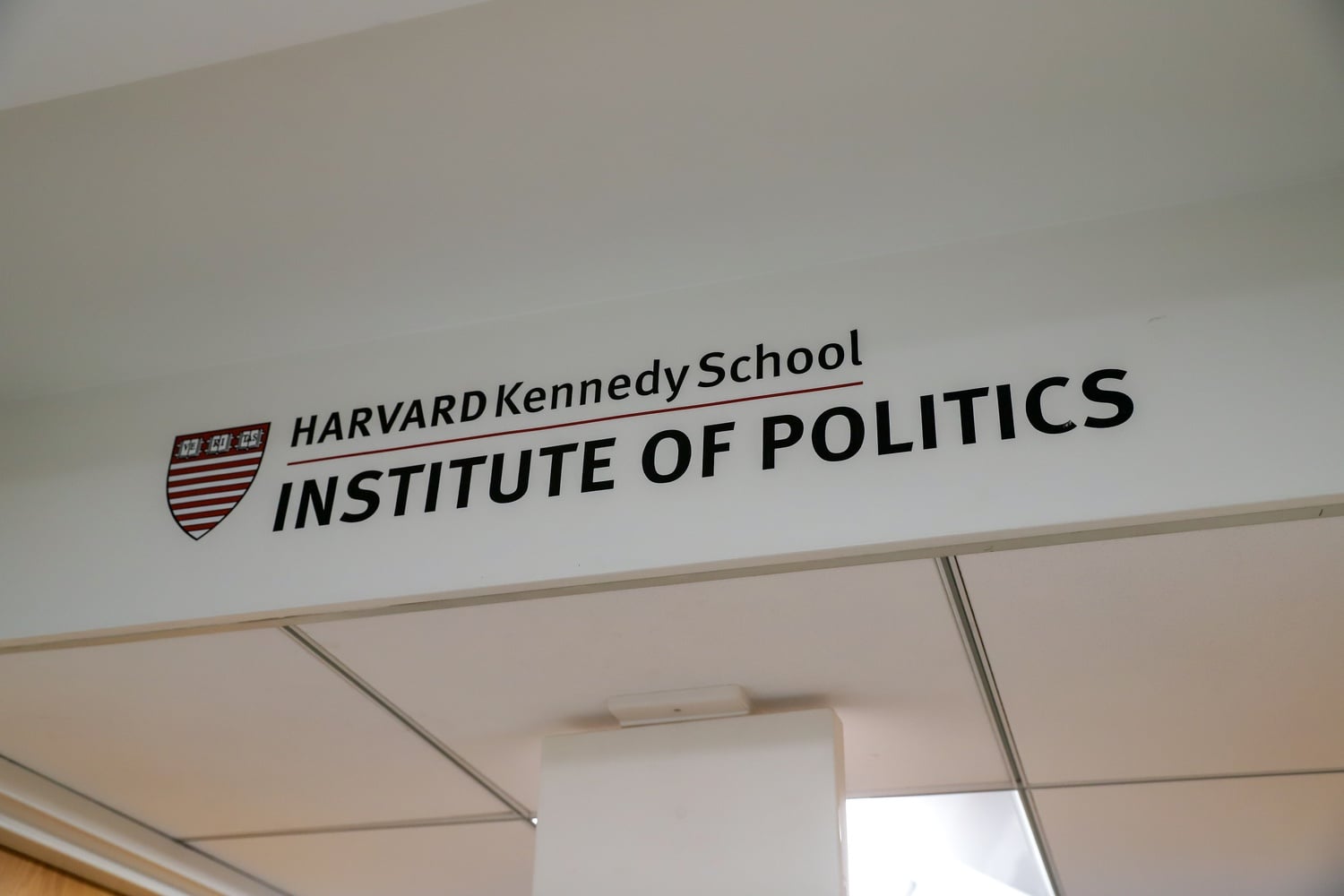
Documentary filmmaker Ken Burns argued Wednesday that America’s current political divisions, while concerning, pale in comparison to those of the Revolutionary era, urging Americans to look to the nation’s founding for perspective at an Institute of Politics forum.
“It’s so Chicken Little — the sky is falling, it’s all over, we’ve never been more divided,” Burns said. “Yes, we have. We were way more divided during the Revolution.”
Burns, who co-directed the twelve-hour PBS series “The American Revolution” with Sarah Botstein and David Schmidt, spoke at the John F. Kennedy Jr. Forum in a conversation moderated by Shorenstein Center Director Nancy R. Gibbs. The event drew more than one hundred attendees.
Over nearly 50 years, Burns has produced acclaimed historical documentaries on subjects ranging from the Civil War to jazz to the Vietnam War. His work has earned multiple Emmy Awards, two Grammy Awards, and two Oscar nominations.
Burns opened on a personal note, recalling that he had sat in the same seat at the IOP 41 years earlier, in 1985, when his film on Huey Long was premiering.
“It was projected on 16 millimeter film, and there were people hanging from the rafters,” he said.
Burns argued that the reality of the American Revolution is often obscured by a narrative focused on political progress. But reducing the founding to great men signing documents, he said, ignores a messier story — a bloody civil war fought largely by teenagers and shaped by the competing interests of enslaved people, women, and Native Americans.
“In this supposedly existentially threatening moment is that we need to just go back and rediscover what actually happened,” Burns said. “It is not the story of great men thinking of ideas in Philadelphia.”
Burns said his research has left him cautiously optimistic. The Revolution, he said, was mostly British victories, punctuated by a few unexpected American wins at critical junctures.
He drew a parallel to the present, pointing to recent court rulings against the Trump administration’s restrictions on speech as evidence of a “developing resistance.”
Get The Crimson in your inbox.
“People have asked me ten questions today about tearing the plaques down, but nobody pointed out that a judge has already said, ‘put them back up,’” he said.
Burns lamented what he described as a decline in public discourse, contrasting what he called the eloquent letters of Revolutionary-era Americans — including children and teenage soldiers — with the coarseness of contemporary communication.
“One of the greatest forces on Earth is the English language,” he said. “It’s just a juggernaut, and we just don’t use it very well these days.”
Burns drew a parallel between Revolutionary-era media and the present, arguing that colonists had a thriving newspaper culture that functioned much like an early internet. But he warned that modern media figures are profiting from disinformation and grievance in ways that corrode democratic life.
“We’ve always been at each other’s throats,” Burns said, “but to not have it be such a part of the language — the uncivilness of this — is so profoundly disappointing.”
Burns also addressed the Trump administration’s budget cuts to the Corporation for Public Broadcasting, which he said provides about 20 percent of his film budgets. He said public television will survive and grow more resilient, but expressed uncertainty about the timeline.
“The thing that I don’t know about is, the thing that is so anxious is: how long will it take?” he said.
Burns said the country’s next chapter should focus on “repair and restoration.” He argued that storytelling is the best antidote to the binary thinking that dominates political discourse.
“What we know from our own lives and the lives of the people closest to us — from the art that we are sustained by, the faith that sustains some of us — is always much more complicated and dynamic,” he said.
Burns also recalled a conversation during the 2008 financial crisis in which a friend in the financial sector told him the country was entering a depression.
“I said: in the Depression, in many cities, the animals in the zoo were shot and the meat distributed to the poor,” he said. “When that happens, I’ll agree we’re in a depression.”
His friend, Burns said, looked visibly relieved.
“There’s something about history that does give you perspective and distance,” Burns said.
Want to keep up with breaking news? Subscribe to our email newsletter
Have a tip for The Crimson? Share it confidentially