Artist Profile: Ava Sarram ’28 on Finding Rhythm in the Lab and on the Dance Floor
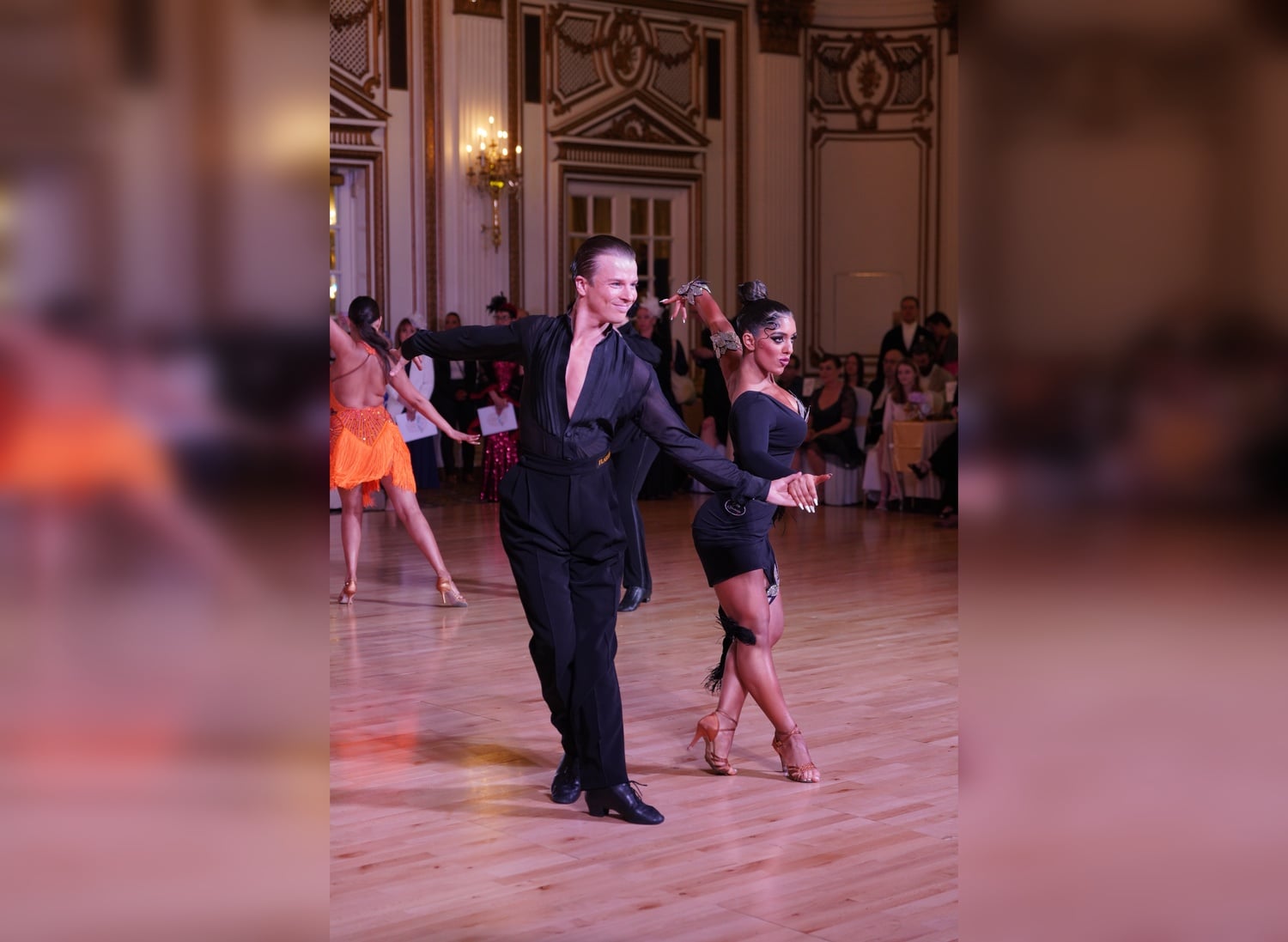
On certain evenings, after a full day of classes in Harvard’s bioengineering labs, Ava Sarram ’28 trades pipettes and problem sets for something less conventional: Latin ballroom dancing.
Sarram, a sophomore in Adams House, did not grow up planning to become a competitive ballroom dancer. In fact, she stumbled upon the opportunity completely by chance.
“It just so happened that I was taking this math class that was in the same building as a ballroom dance studio. Every time I’d come out of that math class, I’d be immediately running into the dance studio. One day my mom turned around and said, ‘Do you want to start taking classes?’ And I’ve been dancing since,” said Sarram in an interview with The Crimson.
What captivated her from the start was a convergence of the music, the performance, and the subtle theatricality of it all.
“There is a lot of acting that goes into it,” said Sarram, recalling her first experience dancing. “When people are dancing, there is this persona that they take on, and it just really draws you in.”
But ballroom dancing, unlike many other forms of individual dance, also requires an acute awareness of another person.
“I loved the music and the connection between the people dancing. I think one super cool part of ballroom is that you're directly connected with another person,” said Sarram. “And so seeing that dynamic play out when people are dancing was also so interesting to me.”
Sarram currently trains in the International Latin style, a branch of ballroom that emphasizes dramatic expression and powerful movements. Over the years, she has competed extensively, first in Pro-Am competitions, dancing with her coach while being judged individually, and more recently with a partner. Her competitions have taken her across the United States and into Canada, experiences she described as “a little bit all over the place.”
For someone balancing national-level dance with a demanding academic path, Sarram doesn’t frame her achievements as exceptional. Instead, she emphasizes the support of the people around her. Her focus of gratitude lands on her dance partner of six months, who drives through traffic to pick her up and listens to her whenever she feels overwhelmed.
“He’s been massive for keeping me sane and mentally there,” said Sarram.
At Harvard, Sarram is concentrating in bioengineering, a field she describes not in technical terms but as a kind of puzzle.
“I think everything that I gravitate towards feels like a puzzle. Anything that can be solved in a creative way, I really enjoy,” Sarram said.
Her interest in research began in high school, when she had the opportunity to shadow in a chemical engineering lab where she works as a research assistant. There, she encountered the iterative nature of scientific work.
“I totally fell in love with research,” she recalled.
And though she describes her pre-med track as tentative, her broader motivation is clear.
“I do feel inclined to go in some direction that allows me to help people,” said Sarram.
That inclination extends beyond academics. On campus, Sarram serves as co-president of Harvard Undergraduates Raising Autism Awareness, an organization that hosts events for individuals with autism. The gatherings are spaces where attendees can “come and be themselves,” a mission Sarram finds deeply significant.
“It’s just so pure and wonderful,” said Sarram. “I absolutely love being a part of that organization.”
The accumulation of responsibilities from clubs, research, and dance poses an ongoing challenge. When asked how she manages it all, she answers with a mix of humor and honesty.
“If anyone has advice for me, that would be wonderful,” said Sarram. “But one thing that has carried me through is holding on to the things you care about, and constantly being in this evaluative state of mind in terms of whether you’re doing things that bring you joy and satisfaction.”
Equally important is her support system.
“My family has been instrumental in helping me manage my time. Having people to talk to and mentally parse through everything has been so important to me,” said Sarram.
Despite describing herself as “relatively introverted,” Sarram has found a similar community in what she calls “pockets” across Harvard. She notes the collaborative atmosphere among her peers, particularly in bioengineering.
“I wasn’t expecting there to be as much support as there is,” said Sarram. “I’m so grateful to have found these pockets of people that make me feel so welcome and loved and appreciated.”
As she prepares for the end of her sophomore year, Sarram remains focused on new academic and personal opportunities. While hoping to do a thesis and continue her research in the future, she also gestured toward personal aspirations, such as plans to deepen her connection to her Persian heritage by learning Farsi more fluently.
“I've been doing things that I never, ever have done or thought I could do,” said Sarram.
For Sarram, the technical demands of bioengineering and the physical requirements of ballroom all come back to the same idea: a puzzle. In the lab, it’s working through problems piece by piece. On the dance floor, it’s learning how to move with a partner and make the dance come to life. As she takes on new challenges, she keeps figuring out how the pieces fit together, and each step forward brings the bigger picture a little more into view.
—Staff writer Maya Y. Koreth can be reached at [email protected]
Want to keep up with breaking news? Subscribe to our email newsletter
Have a tip for The Crimson? Share it confidentially