In Asia Trip, Harvard Divinity School Dean Marla Frederick Pitches Global Partnerships
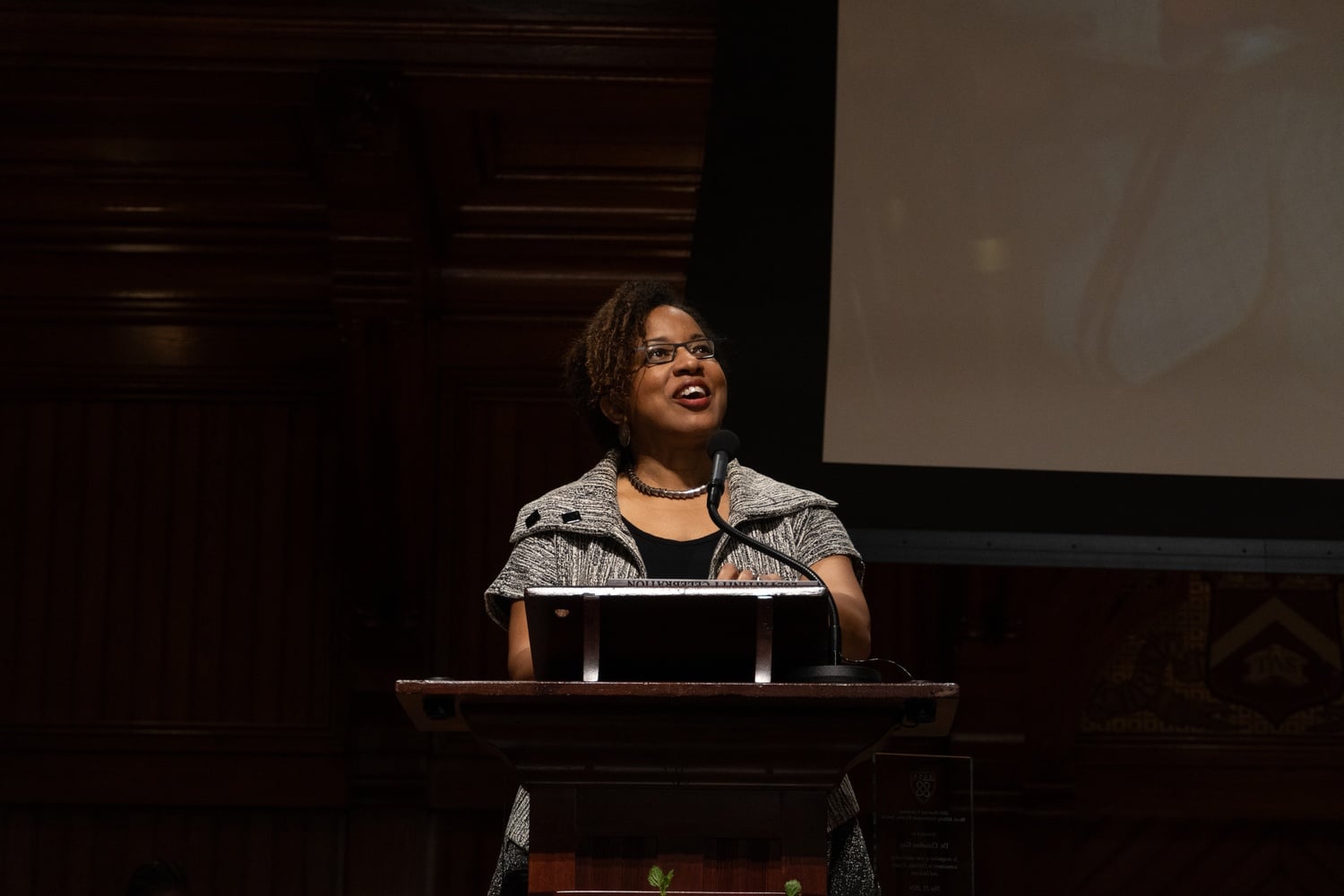
Harvard Divinity School Dean Marla F. Frederick said the school hopes to deepen its ties to Asian institutions and expand student exchange opportunities during a visit to the Divinity School of Chung Chi College at The Chinese University of Hong Kong earlier this month.
The forum was one of several stops Frederick made across Asia, where she met with alumni at Harvard Clubs in Hong Kong, Korea, and Japan. She was accompanied by Gina A. Zurlo, a faculty member, as well as Lori Steven, the school’s associate dean of development and external relations.
According to a recording of the event obtained by The Crimson, Frederick said the trip was rooted in relationship-building and institutional outreach.
"Part of our vision in coming to Asia is to connect with our alumni and friends, but also to explore what kinds of collaborations can take place,” she said.
Frederick added that the school has “opportunities for graduate students to come and do research at HDS” — and that it “would love to send our students here as well.”
When an audience member asked whether HDS would go further — establishing a physical presence in Southeast Asia to bring theological education directly to students who cannot afford to travel abroad — Frederick was candid. (HDS does not currently offer a study abroad program, according to its website.)
“I don't think that’s financially possible,” she said. “I don’t know if that’s how the University is investing — it’s limited.”
An HDS spokesperson declined to comment further for this article.
Those limitations, she explained, are partly a product of the current political climate in the United States. Like other Harvard schools, HDS relies heavily on its endowment, which has come under strain from a Republican-led tax on large college endowments.
“That endowment tax has caused us to have to make cuts in some of our programming,” Frederick said. “That has been the greater strain for HDS — managing the endowment tax.”
Get The Crimson in your inbox.
She distinguished HDS’s situation from that of Harvard’s science-focused schools, which have been more severely affected by the federal government’s freeze on research grants — a freeze that has prompted ongoing litigation. Courts have so far sided with Harvard, though Frederick noted the outcome of the White House’s appeal remains uncertain.
Audience members also pressed Frederick on academic freedom under the current federal administration — particularly for scholars whose work touches on race, inequality, or gender.
“Diversity, equity and inclusion has become such a lightning rod,” she said. “There was a period last year when grants were cut because they mentioned race or the grant had the word inequality in it.”
“So people are concerned — can this get grant funding in the years ahead,” Frederick added. “Will this research paper make it into a journal or not? Will I be able to be hired if my project is on X, Y or Z?”
Frederick said she has tried to reassure junior HDS faculty that tenure reviews at the Divinity School will continue to be conducted on the basis of scholarly merit — rigor, historical engagement, the quality of argument — rather than whether a given project crosses political lines.
“To have these kinds of issues interjected into the questions of scholarship has been a real challenge for all of us in higher education,” she said.
“My hope is that one day, Harvard and all of the universities in the U.S. will be able to get back to the work of doing this kind of rigorous scholarship based on merit,” Frederick added.
Despite those headwinds, Frederick said she remains committed to cultivating meaningful international ties.
“Talking about these possible collaborations is one way of staying connected across Asia and Boston, or Cambridge, and Harvard,” she said.
The Asia trip aligns with goals Frederick laid out in a five-year strategic plan released last October for the school — among them, enhancing HDS’s “visibility, reach, and impact.”
Frederick framed the Asia trip as part of HDS’s broader mission of equipping students to navigate an increasingly fractured world.
“If there's one thing I think our world needs more of, it’s leaders who understand and appreciate each other's humanities across all differences,” she said.
She drew a pointed contrast between two modes of leadership.
“There’s one way to lead that says, ‘I don’t like you. If you’re different from me, I can blow you up,’” she said. “And then there’s another way to lead that says, ‘I can invite you in. We can invite one another in, and we can learn from one another, and I think the study of religion causes us to do that.’”
To illustrate the point, Frederick recalled a conversation with former Secretary of State John F. Kerry, who told her that of all his academic training, it was the study of religion that proved most consequential to his work in international diplomacy.
That vision, she said, is reflected in HDS’s sweeping diversity.
“Our students come from about 32, 35 different faith traditions. Our alumni represent all 50 states and about 70 countries around the world,” Frederick said.
“We really see the need for students to be educated not only about their tradition, but in the context of understanding and appreciating other traditions,” she added.
—Staff writer Andrew R. Levy can be reached at [email protected]. Follow him on X @andrewlevy312.
—Staff writer Alexandria J. Villasenor can be reached at [email protected] or on Signal at ajv.03.
Want to keep up with breaking news? Subscribe to our email newsletter
Have a tip for The Crimson? Share it confidentially