BSO presents Berio/Boccherini, Salonen, and Bruckner: A Dynamic Valentine’s Day Concert
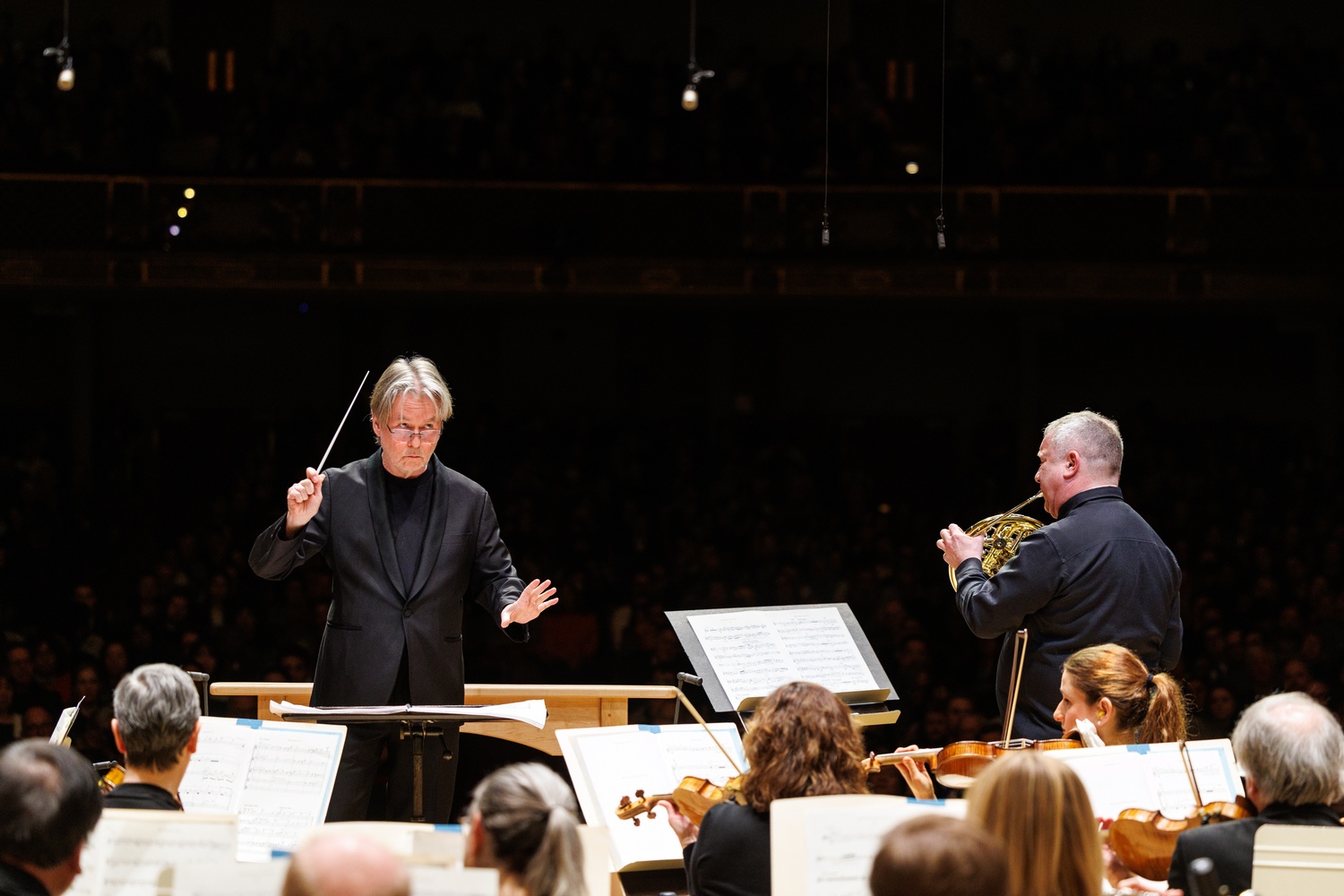
From Feb. 12 to 14, the Boston Symphony Orchestra presented a programme featuring Luciano Berio’s reimagination of Luigi Boccherini’s “Ritirata notturna di Madrid,” Esa-Pekka Salonen’s Horn Concerto with hornist Stefan Dohr, and Anton Bruckner’s Symphony No. 4 in E-flat. The Bruckner, subtitled “Romantic,” was an apt choice for Valentine’s Day weekend, with its grandiose gestures and swathes of sonority. The programme, conducted by Finnish conductor Esa-Pekka Salonen, was an eclectic mix of music for a single evening, providing a myriad of styles, textures, and moods.
The programme opened with Berio’s imagination of a quintet — a string quartet plus guitar — by Luigi Boccherini, the 18th-century cellist and composer who is perhaps best known today for his Minuet in E major. While unquestionably eclipsed by his more famous contemporaries, like Haydn and Mozart, Boccherini’s musical legacy found a clever refraction through the lens of modernist composer Luciano Berio.
Berio’s “Ritirata” featured textures worlds away from Boccherini’s: hazy muted strings, a brass fanfare, and percussion. Originally composed as a short opening piece for the Teatro alla Scala orchestra, “Ritirata” was a charming opening to the concert, effusive in its operatic theatricality, priming the audience’s imagination for Salonen’s following Horn Concerto.
Salonen conducted the BSO in his own Horn Concerto, a magical experience to behold. Salonen’s concerto occupied a very different sound world from the Boccherini/Berio — a far cry from the carnivalesque streets of Madrid. An extremely new addition to Salonen’s compositional repertoire — the horn concerto premiered in August 2025 — this performance served as the work’s American premiere. Led by hornist Stefan Dohr, principal horn of the Berlin Philharmonic for whom the concerto was written, the piece was as virtuosic as it was mysterious and deeply personal.
Divided into three movements, the first movement of Salonen’s Horn Concerto featured a leitmotif that appeared several times throughout the piece, which was played against a synthetic overtone harmony. This was not the first instance of extended horn techniques that evening, an incredible display of Dohr’s command of his instrument in addition to his stage presence. Constantly in dialogue with the orchestra, Dohr navigated the first movement with assertiveness, painting a sonic picture almost like a suspense-laden Old Hollywood thriller, imperceptible and deep.
The second movement, an adagio, oscillated tempestuously between more calm and agitated phases. In a distinctly lyrical monologue, Dohr drew out the horn’s melody in a dreamlike atmosphere, lost in his own world. While interaction with orchestral soloists could have eked out Salonen’s interplay of musical voices more, the third movement was undoubtedly Dohr’s apotheosis. It was a thriller of a last movement, with a grand coda showing off not only Dohr’s facility but also musicality with its gravity-defying range and lightning-fast tempo.
After the intermission was Bruckner’s Symphony No. 4, a staple of the Romantic repertoire. An ode to the symphony — the quintessential Romantic genre exemplified by both himself and Brahms — Salonen’s exact, crystal-clear conducting style guided the orchestra to produce its full range of effects. Bruckner’s vision, while not necessarily Romantic in an emotional, sensuous manner, was still clearly bucolic and angelic, a natural effect of his church organist background.
The symphony opened with its iconic string tremolo, with a solo horn rising out of the dawn mist. Pastoral images abounded, as Salonen led the brass section — the centrepiece of the evening — masterfully. The brass chorale approximately two-thirds of the way into the movement was impeccably played. In the second movement, Salonen brought his clarity to the more delicate, rhythmically sparse sections, in what has traditionally been described as a solemn, quasi-religious movement. The viola tune, accompanied by lute-like pizzicato in the strings, was handled well by the viola section, bringing their rich sonority to an underrated musical moment.
The following movement of the symphony, the “Hunt-Scherzo,” was rendered in a suitably jaunty style, while capturing the caprice and sensuous pleasures of the hunt. The finale, with its ominous, thunderous opening, was evocative of medieval knights and discoursing with the natural world. Alternating between moments of concerted action and serenity, Salonen led the orchestra to the movement’s tantalising climaxes and pulled away with just the right amount of pause, allowing for the movement’s trance-like sections to exert their mysterious force.
In all, the evening was brought to a spirited conclusion. After Berio/Boccherini’s welcoming fanfare, Salonen’s extremes, and Bruckner’s Romantic swells, this Valentine’s Day concert had truly explored the universe of musical possibilities.
—Staff writer Lara R. Tan can be reached at [email protected].
Want to keep up with breaking news? Subscribe to our email newsletter
Have a tip for The Crimson? Share it confidentially