HMS Professor, Israeli Theatre Director Reflect on Cross-Conflict Friendship at HKS Panel
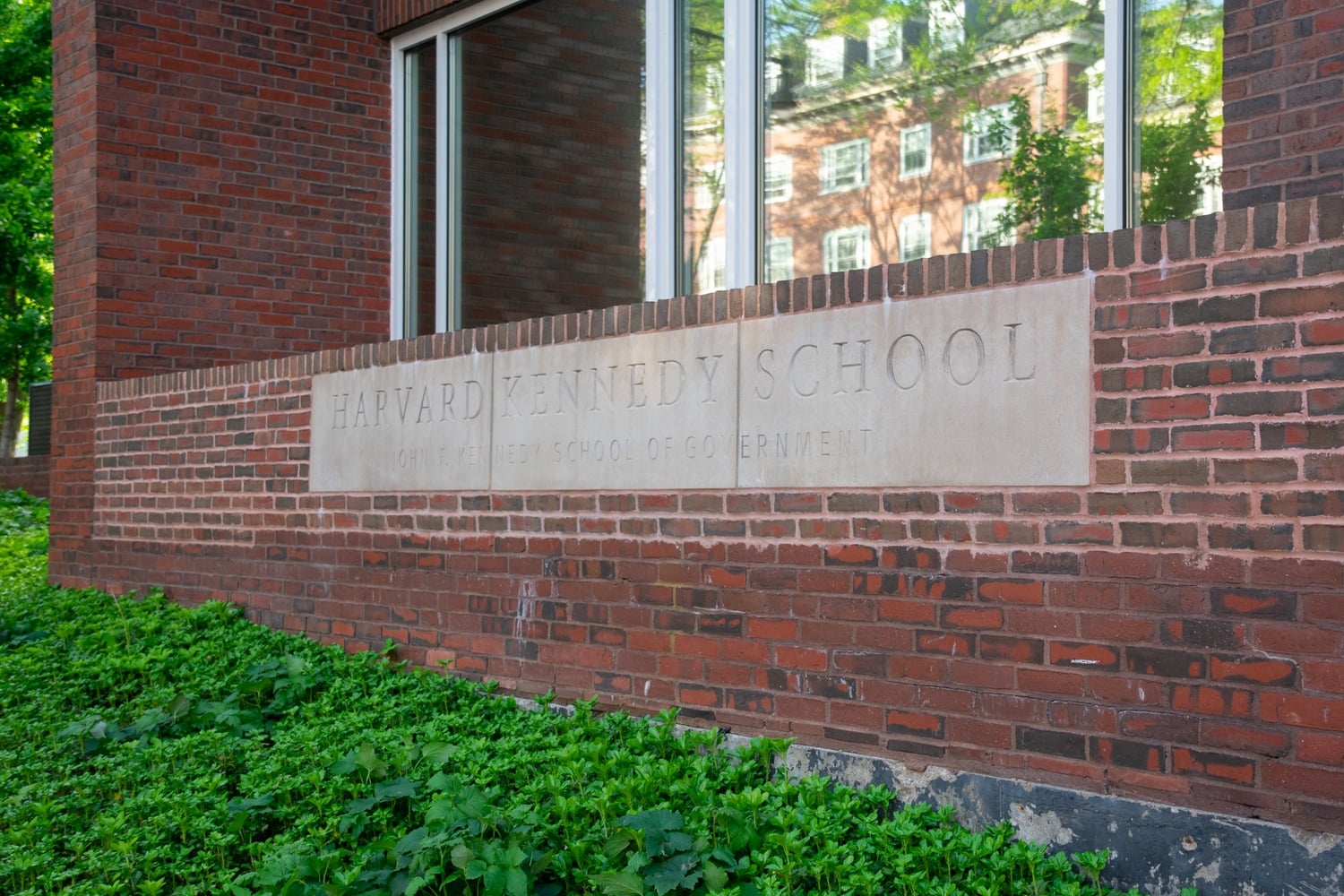
A Palestinian-American Harvard physician and an Israeli-American theater director said at a Harvard Kennedy School event Tuesday that their friendship across the Israel-Palestine divide shows that dialogue between the two sides remains possible.
Eman Ansari, a Palestinian-American physician and assistant professor of pediatrics at Harvard Medical School, and Guy Ben-Aharon, an Israeli-American theater director and founder of the Boston-based company The Jar, appeared at the second event in the Carr-Ryan Center for Human Rights Policy’s six-part series on the Israel-Palestine conflict.
Ansari — who attended medical school in Saudi Arabia, where she was born and holds citizenship — said the physician who became her strongest advocate when she was applying to residency at Tufts University was an Orthodox Jewish doctor. When she told him she was Palestinian, it made no difference, she said.
“I told him, and it turned out to be okay for him,” Ansari said. “And I thought, ‘Oh, maybe they meant Israelis.’”
She later befriended an Israeli classmate during her fellowship, though she said the relationship began with mutual wariness.
“At the beginning, it was like some caution at the beginning, trying to test the water, talk to each other,” she said. “Maybe he’s the one who wants me dead. And that was not him.”
Ansari said those encounters reshaped how she thought about the divisions she grew up with.
“I met people who are Palestinian who didn't like me and Palestinian who did, Jews who didn’t like me, Jews who did. People who didn’t like me, people who did,” she said. “I chose to move past the labels.”
Ansari first met Ben-Aharon roughly seven years ago when a friend invited her to see one of his plays, “The Return.” After they met again in the lobby of Ansari’s workplace, the friendship deepened and the two met each other’s parents, she said.
Their bond was tested after Hamas’ Oct. 7, 2023 attack on Israel. Ben-Aharon said that when the two first spoke after the conflict began, the conversation was not about politics.
Get The Crimson in your inbox.
“We spoke very shortly after October 7 happened, and checked in to see, ‘How are you doing? How’s your family?’” Ben-Aharon said. “Always the human first. It’s your friend. We’re not checking on the status of a state — you’re checking in on your friend.”
Ben-Aharon recalled a joint interview the pair did on WBUR three weeks after the attack, where they discussed bridging the divide between Israelis and Palestinians. He said the conversation took an emotional toll on both of them.
“The minute the interview was over, Eman burst into tears, and I went over and hugged her, and we just stood there,” he said.
Ansari said her friendship with Ben-Aharon has drawn backlash from other people in her life.
“A lot of people think that just simply sitting with an Israeli, I’ve abandoned the cause, and I don’t think that that is a vision for our future,” she said. “How are we going to solve the problem if we will not be able to talk to each other?”
She also argued that Harvard has suppressed Palestinian voices on campus by cancelling programs related to Palestine.
“Harvard has canceled so many programs about the Palestinians, anything that mentioned the word Palestine is being pursued, canceled, erased. And that is unfair,” she said. “That is not only unfair for the Palestinians like me, that is unfair for us to know about the world. We would be illiterate about the world if we don’t know about Palestinians.”
A Harvard spokesperson did not respond to a request for comment.
Mathias Risse, the center’s faculty director, called the discussion “especially urgent” and said the series was grounded in the principle that “civilian lives carry equal worth everywhere” when introducing the speakers on Tuesday.
“Protections and obligations of humanitarian law do not become optional in moments of escalation,” he said.
Ansari said that despite criticism from those who view her relationship with Ben-Aharon as a betrayal, she and Ben-Aharon have no plans to stop appearing together.
“The reason why Guy and I show up time and again is because we will not stop until we find a way for the two people to be able to live together,” she said.
—Staff writer Andrew R. Levy can be reached at [email protected]. Follow him on X @andrewlevy312.
—Staff writer Alexandria J. Villasenor can be reached at [email protected] or on Signal at ajv.03.
Want to keep up with breaking news? Subscribe to our email newsletter
Have a tip for The Crimson? Share it confidentially