
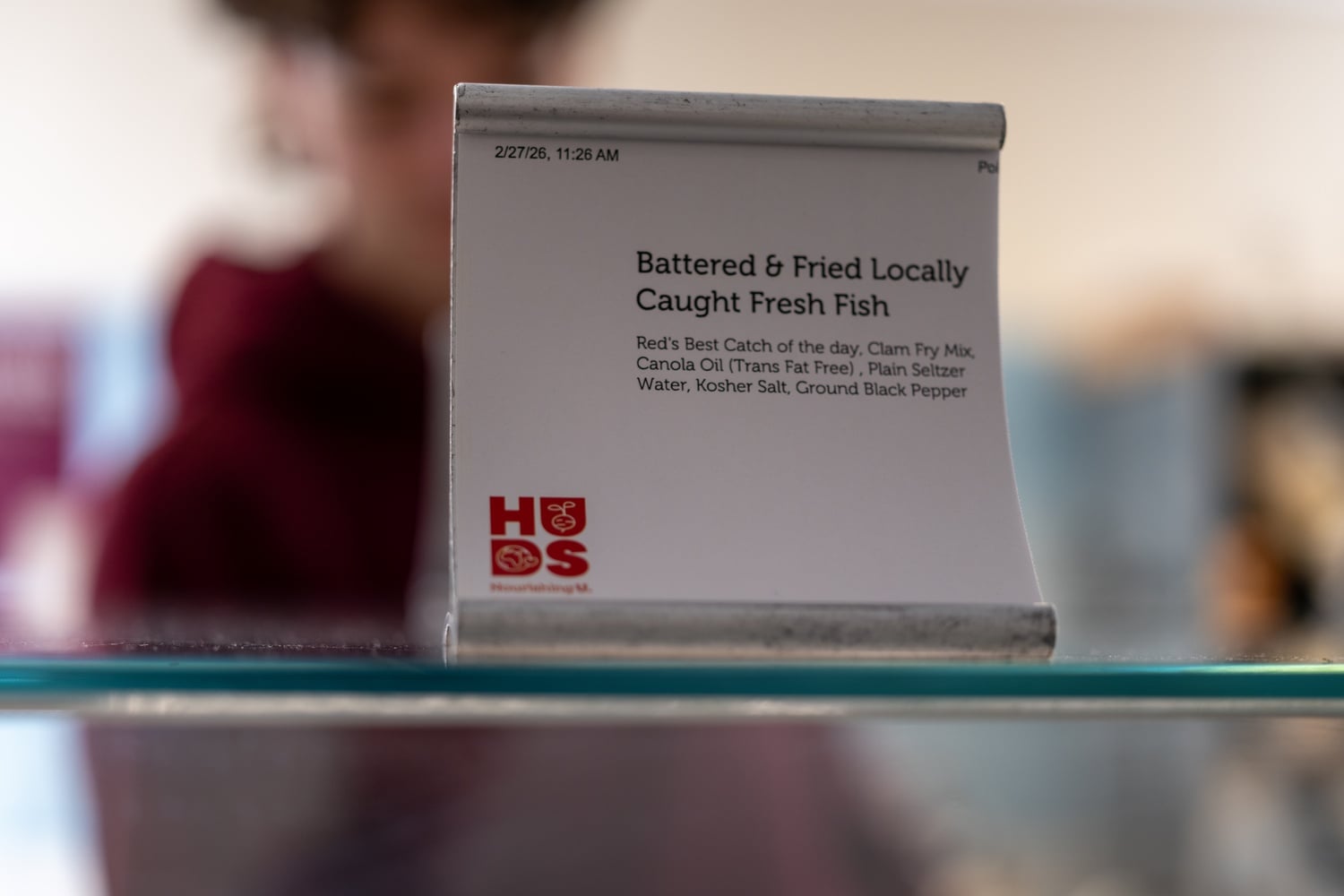
n Fridays, Harvard dining halls usually serve fish and chips: lightly battered, golden fried white fish with a side of tartar sauce. Among students, the staple has come to be known as “Fish Fridays.” Officially, it’s called “Catch of the Day.”
The dish is the result of a larger collaboration between Harvard University Dining Services and a Boston-based fish wholesaler called “Fresh Catch.” The program helps ensure that local fishermen can sell a full day’s catch, and began in 2015 as part of the University’s wider efforts to promote sustainability and support local businesses.
The partnership works year-round. In 2025, the program brought almost 20 different types of fish to Harvard’s dining halls. Each week, HUDS buys around 1,500 pounds of fish at a set price, insulated from market fluctuations.
Still, “Catch of the Day” proves to be a divisive dish on campus, with students often speculating about the source of the fish.
For students like Megan Campos ’29, learning about the program has made the dish easier to appreciate. “I really like how Harvard is like helping the local fishermen in that aspect. I didn’t realize that there was an actual program behind it. I thought it was just frozen fish,” she says.
‘It Doesn’t Get Fresher Than That’
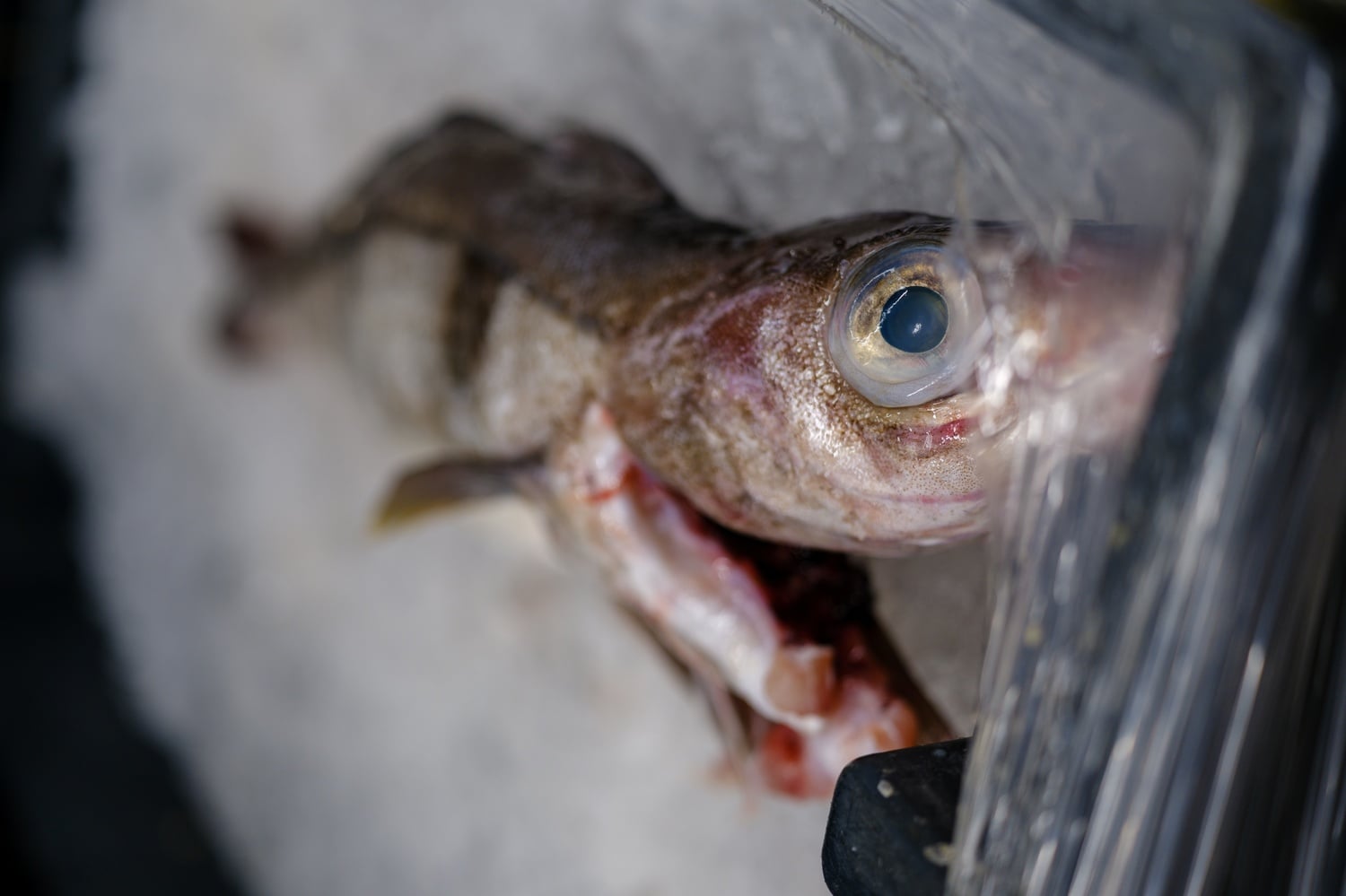
Located at the tail end of the Boston Fish Pier and directly across from Logan International Airport, the dock is a flurry of movement. Forklifts rumble through carrying large, plastic vats of fish covered in ice. The sporadic caw of seagulls interrupts the steady hum of engines and machinery.
Standing at the edge of the dock is Jared Auerbach, the chief executive officer of Red’s Best. A fisherman by trade, he sports a short, rugged greying boxed beard, a navy hoodie, and bundles a whole lot of energy.
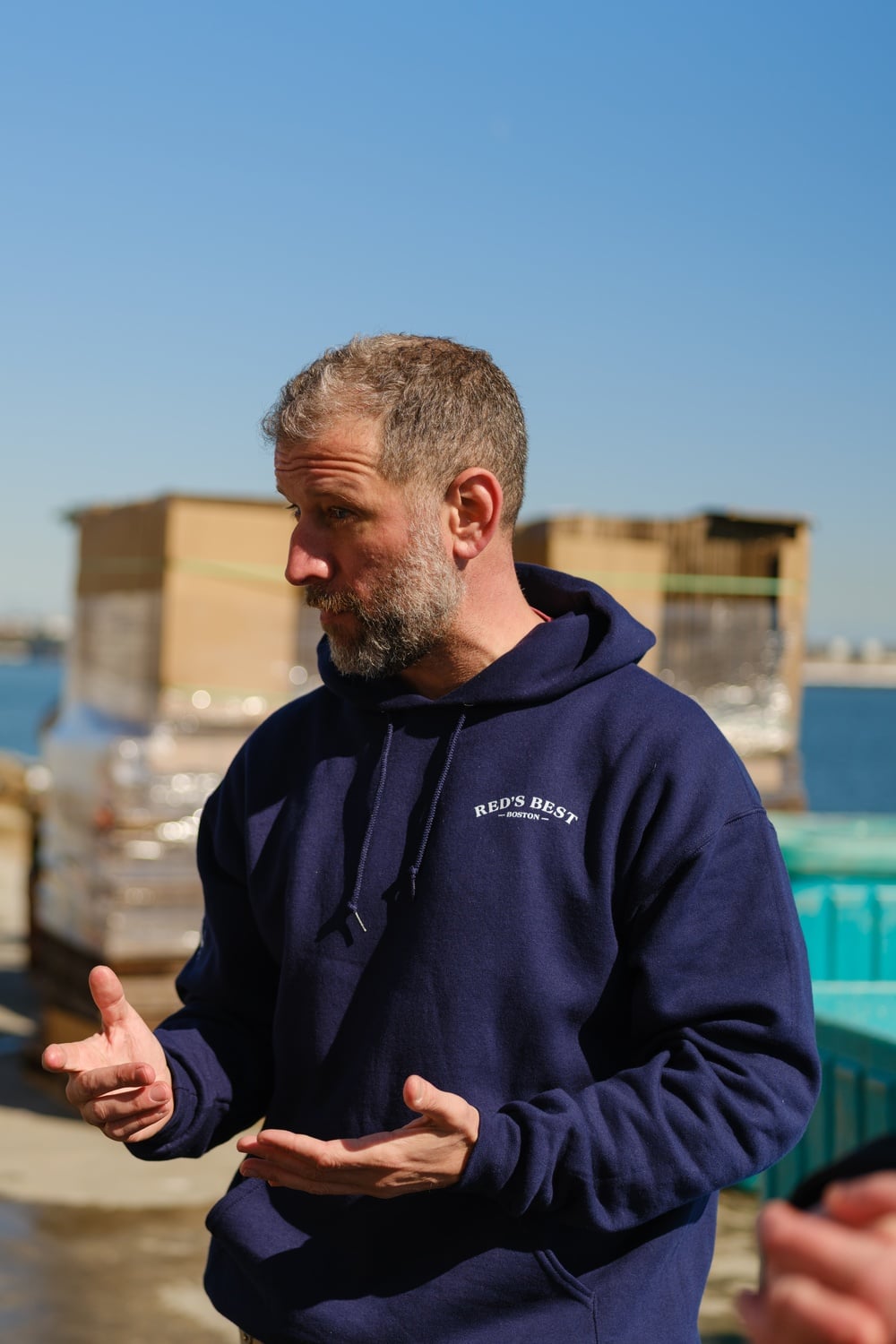
His experience working on a commercial fishing boat in Alaska exposed him to the high expenses faced by fishermen operating smaller boats.
For small fishing boats, the abundance — and therefore, the price — of a particular catch can vary greatly from week to week. A filet of Haddock — a mild, firm-fleshed white fish related to cod — might be $6 a pound one week, but $12 the next.
“When you’re in that high-demand, low-supply, you feel like the queen of the world,” Auerbach says, throwing his head back. “You cannot conceive of a day where you would ever not be able to sell striped bass. Two weeks later, you’re buried in them.”
For local fishermen, this volatility means their source of income is often unreliable. Selling to wholesalers can be difficult for day boats, who often cannot compete with the volumes caught by larger trawlers. Fish that remain unsold at the end of the day are often auctioned off at low prices.
“If everybody hits pollock one day, the price goes so low that they can’t even recoup their costs and pay the staff,” Jamey Lionette, head of the sustainable seafood program at Red’s Best, says.
Auerbach describes this system of auctioning and daily price-setting as a form of “caveman micro-economics” that relies largely on intuition to “gauge the demand.”

Auberach founded Red’s Best in 2008 to solve this problem, making smaller boats more profitable by taking the guesswork out of pricing fish. The company uses web-based software to manage inventory and track supply and demand, collecting data on catches from a wide range of boats and matching that supply with buyers.
“Understanding the demand is tricky, right?” Auerbach says. “One, it’s just like, ‘Who the hell wants this stuff?’ But two, ‘How badly do they want it?’ because that’s how you set a price.”
Red’s Best occupies a plant at the end of the pier, where most of the fish from that week’s catch are gathered, recorded, and prepared for delivery. The plant is split into two main areas: one for scaling and cleaning fish, and another for picking and packing orders for wholesalers and specific orders, including Harvard.
The busiest period for Red’s Best runs from Sunday through Thursday, where boats head out as early as 4 a.m. and the team on the dock must be prepared to unload them as soon as they return.
“It never ends,” Auerbach says, gesturing as if to underline the point. “It is non-stop. These boats don’t care about holidays, days of the week — they don’t care about temperature.”
Even during a blizzard, fishermen bash snow and ice off their boats with sledgehammers before heading back out onto the water.
The hardy fishermen yield only to wind.
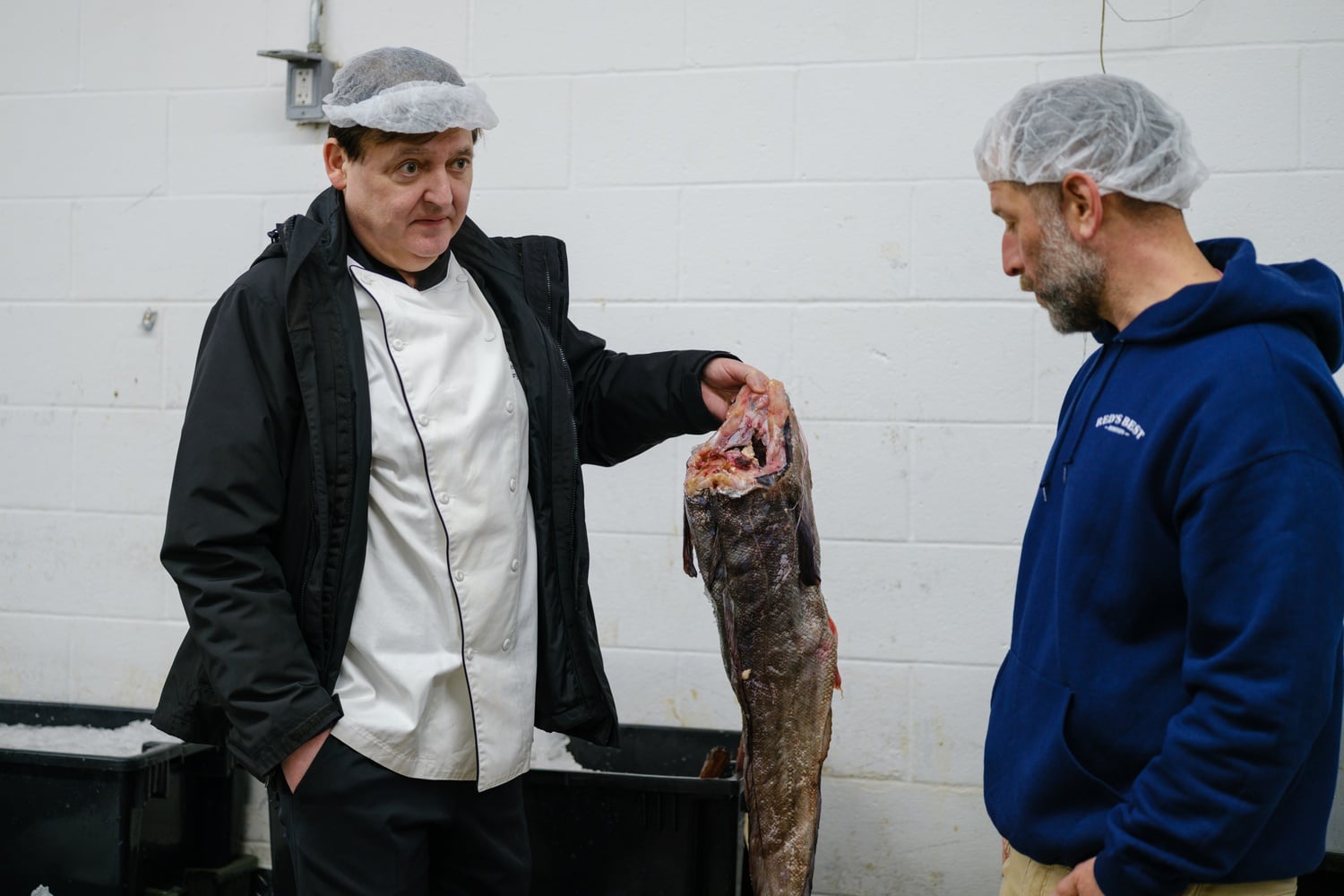
Inside the processing half of the plant, silver machines glean and hum. The breeze of the harbor is replaced by the sound of air conditioning. Fish, ready to be descaled, run along the conveyor belt, a metal river that meanders around the room, each bend marking out a different station.
After being descaled, the fish pass through a hopper that keeps them moving through the system. On an upper line of the plant, eight workers fillet the newly descaled fish. The fillets are returned to the top conveyor, whilst the excess fish trimmings, heads and bones are separated to be sold to lobstermen as bait.
The fillets are then washed and brought down to another set of workers, who pour over the fish at a candling table. Illuminated by a yellow ochre lamp, the fillets are scrutinized for any imperfections before being sent for packing.
For customers like Harvard, the fish is amassed into wholesale cases and picked up on a Wednesday morning by Sysco trucks and delivered to the houses.
The delivery is then portioned out in the houses and prepared for Wednesday dinner, and frozen for Friday’s lunch.
‘A Great Relationship’
Chef Martin T. Breslin, director for culinary operations at Harvard’s dining services, met Auerbach while looking for new suppliers of local shrimp.
Breslin is described by both friends and himself as a “good Irishman” who loves seafood. His side-swept, angular fringe is speckled bronze and silver, and dressed in his whites — a double-breasted, black buttoned chef’s uniform made from heavy cotton — he smiles and gestures excitedly as he recounts how the Fresh Catch program began.
“I wanted to buy local, sustainable shrimp — not coming from the Gulf of Mexico, but coming from here,” Breslin says.
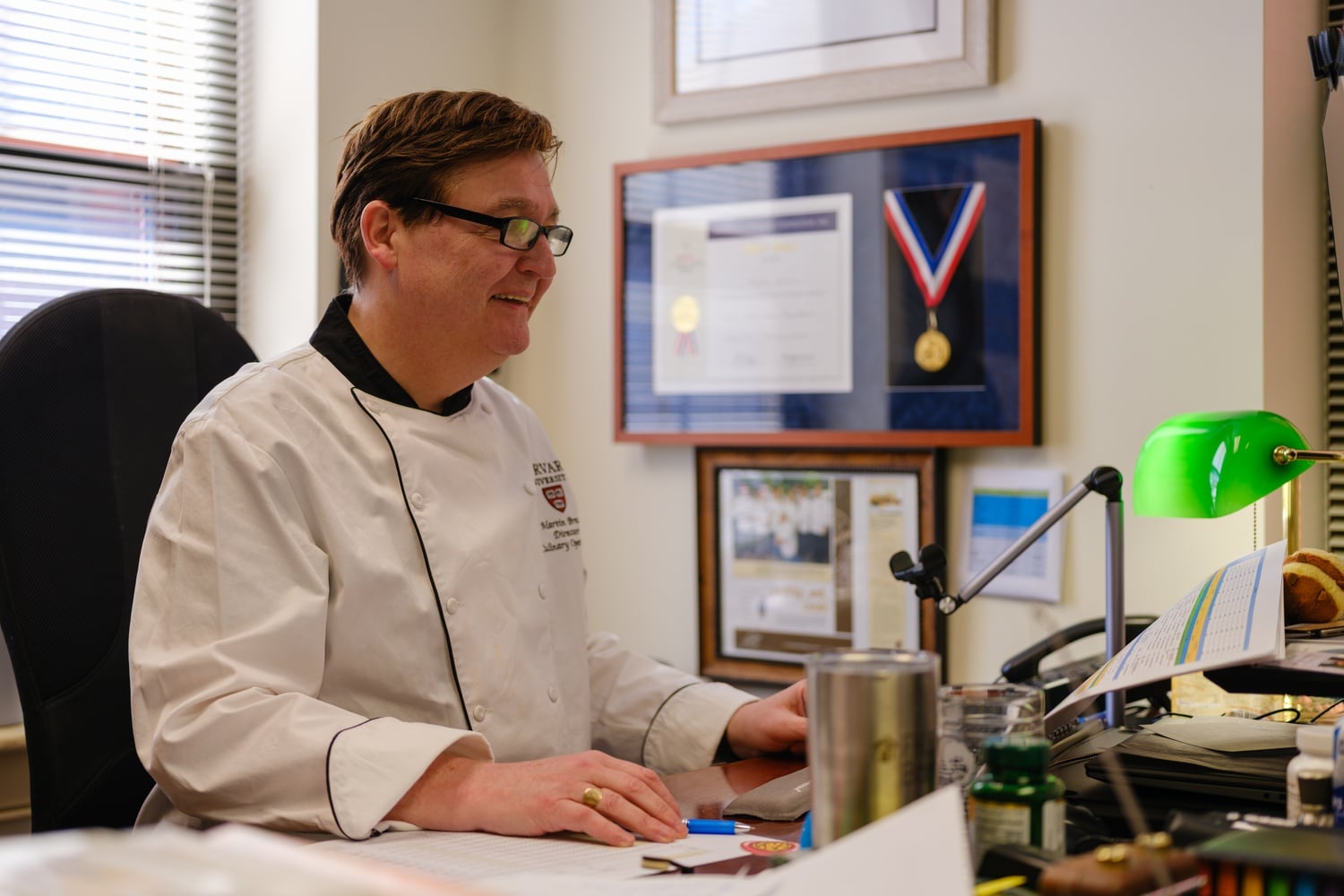
While talking about sustainable shrimp sourcing, Auerbach and Breslin begin discussing if Harvard would also buy fish as part of the University’s efforts to source locally.
“Traditionally, chefs write menus, and they will write what fish they want on the menu, and that dictates the demand,” Breslin explains.
The partnership with Red’s Best flips that process. Breslin decides what to cook based on the week’s catch, using ingredients already available in the dining hall kitchens and eliminating the need to order additional ingredients.
“The chefs don’t know the species until I tell them on a Wednesday morning,” Breslin says. “I tell them what the species are and what recipe to use on a Wednesday morning.”
Not every fish works in the same recipe, Breslin says. On Fridays, the team serves fish and chips from a type of white fish — haddock or maybe hake — in a light Irish-inspired batter.
“That’s our own recipe,” Breslin says. “I’m originally from Ireland, and it is very authentic, how we do our fried fish on Friday.”
For Breslin, buying fresh fish and cooking a meal according to the catch of the day reminds him of his childhood.
Growing up, his mother Trish would head down to the boats at the small, bustling fish port of Howth Harbour, northeast of Dublin’s city center, to check out the local catch every Friday.
She would buy whatever fish was available and cook dinner for her six children. “It was eight different fish every Friday, throughout my entire childhood, growing up as a teenager, the same until I left home,” Breslin says.
That approach would later inspire the Fresh Catch program.
“My mother would go to the boats and she would pick what they got. Why can’t we do that here?” he adds, raising his eyebrows. “And that’s how that started.”
Breslin visits Red’s Best every few months and maintains a close relationship with Auerbach and Lionette. They frequently communicate over the course of a week, providing updates on the catch of the day or discussing adding a new species of fish to the roster. They’ve also cultivated a close friendship.
“Jamey said to me, he talks to me more than his wife sometimes,” Breslin says in a cheeky whisper. “So, we’re constantly talking.”
The mission alignment between Lionette, Auerbach, and Breslin — and between Harvard and Red’s Best — creates a great relationship, Lionette adds.
‘We Started With Harvard’
Since piloting the model with HUDS in 2015, Red’s Best has expanded the fixed-price catch-of-the-day model to other educational institutions across the region.
Today, the company uses the same system with public school systems in Cambridge and Providence, hospital cafeterias, and other universities across New England, including the University of Connecticut and Brown University.
“Once we realized it worked and that there’s plenty of fish, that’s when we hit the road, basically started pitching it to other universities, and then got to private schools, and then realized, well, there’s no reason we can’t do public schools,” Lionette, who led the program expansion at Red’s says.
The shift to institutional dining has helped provide more security for the fishermen operating day boats, who now know they will receive a reliable price for their catch.
Lionette says the model has also allowed Red’s Best to introduce less common species to school menus, particularly fish that are seasonally abundant but less familiar to consumers.
Breslin says that he is proud that the program allows Harvard to support local fishermen while bringing fresh produce to dining halls.
“When you’re looking at our local seafood here in New England, it is some of the best seafood on the planet,” Breslin says.“It’s amazing. It could be on your plate in 48 hours at Harvard.”
—Staff writer Thamini Vijeyasingam can be reached at [email protected]. Follow her on X @vijeyasingam
Want to keep up with breaking news? Subscribe to our email newsletter
Have a tip for The Crimson? Share it confidentially