Organic Waste, Medical Device Start-Ups Win $75,000 at HBS New Venture Competition
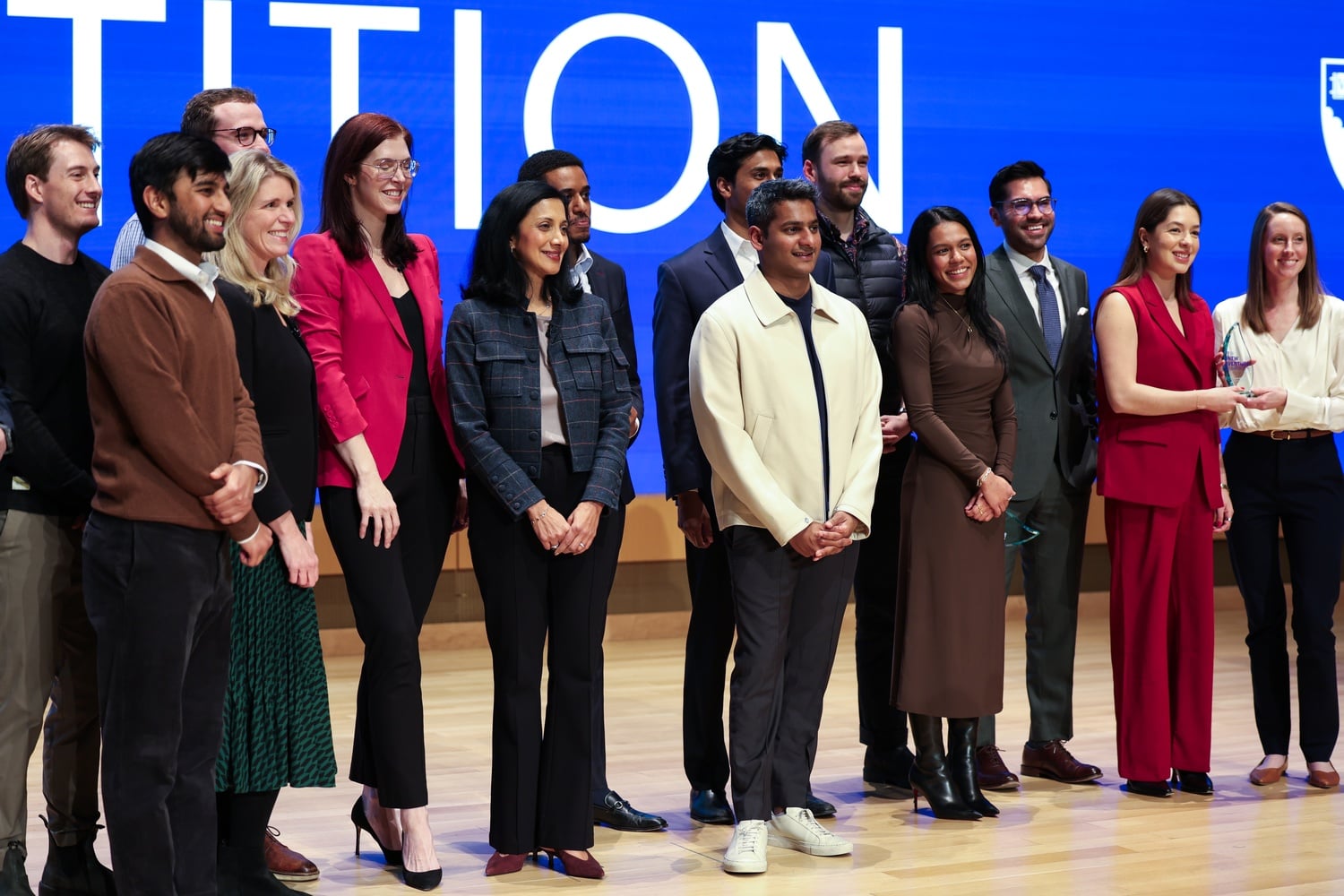
An organic waste start-up and a medical device company each won $75,000 at the finale of the 30th annual Harvard Business School New Venture Competition on Thursday.
Revolv, an agricultural technology venture that converts organic waste into animal feed and fertilizer, took the top prize in the Social Enterprise Track. Serosafe Surgical, a clinical-stage medical device start-up developing alternatives to post-operative surgical drains, won the Rock Business Track.
Eight finalist teams delivered 90-second pitches at the event, hosted by HBS’s Arthur Rock Center for Entrepreneurship and Social Enterprise Initiative. The competition was divided into the two tracks — Social Enterprise and Rock Business — with $75,000 awarded to each winner, $25,000 to each runner-up, and $5,000 prizes for crowd favorites.
Revolv was founded by Biruh Demilew and Delila Kidanu. In his pitch, Demilew said the company’s model could reshape food systems in developing economies by converting organic waste into affordable agricultural inputs.
“Our network facilities will be able to supply millions of farmers with affordable inputs, create thousands of jobs, carve methane emissions from organic waste, and, more importantly, make nutritious food affordable to millions of people,” he said.
Serosafe Surgical was founded by Goutam Gadiraju, an MD/MBA candidate at Harvard Medical School and HBS. Gadiraju said his clinical experience — and published research at Brigham and Women’s Hospital on the pain and quality-of-life impacts of surgical drains — led him to launch the company.
“We really laser focused on figuring out what problem we needed to solve,” Gadiraju said in an interview after his win. “We really understood that this was a problem that needed to be fixed.”
Get The Crimson in your inbox.
The eight finalists were selected from a broader pool of semifinalists who spent weeks receiving feedback from entrepreneurs, investors, and philanthropists before the finale.
Thara N. Pillai, director of the Arthur Rock Center for Entrepreneurship, said the competition offers value beyond the awards.
“Every team walked away with nearly twenty pieces of actionable insights, and new connections to help move them forward,” Pillai said.
The New Venture Competition has served as a launchpad for start-ups over the past three decades. Last year’s Social Enterprise winner was Lexi — an AI-powered medical interpretation platform. Siddharth UR, a member of the Lexi team, said that the competition helped accelerate the venture’s growth.
“It’s not all exaggeration to say that so much of our momentum was catalyzed right here one year ago in this room,” UR said.
Demilew closed the evening by expressing gratitude to the project’s supporters with a forward-looking message.
“Thank you everyone who showed up here,” he said. “The journey begins.”
—Staff writer Katharine E. Chavez can be reached at [email protected]. Follow her on X @KatharineEC7.
Want to keep up with breaking news? Subscribe to our email newsletter
Have a tip for The Crimson? Share it confidentially