Framing the Past: Allison Jackson Talks Frame Conservation
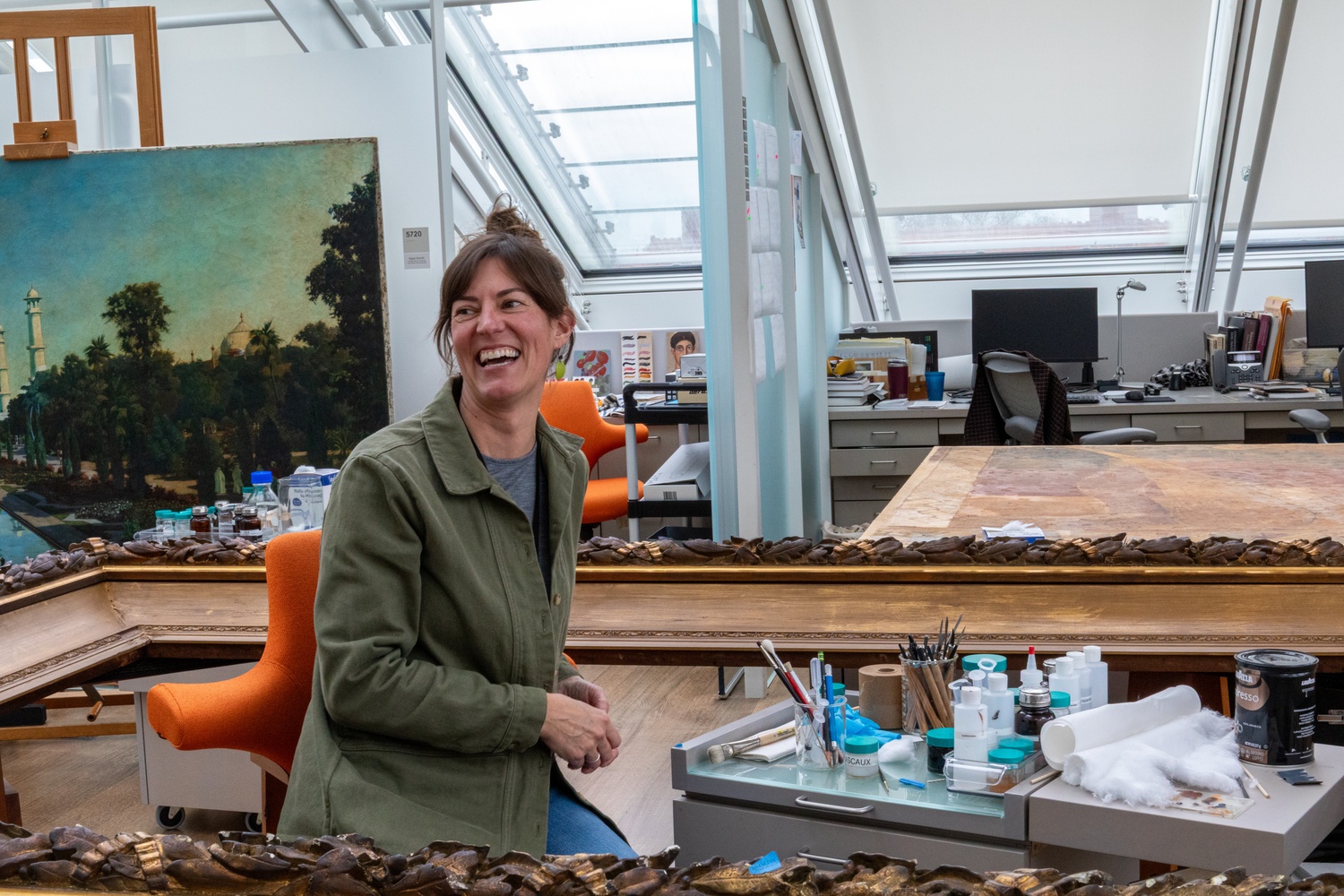
p on the fifth floor of the Harvard Art Museums, sunlight pours into a glass-walled conservation lab, where restoration is quietly underway. Frames and paintings lie across the workspace in various stages of repair, each requiring a different method of preservation and reconstruction. Moving carefully among them is Allison K. Jackson, an associate frame conservator at the Harvard Art Museums.
While a visitor might spend minutes analyzing a painting, the frame rarely commands the same attention. Jackson’s life work, however, suggests we should look again.
“Frames themselves were not always considered works of art in their own right,” Jackson says. “It feels pioneering to consider the frames as works of art themselves, about sharing the impact of frames on an artwork, and making sure they are treated as such.”
Her view reflects a broader shift in the field. To conservators, frames are more than accessories; they are artworks that reflect the stylistic tendencies of a particular time and place. For more than the past 20 years, Jackson has treated each project as a chance to highlight these important factors. Her connection to the craft, however, began long before she ever stepped in a museum or a lab.
“I’m a second generation frame conservator,” she says. “My mom was a frame conservator, so I always knew about the field and have been exposed to frames my entire life.”
Growing up in the small town of Harvard, Massachusetts, Jackson was shaped by two early influences. Her mother ran a frame conservation studio just outside their home, while her father owned a hardwood flooring business. She recalls spending long hours watching them work.
But Jackson did not initially plan to follow in her mother’s footsteps. Instead, she pursued furniture conservation. After graduating from the University of Vermont, she worked with small, private furniture conservators across New England, learning restoration techniques. Eager to leave her home, she found a conservation contact in Hawaii through the American Institute of Conservation.
When that opportunity fell through, Jackson took a job at a woodshop in Hawaii instead. There, she learned to build and design furniture, shifting her focus from preservation to creation.
It was only after she returned to Massachusetts and began to help out with projects in the Museum of Fine Arts in Boston that she began to seriously consider frame conservation as a career.
“When I saw the frame lab there, that’s when I kind of really realized that that’s what I wanted to do,” says Jackson.
Jackson joined the Harvard Art Museum’s conservation lab in 2012. Now, she works in frame conservation and art education at the museum, while also running an independent practice, restoring frames for private collectors and museums.
While no two days as an art frame conservator unfold the same way, Jackson’s work usually follows the same general process. When she first receives a frame, she begins with a careful assessment, detailed photography, and written documentation of its condition, assessing any damages.
“My job is a damaged frame, so I see them a lot,” says Jackson. “A lot of times it’s like the hardware on the back has failed and it’s fallen off the wall, or someone drilled a hole putting in hardware on and the screws came through the front of the frame.”
Most of the damage she sees on Harvard Art Museum frames consists of missing decorative embellishments, flaking gilded or painted surfaces, and other structural imperfections. Many frames will have multiple defects. For instance, Jackson is currently restoring a massive frame for the “The Taj Mahal, Sunlit” by James Rogers Rich. The frame was acquired in poor condition: missing ornaments, tarnished original gilding, and deteriorated layers of gesso.
After her initial assessment, Jackson writes a condition report and treatment proposal, outlining the best course of action. Her goal is to always reproduce the frame as faithfully as possible while making changes that can be reversed in future restorations.
“We’re really trying not to interfere with the original,” Jackon says.
If the frame’s damage is so severe that a typical restoration cannot salvage it, or a canvas is missing a frame entirely, then Jackson creates a historical reproduction from scratch.
Such is the case for “La Rose de l’Infante (Effie Stillman)” by Ford Madox Brown. The painting, produced during the Victorian era, originally had a frame designed by the artist himself. After the original was discarded and replaced with an unsuitable one, Jackson worked with a framemaker and woodcarver to recreate a design faithful to Brown’s vision.
After it is constructed, the frame needs to be gilded, a practice that Jackson specializes in. Gilding is the process of applying ultra-thin layers of gold to a wooden surface. In frame restoration, she typically works with two historical techniques that each produce a distinct finish.
Water gilding creates a luminous, almost mirror-like sheen. The process involves layering bole, a clay-like base, beneath the gold leaf, then brushing the surface with water to bring out its shine. Oil gilding, in contrast, results in a softer, matte finish, using a slow-drying adhesive to bind the gold to the surface.
The material itself is extraordinarily delicate. Each sheet of gold leaf is so thin it can tear at the slightest touch, requiring specialized tools — often made of squirrel hair brushes — to lift and place it.
For Jackson, gilding also carries a personal resonance: it’s work she first encountered in childhood, watching her mother in the studio.
“When I was a kid, going out to my mom’s studio, she would put a piece of gold on her cheek or something before we went to a school dance,” says Jackson.
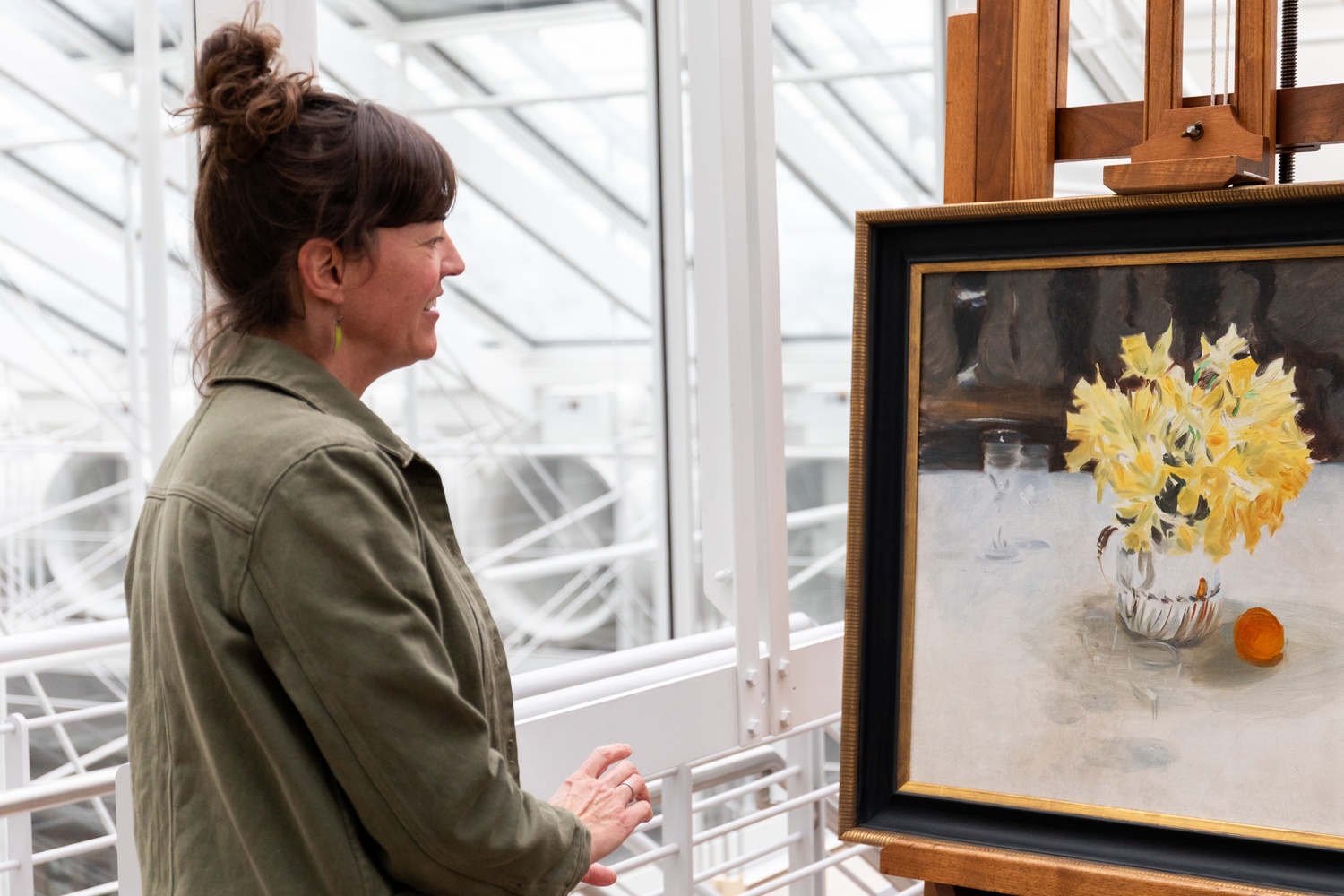
When a frame is complete, it returns to review — paired once again with its artwork in a museum exhibit or private collection. Some frames are not as large as “The Taj Mahal, Sunlit” or intricate as “La Rose de l’Infante” — they simply require a frame accurate to their history. Such is the case with the last frame that Jackson is working on, called “Daffodils in a Vase” by John Singer Sargent.
A rolled-up artwork that sustained a lot of damage, the piece desperately needed a frame. Instead of creating a frame from scratch, Jackson decided to reuse one from another piece.
“The frame was on a Toulouse-Lautrec drawing,” Jackson says. “Having done research on Sargent frames in the past, when I saw this, it immediately made me think of daffodils, and perhaps it could be reused.”
With a few simple alterations, such as cutting the frame down and adding a fresh coat of black paint, the artwork was ready to be added back into the collection. Ultimately, Jackson’s goal is not to make frames flashy or attention-grabbing. Instead, they should situate the artwork in its proper historical context.
“I think a lot of conservation work in general is unseen, and so if you do a good job, the frame is not calling attention — they should be complimentary.”
Most people will never notice the frame and all that it carries. But for Jackson, that invisibility is part of the job.
—Magazine writer Valerie I. Ogboi can be reached at [email protected]
Want to keep up with breaking news? Subscribe to our email newsletter
Have a tip for The Crimson? Share it confidentially