What’s at the Heart of Central Square?
Though Central Square can be described as being in constant motion due to economic shifts and new residential waves, the Square has managed to celebrate, remember, and preserve elements of its past.
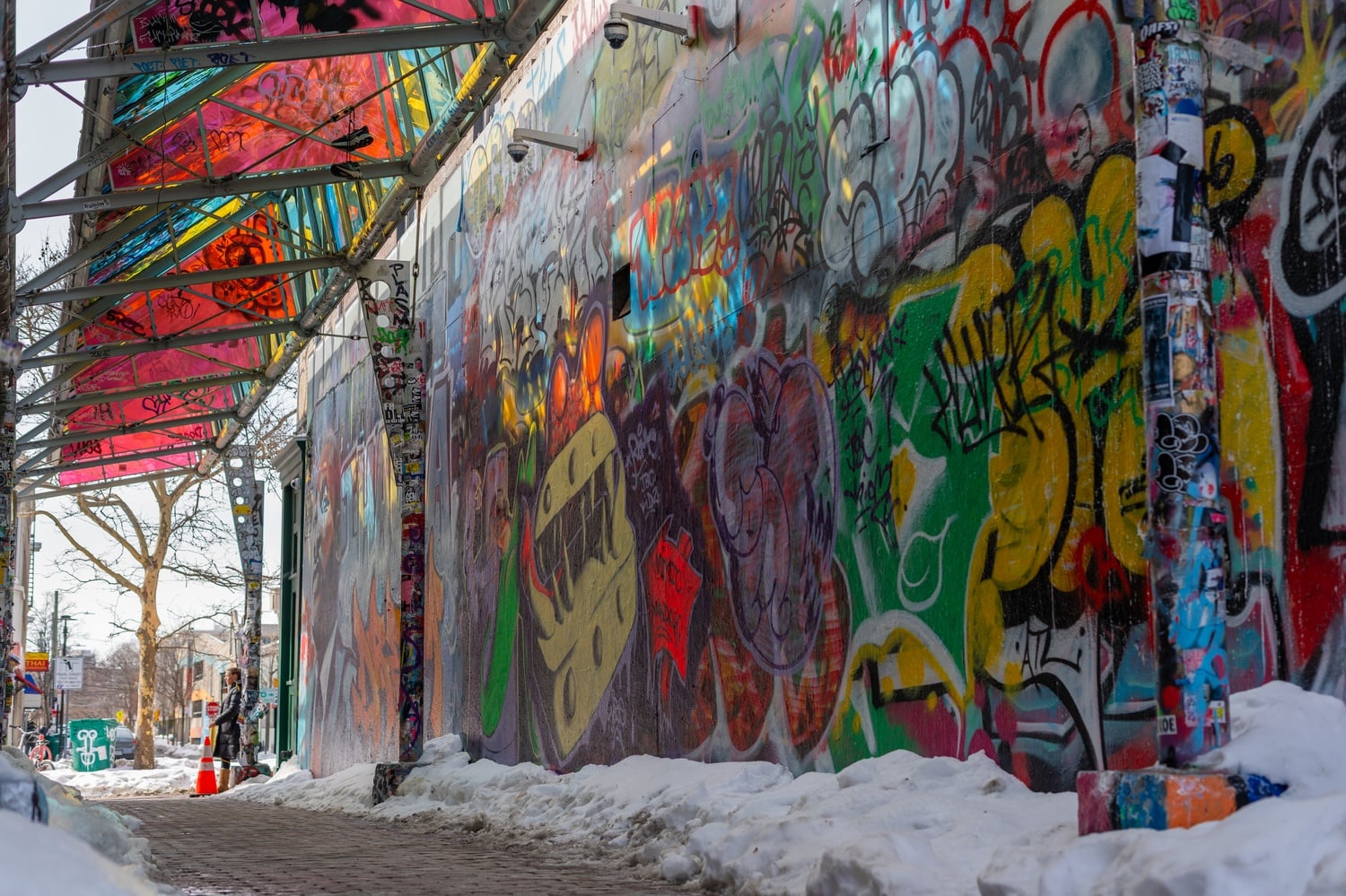
block past the T station in Central Square, beside Brick & Mortar, a narrow brick alley doubles as a living canvas. Layers of spray paint pile up like urban sediment, covering the work of rookie teenagers, professional artists, and first-time painters. Come back a week later, and whatever you saw before is gone.
“It changes literally by the hour, so this poster will be gone by tomorrow,” says Rus Gant, watching an artist next to him cover the wall with yet another layer of spray paint. Gant,a multi-technology artist, has spent decades documenting the Square.
Graffiti Alley came to life as a breathing mural about ten years ago, when the owners of Brick & Mortar invited dozens of artists to paint the alley to help draw attention to the restaurant. The idea stuck. Ever since, the walls have never stopped moving.
That constant reinvention mirrors Central Square itself.
Once a shopping hub for candy factory workers, the Square now caters to software engineers and researchers spilling out of Harvard and Kendall Square. But the heart of Central Square is still alive.
After the inauguration of the Central Square subway station in the spring of 1912, Central Square became a hub for movement.
William A. Bancroft, Class of 1878, who attended the inaugural party for this subway, located in the Board of Trade Building in Central Square, celebrated this feat.
“Fifty-six years ago today and for nearly a week later the only public transportation to and between Cambridge and Boston was the omnibus,” he said, according to the Boston Herald.
“The facilities have since then steadily improved until today there has been built within the territory of Cambridge the finest subway in the world,” Bancroft added.
At the time , Massachusetts Avenue was paved with brick, a streetcar running down its center. The new station accelerated foot traffic — and commerce.
By the 1940s and 50s, shoppers crowded Mass Ave. department stores like Corcoran’s , Harvard Bazaar, and Enterprise. But by the 1960s, a different kind of resident began to reshape the Square.
Filmmaker Liane Brandon arrived in 1966 after years of transient work. Taking night classes at Boston University while teaching in Boston Public Schools, she was ready to settle. But Brandon says she didn’t search for an apartment — Douglass Street found her.
She quickly fell in love with her five story walk-up on Douglass, an offshoot street from Massachusetts Avenue in the middle of Central Square. — found her. Despite the fact that the building had no central heat and exposed brick walls, she found it both cheap and “quite attractive.”
From the window of this apartment, Brandon witnessed her neighborhood change around her. When she first moved in, she says the district was working-class and family oriented. Her window view in 1969 was lined with a local pub, a tailor, and a few mom-and-pop shops.
Meanwhile, because rent prices remained accessible, the neighborhood became home to a booming countercultural movement.
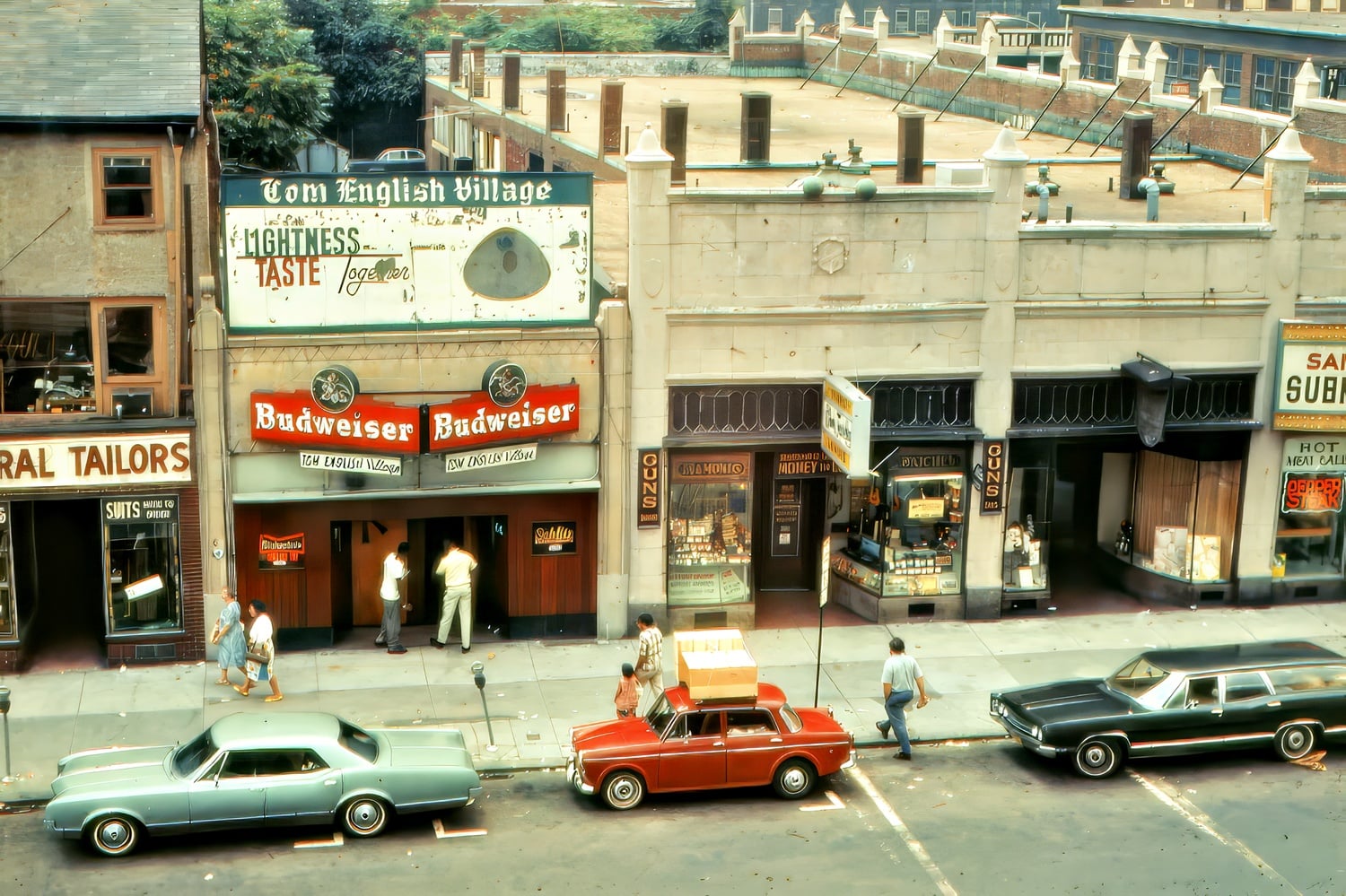
Just across the intersection on Brookline Street, “Old Mole” — a countercultural newspaper, fueled by a strong student movement— printed its coverage of local news alongside anti-war and pro-civil rights messages. On Massachusetts Avenue, the countercultural studio Newsreel played independent films. “There was no social media or internet or YouTube. So, word of mouth, newspapers, and independent films were the way to get the word out about the anti-war movement, because it certainly wasn’t being picked up by television,” Brandon says.
As criticism mounted over the U.S.’s involvement in Vietnam, Central Square functioned as “action central” for the anti-war movement. All within a mile radius, activists spread a revolutionary consciousness right from Central Square. From her kitchen, Brandon planned demonstrations and marches with the feminist collective Bread and Roses. Beside her, her significant other at the time led anti-draft efforts.
But their movement — and Brandon’s idyllic window overlooking Douglass Street — were interrupted by a new wave of realtors and developers. A bank bought up much of the Street and began demolishing homes and establishments.
Upon learning that her building was going to be torn down, Brandon organized with her neighbors to put up a “valiant fight.” They tried to have the building declared a historic structure to prevent the demolition, but their efforts were unsuccessful. Many local families were displaced, or felt prompted to leave due to their changing neighborhood landscape.
Brandon left Central Square permanently soon after. Douglass had lost its countercultural appeal. And without the street she remembers, “there was no reason for me to go back,” she says.
Little remains of this past life today. Turning right onto Douglass Street from Mass Ave, pedestrians are now greeted with a brightly-lit McDonald’s, open 17 hours per day.
“Everytime I drive on Mass Ave and go past that McDonald’s, it makes me so sad,” Brandon says.
Her story reflects a series of large economic shifts that would come to reshape the character of the beloved neighborhood. In 1946, Central Square was surrounded by 66 confectioneries, whose factory workers shopped in the Square.
But the rise of large, national confectionary companies like Hershey’s and Nestle began to erode their local customer base. Over time, most of these factories closed, leaving behind land that was later occupied by biotech companies. The candy workers who once shopped in Central Square were also displaced.
“The big corporations came in,” Gant says, “and then the property became more valuable.”
“Even a candy company couldn’t compete with big companies,” he adds.
These changes did not just worry Brandon, they were on the minds of many who frequented Central Square and called it home.
In 1980, Central Square was designated as a Commercial Area Revitalization District to address the economic decline of the neighborhood as suburbanization moved families from Camrbidge to surrounding suburbs. Through CARD status, Central Square gained access to tax-exempt financing and other financial benefits to promote economic growth plans, which were written with the feedback of local residents and business owners.
In a Nov. 1987 report titled “Central Square Action Plan,” the City of Cambridge laid out further goals for the revitalization of Central Square. The City aimed to promote development that would be “economically viable and respectful of the Square’s present unique retail environment.”
The outline included a pledge to “preserve the Square’s cultural diversity,” to create a “people-oriented space,” and to encourage the development of retail establishments that “cater to the people of diverse economic and social groups who live in the surrounding neighborhood.”
But despite residents’ dedication to the heart of Central Square, preservation is easier to plan than carry out.
“That’s the change — the pharmaceutical guys coming in and the MIT people who could afford to go to dinner for 40 or 50 dollars,” says Gant.
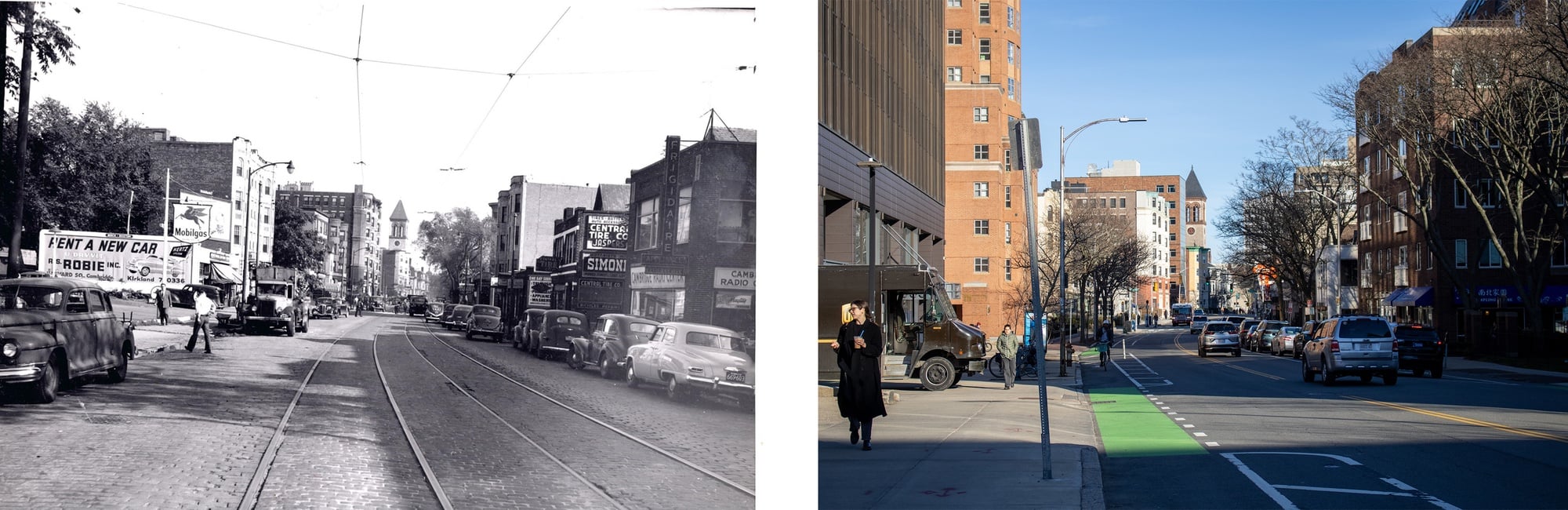
This new influx of people, particularly pharmaceutical employees instead of blue-collar workers, has influenced Central and its businesses, according to Gant. Longtime businesses have had to evolve to keep afloat in a new era of demands. Teddy Shoes, which sold affordable footwear in the 1940s, shifted its focus in the 1990s. Today, by selling dance shoes for the nearby dance studio, it has managed to stay right where it was 85 years ago.
Meanwhile, local staples like Hi-Fi Pizza, Harvard Donut, and Candy Mart, have been replaced with high-end restaurants and fast-casual chains.
But even as the clientele of Central Square’s restaurants changed, the cultural spirit that Brandon remembers was not so easily erased. Decades-old businesses have managed to hold onto their leases, continuing to serve as gathering spots for Cambridge residents who have seen the Square’s various phases.
In fact, the cyclical interests of popular culture have renewed obsession with familiar favorites. The Middle East, a complex of music and entertainment venues, has inhabited the square since the 1960s. Every Friday and Saturday night, crowds of young people still line up along Brookline Street, waiting to get into Sonia for a cocktail and live music. Cheapo Records has gone full circle, returning to the vinyl it sold in the 1940s now that the format has regained popularity among young people.
Other longstanding businesses now attract far more people than when they first opened. Brookline Lunch — a tiny café that has been in the square since the 1940s and seats barely twenty — has become a Gen Z favorite.
Just as they were in ’69 and ’87, those living in and around the Square are invested in maintaining Central Square’s distinctive aura. In 2019, local property owners petitioned the state for Central Square to be declared a Business Improvement District. With this designation, a team of residents has commissioned murals to attract foot traffic and turn the district into a hub of experiences.
Just last year, Found Market, a series of markets of vintage clothing and accessories, chose to host their open-air markets University Park, which is nestled within the Square. Found itself also has two stores located in the neighborhood.
Sam Clovers, one of the co-creators of Found, said that the allure of Central Square was its public transportation, surrounding businesses, and the people. “Central Square is always our favorite,” Clovers said. “It is close to public transportation. So many incredible restaurants, cafes, bars, you know, there’s so much good stuff.”
“It’s just just a vibe,” Clovers added.
As Central Square continues to channel and revitalize its old character, the layers of history — the brick of Massachusetts Ave., the confectioner storefronts, the antiwar newspapers once spread through from apartment to apartment — have not been completely removed.
They are part of the Square’s ongoing story, just as every artwork on the walls of Graffiti Alley becomes incorporated into the paintings that cover it.
— Magazine writer Diego García Moreno can be reached at [email protected].
— Magazine writer Victoria D. Rengel can be reached at [email protected]. Follow her on X @VictoriaRengel_.
Want to keep up with breaking news? Subscribe to our email newsletter
Have a tip for The Crimson? Share it confidentially