Lowell House Opera ‘No Exit’ Review: There’s ‘No Exit’ From This Sound Machine
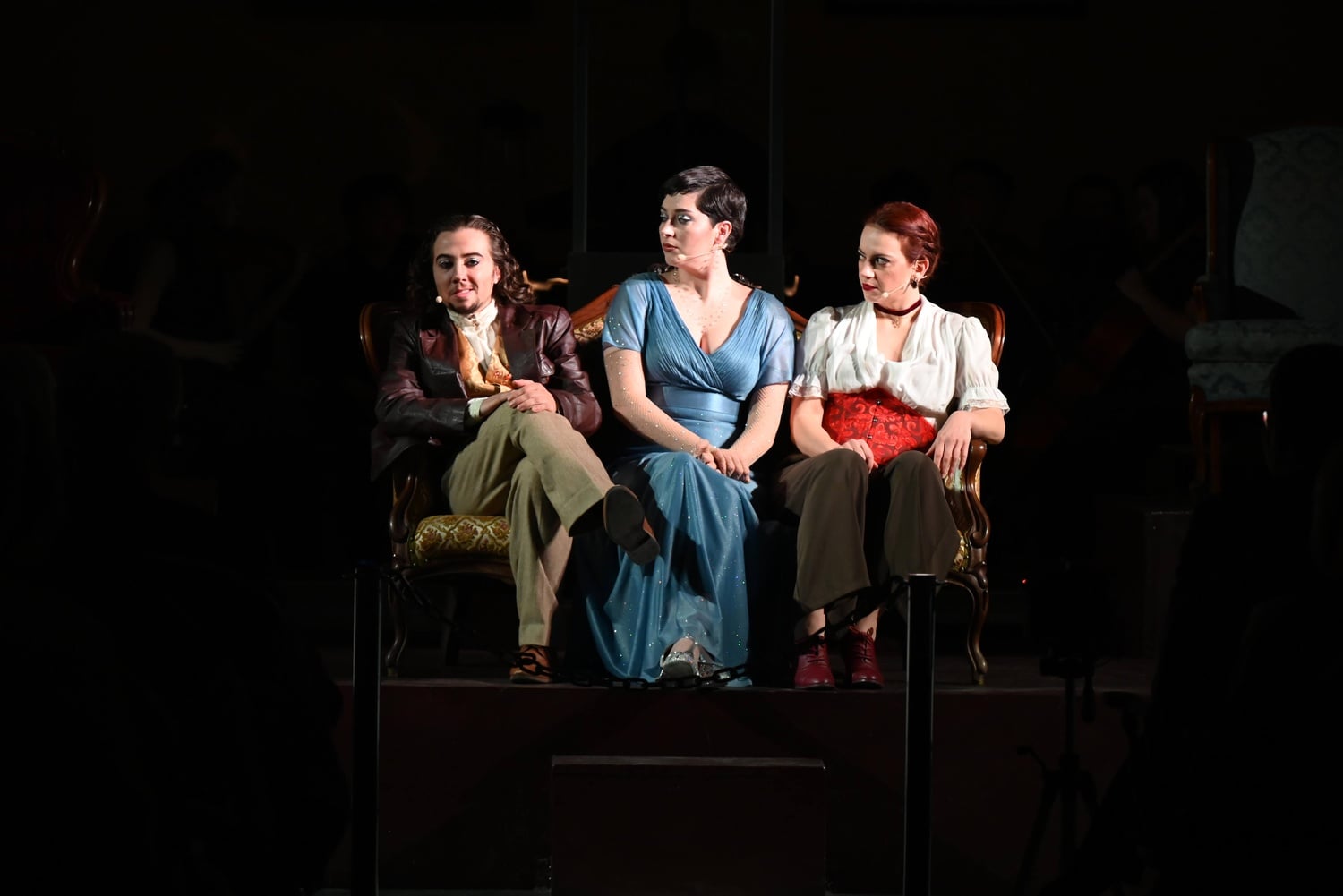
From March 27 to March 29, Lowell House Opera held performances of its 80th production, “No Exit.” While previous operas have included staple works such as Verdi’s “La Traviata” and Mozart’s “The Magic Flute,” for this year’s performance, LHO commissioned a work from Ethan A. Chaves ’26, a senior at Harvard College double concentrating in Philosophy and Music and pursuing a degree in composition at the New England Conservatory through the dual degree program. Chaves’ opera “No Exit” was adapted from a 1944 play of the same name by 20th-century French writer and philosopher Jean-Paul Sartre, a seminal work of existentialist commentary. In both the play and opera, three characters — Garcin (Leo Balkovetz), Inez (Arianna N. Paz ’19), and Estelle (Chen Wine) — spend time in the initially innocuous “Hell” of each others’ company before concluding with the line: “Hell is Other People.”
Chaves was inspired to write the opera after watching a production of Sartre’s play in Vienna, Austria, where its oppressive atmosphere seemed to call for a musical setting.
Musically, Chaves and conductor Reuben Stern ’20 placed a finger on the pulse of auditory comfort and pushed hard. An orchestration of whining ascents and descents, punctuated by crackling string and keyboard pointillism created something akin to musical inertia.
The show, directed by stage director Haley M. Stark ’25 — was entirely different to how one would imagine that of watching the play: Instead of merely observing the characters’ hellish descent, the audience was pushed in alongside them by the overture’s stunning motifs evocative of a plummeting elevator.
Chaves’ genre-mixing only furthered this melange of chaos. Chaves leaned into elements of jazz, characterized by a walking bass and slinking saxophone, and simultaneously rock ’n roll, necessitating the use of a stereo system and microphones for the singers. Whilst microphones and speakers are atypical for the opera genre, these elements provided the production the freedom to deviate from the traditional, playing with audio distortion and creating an all-encompassing surround-sound effect. In one instance, the end of Garcin’s which one adopted a metal sound, mirroring the narrative exposure of his moral depravity as he explained his damnation.
Throughout the opera, even in the more bare recitative sections, the orchestra crawled across anxiety-ridden chromatic phrases that served as a constant reminder of something rotten beneath the characters’ elaborate tales and attempted self-justification. As the production progressed, the structures of language and music literally broke down. The orchestra’s aural torture bled into the vocal music, as singers increasingly used vocal fry and microtones. By morphing into an extension of the auditory torture chamber, the characters truly became each others’ hell.
The three principal characters were differentiated through music, color, and physical space. Garcin — a deserter — was initially accompanied by a military orchestration, the sultry Estelle sang alongside throaty violins atop a bed of unearthly electronics, and Inez — whose mezzo range was sometimes lost amidst the instrumentation — had vocal parts as rhythmically cutting and harsh as her perennial glare.
The characters were also defined by their assigned primary colors through Lighting by Fritz Bosch made possible the definition of the characters through assigned primary colors: diluted yellow for a cowardly Garcin, red for a furiously knife-wielding Inez, and blue for Estelle, whose stratospheric performance in one specific solo section was visually accompanied by trickling water projected on a background screen. The effect was reminiscent of a sinister siren song, further aided by the fact that her — and others’ — eyelids were somewhat unidiomatically but nonetheless hauntingly painted to resemble eyes always open.
While the characters’ emphasized distinctions occasionally verged on the caricaturesque, they made the characters’ eventual convergence more successful. By the end of the opera, the vastly different lighting created a satisfying contrast to the indistinguishable timbres of Garcin and Inez’s voices.
Despite the concept of hell as “other people” being reliant on an uncomfortable physical proximity, the opera’s staging — primarily three armchairs on their own islands and a central love seat — was not conducive to this sort of intimacy. The characters were physically forced together, not by the set but instead by a form of auditory torture which forbade them from sitting in isolated silence and pushed them to interact on the central ochre love seat. The sound — serving metaphorically as a torture mechanism — faded in and out of a Area 51-esque electrical static, and the use of a wind machine sounded akin to icy whistling through teeth.
While the play and opera are meant to be set between the 1930s and 1940s, the contrast of the production’s glitzy set design by Tori A. Kauffman ’26 and dystopic sound design more closely portrayed the strikingly stark relationship between the glamorous 1950s and a dystopian McCarthyist terror. Though perhaps inadvertent, this shift in timeline evoked a cultural and political anxiety that holds more contemporary parallels than a broad-stroke post-war existentialism.
There may have been no exit from LHO’s newest production, but the opera’s commitment to fully immersing its audience made the show captivating in spite of its limited thematic variety. From the impeccable musical direction to the small but technically astounding orchestra playing a demanding score, Chaves’ opus and the production as a whole is deserving of acclaim.
“No Exit” ran at Lowell House from March 27 to March 29.
Want to keep up with breaking news? Subscribe to our email newsletter
Have a tip for The Crimson? Share it confidentially