From SXSW: ‘Wishful Thinking’ is a Monumental Debut
Dir. Graham Parkes — 4.5 Stars
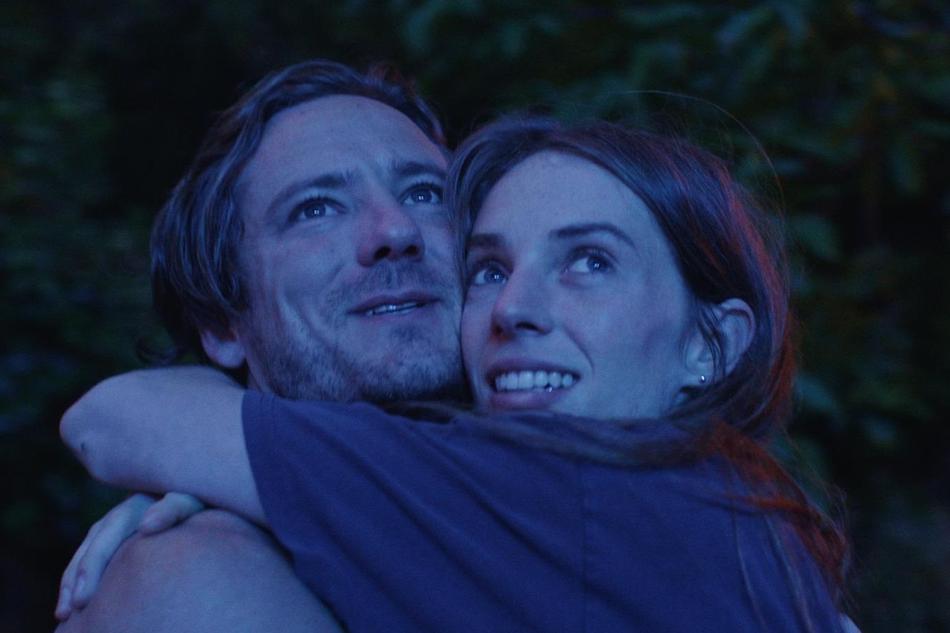
With “Wishful Thinking,” first-time feature film director Graham Parkes breathes new life — and science fiction — into the romantic comedy.
Winner of SXSW’s Narrative Feature competition, the film follows an Oregon-based couple — Julia (Maya Hawke) and Charlie (Lewis Pullman) — and their loving but extremely volatile relationship. One second, they are in effortless bliss; the next, they erupt into explosive, emotionally charged fights over the smallest of things. Parkes captures this instability within the first few minutes of the film, immediately pulling us into their realistic, lived-in dynamic.
Much of the pair’s tension stems from career anxieties and diverging wants. Julia is an ambitious video game designer, while Charlie is a struggling musician stuck in a recording studio job he hates just to make ends meet. Desperate to fix their issues, the pair attend a seminar hosted by twin karmic influencers, the Tillies (both played by Kate Berlant).
At the seminar, they are prompted to recount what first attracted them to each other. The scene is presented in a unique split-screen format, intercut with flashbacks of the couple’s meet-cute. By the end, the two are in near-perfect, almost enchanted synchrony, at which point the film’s mythical energy begins to take hold.
Later, when Julia finds out that one of her manifestations works, she and Charlie quickly realize that their relationship has unexpected impacts on the rest of the world. When they’re good, the stock market flourishes, their houseplant is green and lively, and Charlie’s band goes viral. The pair take advantage of these karmic aftershocks, testing their theory in hilarious ways.
When they’re bad, however, things crash down again. At the film’s core is the concept of one’s own problems feeling enormous and omnipresent. Even when Julia and Charlie are passionately in love, there’s this underlying, irreconcilable tension of the two’s life goals being incompatible — Charlie wants to get married and have children, while Julia is focused on her career.
“Wishful Thinking” is completely anchored by Hawke’s and Pullman’s flawless performances. Their chemistry is viscerally natural, ensuring that the characters of Julia and Charlie never feel hateful. Instead, they feel like two people who perhaps love each other too much. When the two of them want to escape an argument, they put on the Thompson Twins’ 1983 hit “Hold Me Now” and “sexy dance.” It’s a playful, but bittersweet recurrence throughout the film.
These frequent pop culture references are a treat. At one point, the fighting Julia and Charlie are referred to as “Marriage Story,” a reference to the 2019 feature film; Jon Hamm makes a cameo, visiting Charlie’s studio to record a voiceover, and his presence becomes a funny plot point throughout; Influencer Jake Shane is also hilarious as an awkward coworker obsessed with Julia.
On all fronts, “Wishful Thinking” is stunningly well-made. The split-screen effect is utilized several times, demonstrating the dual perspectives of its two main characters as well as Parkes’ commitment to giving both sides equal footing. Set design also plays a major role, as the state of the couple’s house becomes a visual barometer for their relationship’s health. The ending is handled masterfully, closing with a beautiful scene of the two on the beach, filmed in one take and employing the split screen one last time.
Few people can say they wrote their debut feature while crashing in their lead actor’s house, but this closeness and intimacy shines through. Parkes’ screenplay, based on personal experiences, is packed with both humor and emotion. Amid a festival full of action and horror films, “Wishful Thinking” proved that a character-driven romance can be just as, if not far more, exciting.
—Staff writer Capri S. Wayne can be reached at [email protected].
Want to keep up with breaking news? Subscribe to our email newsletter
Have a tip for The Crimson? Share it confidentially