Abugararah, Sennott Campaign on Giving Students Binding Role in Harvard Decisions
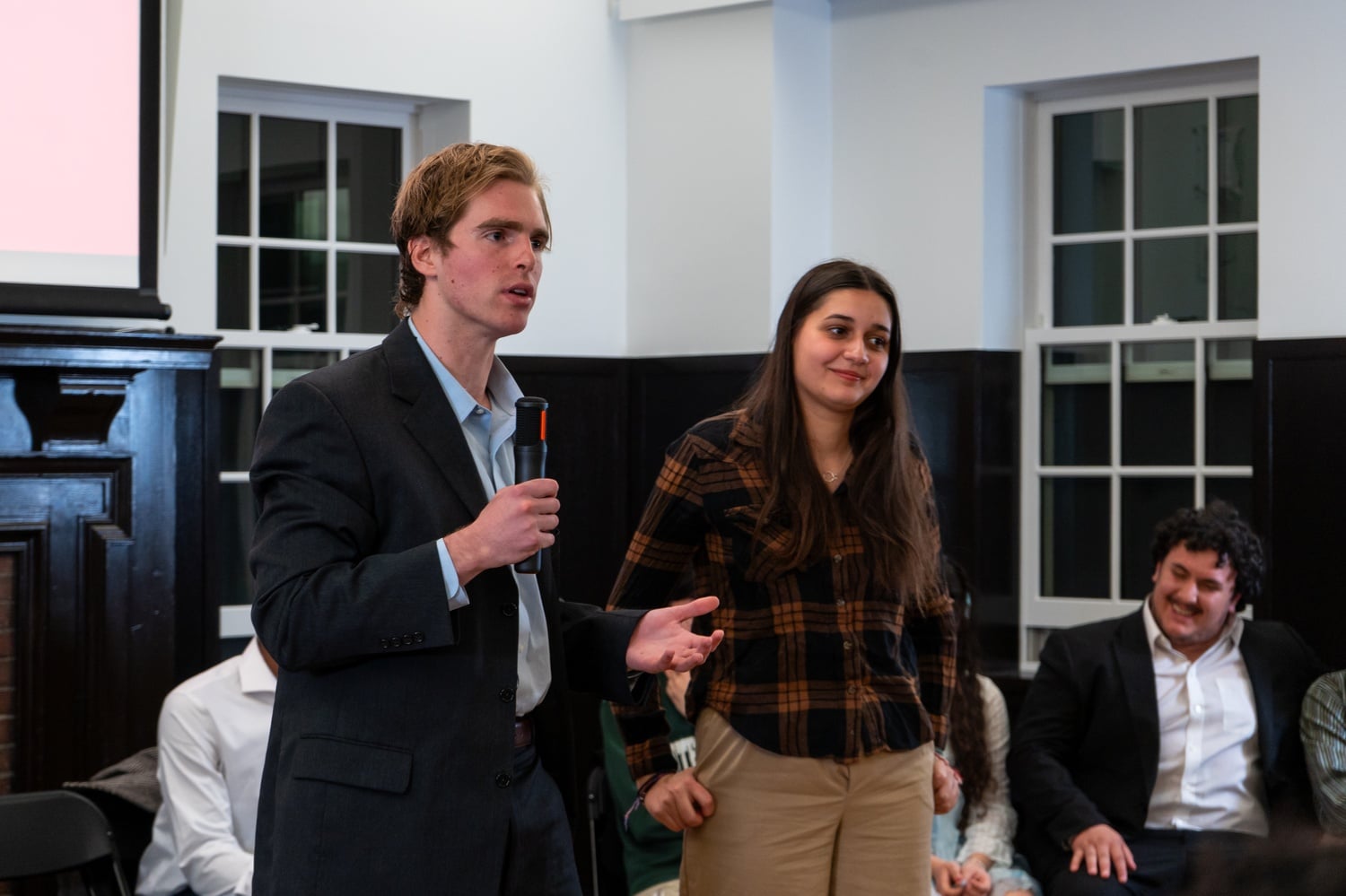
Amira I. Abugararah ’28 and Jackson C. Sennott ’26-’27 are running for the Harvard Undergraduate Association co-presidency on a pledge to give students a seat at Harvard’s decision-making tables — and a promise to resign if they cannot deliver it by the start of next spring.
The pair, who described themselves as “outsider candidates” with backgrounds rooted in political organizing rather than student government, are framing their bid around a single argument: that the HUA’s repeated failures to fix what students complain about stem not from the shortcomings of past officers, but from a structural lack of power.
“Why has the HUA not been able to do so already?” Sennott said of student frustrations over the body’s response to grading reforms, club funding delays, and social life. “We believe that the answer is not that it’s anyone’s fault. It’s because HUA actually lacks institutional power, and we want to fix that.”
Sennott, who has taken two gap years during his time at Harvard, is a co-founder of Democracy House, which funds civic action projects, and serves as operations chair for Students for Freedom, a group formed last spring to challenge the Trump adminstration’s campaign against Harvard.
Abugararah, who hails from Romania, is co-president of the Romanian Association and an Action Network coordinator with Amnesty International USA.
“We’re running because we have seen how the HUA has operated in the past, and we really think it failed students in many regards,” Abugararah said. “We didn’t think that a lot of the people who are running right now can deliver such a change, because they have been part of the system.”
The pair’s platform is organized around academics, career pathways, facilities, and community life — but its central plank is structural reform of the HUA. They want required student votes on academic decisions that directly affect undergraduates, joint referendums with faculty and graduate student governments, a student seat on the Administrative Board, and a portion of the University’s endowment managed by students through the Harvard Management Company.
To force the issue, the pair has committed to resigning if they have not secured meaningful institutional gains by the beginning of the spring 2027 semester.
Get The Crimson in your inbox.
“If we haven’t gained this institutional power, we can’t deliver what we need for the students,” Sennott said. “So we’re going to keep ourselves to that commitment and not just talk about this, but really turn it into action.”
On academics, Abugararah said the General Education program is overdue for an overhaul that many faculty would welcome if students pushed harder for it. The pair also wants to expand career pipelines through more research fairs, Harvard-curated internships that count for academic credit, and additional fieldwork programs.
“You hear these crazy stories, like freshman year of people applying to 100 internships, and you’re like, ‘Oh, what am I doing with my life?’” Abugararah said.
Sennott said the pair wants to overhaul the digital infrastructure students rely on — including PassioGo, my.harvard, and Canvas — by establishing a chief technology officer position within the HUA and hosting semesterly hackathons.
The candidates also want the College to create a student-run student center, arguing that no comparable space currently exists.
“We don’t have that community space where we can all get together and kind of do our own thing and see each other,” she said.
Other community proposals include monthly class-year dinners in Annenberg, an alternative spring break centered on public service, and a dedicated mental health week.
Asked what they would change about how the HUA has operated in years past, the pair said the body has remained too consultative and insufficiently transparent.
“The HUA has had more of a consultative role in the past, and even if we got policy through, it hasn’t been that decisive in what the University did,” Abugararah said.
—Staff writer Kaylee Razo can be reached at [email protected].
Want to keep up with breaking news? Subscribe to our email newsletter
Have a tip for The Crimson? Share it confidentially