Sediqe, Fernandez Launch HUA Bid Centered on Accessibility, Financial Independence
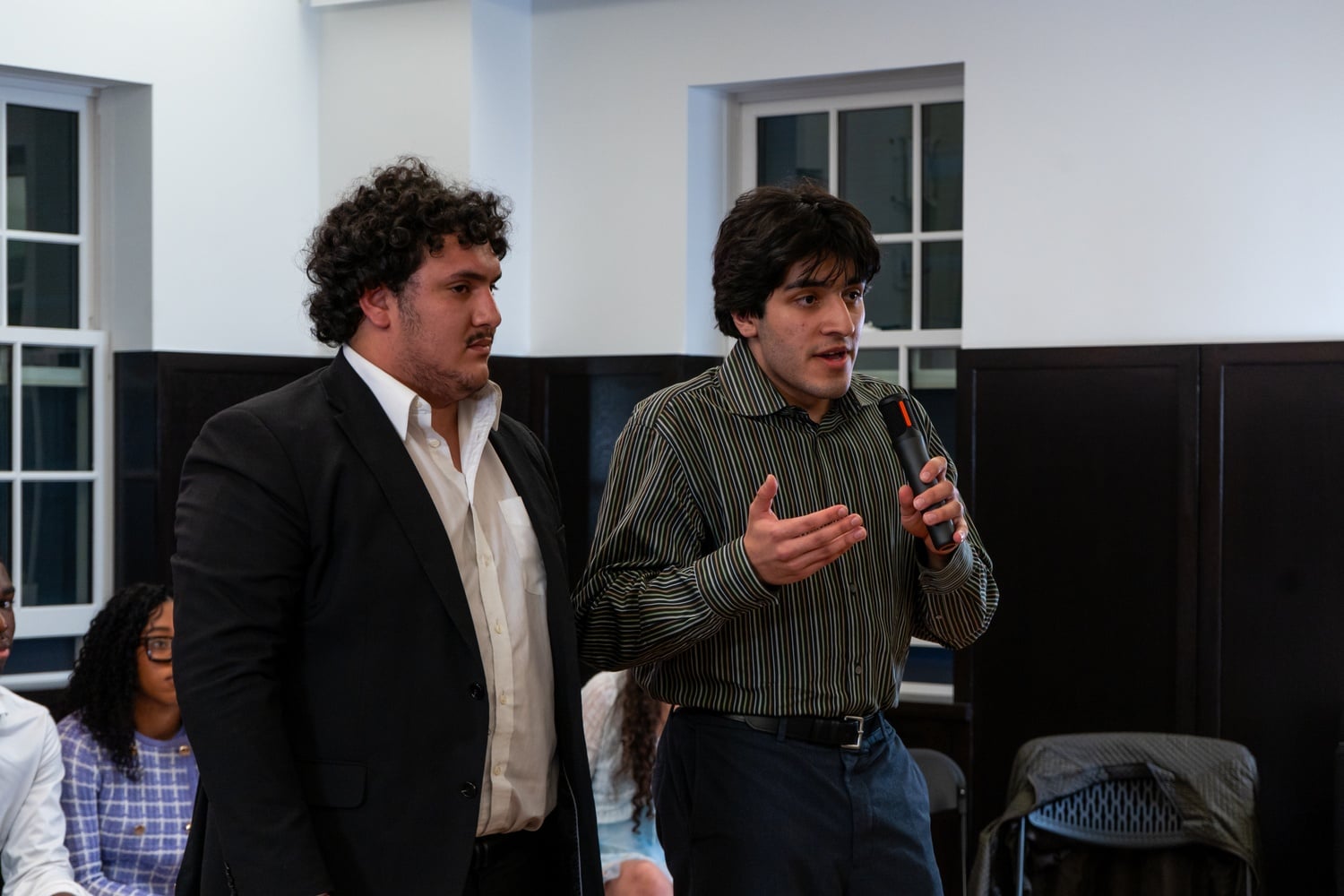
Ali Sediqe ’28 and Manuel Fernandez ’28 are running for the co-presidency of the Harvard Undergraduate Association on a promise to make the body more accessible and more independent from Harvard’s administration.
Sediqe, an Afghan-American from Toledo, Ohio, and Fernandez, a first-generation, low-income student from Tabasco, Mexico, said their backgrounds are the foundation of their campaign. Neither has previously served in the HUA — a fact they cast as an advantage.
“We have a lot of opposing views and don’t agree on a lot of things, in life and general philosophy,” Sediqe said. “But it’s the fact that we can come together and talk about this and have diverse conversations.”
Fernandez is an officer with the Phillips Brooks House Association and is involved with Latino affinity groups on campus. Sediqe is involved with the Islamic Society and the Central Asian Association.
The pair said the current HUA has struggled to pull students into its meetings — a dynamic they want to flip.
“There clearly is an issue with actually getting students to show up to the HUA and make their voices heard in the first place,” Sediqe said. “If we meet students where they’re at instead of having them come to us, we can really be more effective.”
Fernandez said he wants the HUA to hold mandatory monthly meetings with representatives from every affinity group and student organization — a model he said mirrors PBHA’s cabinet structure.
“If HUA does not know what are the monthly necessities,” Fernandez said, “how are they going to advocate for something?”
The pair also plans to set up “office hours” in dining halls, run weekly Instagram update videos, and send out a newsletter modeled on the one published by the Institute of Politics. Fernandez said the HUA should run its communications more like New York City Mayor Zohran K. Mamdani, whose “100 Days” social media posts he cited as a template for transparency.
Sediqe and Fernandez said the current co-presidents, Abdullah Shahid Sial ’27 and Caleb N. Thompson ’27, were effective in responding to the Trump administration’s attacks on international students earlier in their term but fell short on other issues, pointing specifically to the Harvard Foundation’s summer layoffs.
Get The Crimson in your inbox.
When the College folded its three diversity offices into the revamped Harvard Foundation in July, roughly 35 undergraduate interns lost their jobs, and the Foundation later hired only 12 student workers for the school year. Fernandez said the HUA failed to advocate for the students who had been cut from their positions.
“We all knew through The Crimson that these people were laid off,” Fernandez said. “There was no HUA communication for the Foundation.”
The HUA, he said, should make a practice of sharing the substance of its day-to-day conversations with deans so that students can see which issues are being raised on their behalf.
Sediqe added that he wants the HUA to build out an emergency fund that student groups can tap when staffing or funding decisions leave them in the lurch.
“If something impacts one student, it impacts all students,” Sediqe said.
The pair’s platform also hinges on financial independence from the College. Funding for the HUA currently flows through the administration via the mandatory Student Activities Fee, a structure Sediqe said compromises the HUA’s ability to push back.
“You can’t bite the hand that feeds you,” Sediqe said. “There are always going to be strings attached to that, and then we’re going to be liable, in some degree, to the College and whoever is giving that money.”
Sediqe said he plans to expand the HUA’s fund for direct donations — an alumni donation channel Sial and Thompson launched this year — as a source of no-strings-attached revenue. He said alumni contributions to the HUA should be distributed across student groups through a transparent formula, not earmarked for specific organizations.
Fernandez said he wants the internal structure of HUA leadership to be “horizontal.” The HUA’s agenda should be set in part by student polling, he added, so that issues beyond high-profile ones like the grade cap can rise to the top.
He said he recently saw a sign in a campus maintenance office reading “Make Harvard College for the 99, not the 1 percent” and had adopted it as a guiding principle.
“Harvard should be for the FGLI students. Harvard should be for the international students. Harvard should be for the American students,” Fernandez said. “Harvard should be not only for the New York people, and not only for the final club people, and not only for the 1 percent income people, which is how the world sees us.”
“In reality, the majority of Harvard is not like that,” he added.
—Staff writer Mark C.Z. Snekvik can be reached at [email protected] and on Signal at marksnek.62. Follow him on X at @markcsnekvik.
Want to keep up with breaking news? Subscribe to our email newsletter
Have a tip for The Crimson? Share it confidentially