Sial and Thompson Pledged to Challenge the Administration. Their Leverage Proved Limited.
After campaigning on sweeping reform and student advocacy, HUA co-presidents Abdullah Sial ’27 and Caleb Thompson ’27 found their agenda stalled by institutional limits — leaving behind a term defined as much by frustration as ambition.
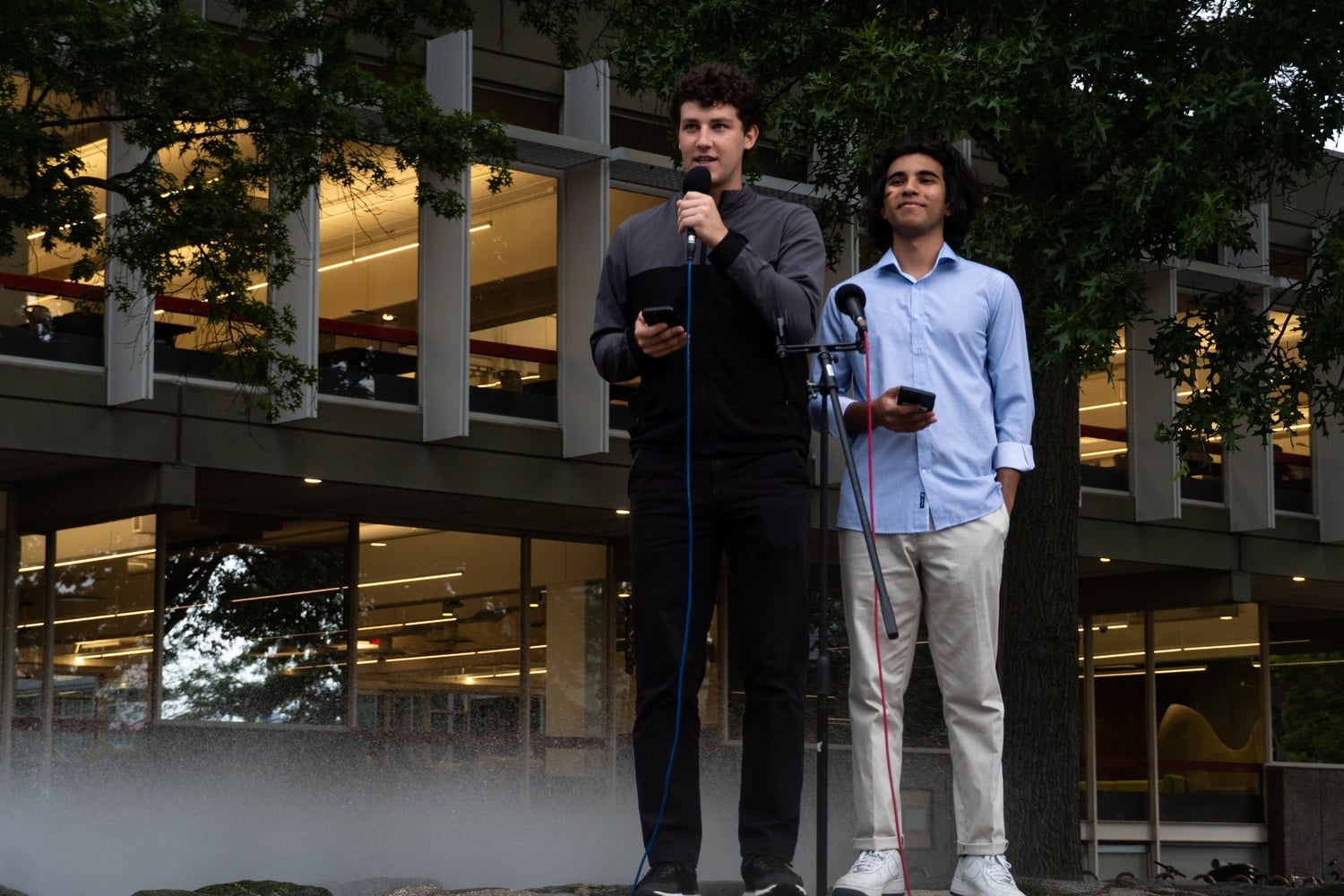
n October 2025, just months into his term, Harvard Undergraduate Association co-president Abdullah Shahid Sial ’27 drafted a resignation letter.
The move came after the HUA Election Commission refused to release results from a student referendum on Harvard’s divestment from Israel — a decision that left Sial, who had campaigned on amplifying student voices, feeling “extremely embarrassed” to be a part of the body.
“I’d written down my letter,” he said. “I just never sent it.”
Sial and co-president Caleb N. Thompson ’27 had entered office amid campus unrest, pledging to advocate for students in the face of mounting pressure from Washington and administrators on campus.
By the end of their term, they said they held to that principle — but struggled to translate it into concrete change.
The referendum controversy became a breaking point.
“I felt extremely powerless in that position,” Sial said. “I couldn’t encourage them to take any action. I couldn’t encourage the administration to take any action. I couldn’t do absolutely anything.”
After consulting with Thompson and close friends, Sial ultimately stayed — deciding resignation would amount to “chickening out” on both students and a campaign centered on reforming an institute many see as ineffective.
Still, he remained “really, really angry” at the Election Commission’s decision.
Get The Crimson in your inbox.
“The very act of hiding them to begin with, even for a short term, is absolutely appalling,” he said. “It’s insane how they thought they could get away with it.”
Sial and Thompson ran on an ambitious slate: free printing and laundry, summer storage, mobile HUIDs, extended dining hall hours, hot breakfast in every neighborhood, and fixes to the Crimson Cart rollout.
By year’s end, only free laundry has been implemented — a change the pair acknowledged was largely administration-led. They also launched an alumni donation fund and took public stances on national political issues.
“We acknowledge how we couldn’t follow through with every single promise we made,” Sial wrote in a statement. “However, Caleb and I can confidently say that we did in fact try our very best.”
The Crimson spoke to 13 HUA affiliates, past officials, and more than a dozen students to assess a presidency defined by high ambition — and persistent bureaucratic constraints.
Big Promises
From the outset, Sial and Thompson framed their administration around a core idea: the HUA need not always be in lockstep with Harvard.
“We don’t see the student government as an extension of the administration, which we felt was the case before we came in,” Sial said. “If they happen to be in conflict with what the administration wants, then our side takes preference.”
That approach shaped their early months. Within weeks, the pair issued a statement condemning the Trump administration’s attempt to revoke Harvard’s ability to host international students — the first independent public stance the HUA had taken on a major political issue.
Sial, himself an international student from Pakistan, also became a visible presence at rallies, speaking alongside Thompson and helping lead Students for Freedom, a group formed last spring to challenge the Trump adminstration’s campaign against Harvard.
“It was pretty remarkable to work alongside him during that crisis,” Thompson said. “He put himself out on a limb.”
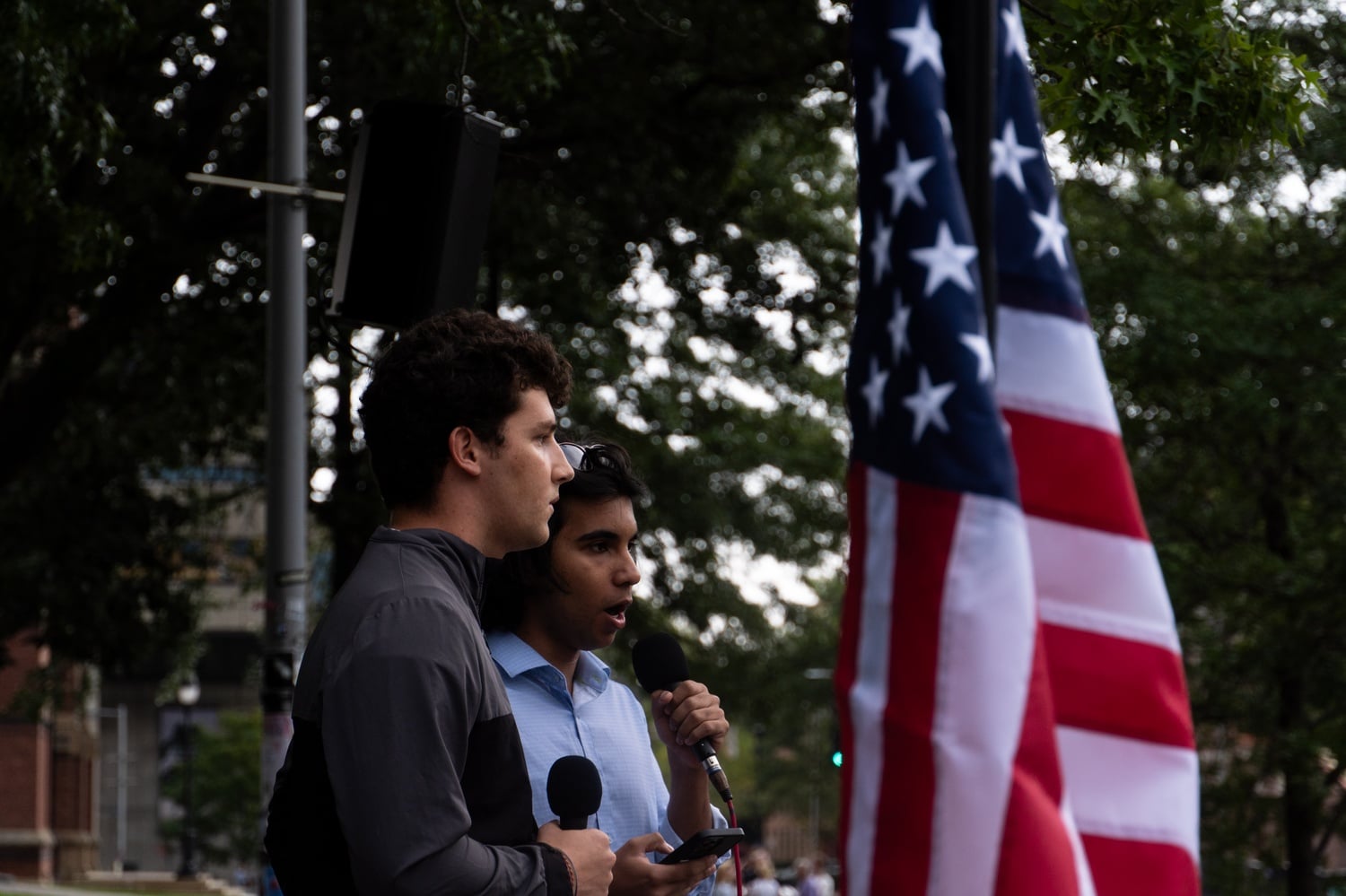
Behind the scenes, the pair said they pushed administrators to expand support for international students, including urging increased staffing at the Harvard International Office and relaying student concerns about visa uncertainty.
But those efforts often ran up against the limits of the HUA’s authority — a reality underscored by the divestment referendum.
Sial described the Election Commission’s refusal to release results as “a mockery of the democratic process,” adding that the body had effectively “inverted rules” in real time.
“We don’t have jurisdiction with the Election Commission,” he said. “And that’s very intentional.”
Isabelle G. Agarwal ’28, the HUA’s residential life officer, said the co-presidents entered office without fully grasping those constraints.
“They came on as members who are not part of the HUA, which means that I don’t think they necessarily knew how much blockage from the admin happens in the HUA,” she said. “I don’t necessarily think they knew exactly how to implement things.”
Sial acknowledged as much.
“I realized that I can’t actually go through all the phases of reform as I intended to,” he said.
As the year progressed, Agarwal said, the disconnect became more visible.
“At times it felt very difficult to do things, and at times it still feels very difficult to do things,” she said.
Still, some student leaders involved in the referendum said the co-presidents handled the situation as best they could.
Violet Barron ’26, then leading the Palestine Solidarity Committee, said Sial and Thompson were transparent throughout.
“I really don’t know what Sial and Caleb could have done,” Barron said. “In fact, it may have been nothing.”
Funding Fights and Internal Gaps
With many policy goals stalled, Sial and Thompson turned to what they saw as the HUA’s most tangible lever: money.
The establishment of the alumni gift fund and the soliciting of donations did not come without pushback from the Harvard administration.
“We had some opposition from within the administration after we set up the donation platform,” Sial said.
The pair said that while administrators did not block the effort outright, they were “severely discouraged” from reaching out to additional alumni who could serve as potential donors.
According to Sial and Thompson, that resistance stemmed from a broader University push to “recenter academics” — one that left little room for expanding funding for extracurricular life.
“Enhancing our club life and extracurricular life, it’s not a zero-sum game,” Thompson said.
A College official said administrators’ response to the HUA’s donation plan stemmed from a desire to best position Harvard donors during a “challenging time for the institution,” rather than the effort to recenter academics.
Despite that friction, the co-presidents said the fund ultimately gave them leverage in negotiations over student funding. They pointed to a dramatic increase in Student Activities Fee allocations — which Sial said would exceed $1 million next year — as evidence of that pressure.
However, the scope of the fundraising effort itself remains unclear. Since its initial $10,000 donation, the fund’s growth has not been publicly tracked.
Internal documents reviewed by The Crimson suggest limited outreach. Of an organizing spreadsheet maintained by the HUA’s Alumni Outreach team, only two of nine tabs contain any alumni contacts, and none include completed fields for “first contact date” or “status.”
Daniel Zhao ’28, the HUA’s co-treasurer, said building a sustainable donor network would require more sustained attention.
“It takes a very strong degree of focus to get this done. Caleb and Sial were great for the ideas that they were proposing and for the things that they want to accomplish,” he said. “It’s not necessarily to say that Caleb and Sial weren’t focused. It’s just that they had different goals.”
At the same time, Sial and Thompson said they made a deliberate decision to scale back internal spending. The previous administration had allocated thousands of dollars to internal programming, including a $4,000 off-campus retreat and $10,000 on a senior class gala and trampoline park outing.
This year, they chose to redirect those funds toward student organizations.
“Every marginal dollar you’re spending within the organization is taking money away from clubs,” Thompson said. “We had our hands tied.”
Those limits were not confined to fundraising efforts.
Inside the HUA, officers said similar patterns emerged — with execution often falling to individuals rather than a coordinated leadership structure.
Finn R. Berard ‘29, the body’s first-year representative, said most of the work Sial and Thompson were credited for was fueled by independent officer action.
“It was organized by the officers, executed by the team, and carried out through there,” he said. “Not necessarily top down.”
Others described gaps in communication that compounded those challenges.
There was a “lack of communication right from the beginning,” said Dillon A. Dukes ’28, the HUA social life officer.
Well-Being Officer Joshua T. Eneji ’28 argued that the lack of structure left officers responsible for carrying out most major initiatives on their own. When the winter shuttle program — a campaign promise — moved forward, Eneji said he was responsible for coordinating more than 400 students during his finals period.
“But then it had to be solely me handling that,” he said. “I think there was a lot of big promises made.”
Sial credited team officers for their efforts and execution, writing that they were “absolutely instrumental in the changes the current administration was able to bring about.”
“We are immensely grateful for everything they did,” he added.
Mixed Verdict
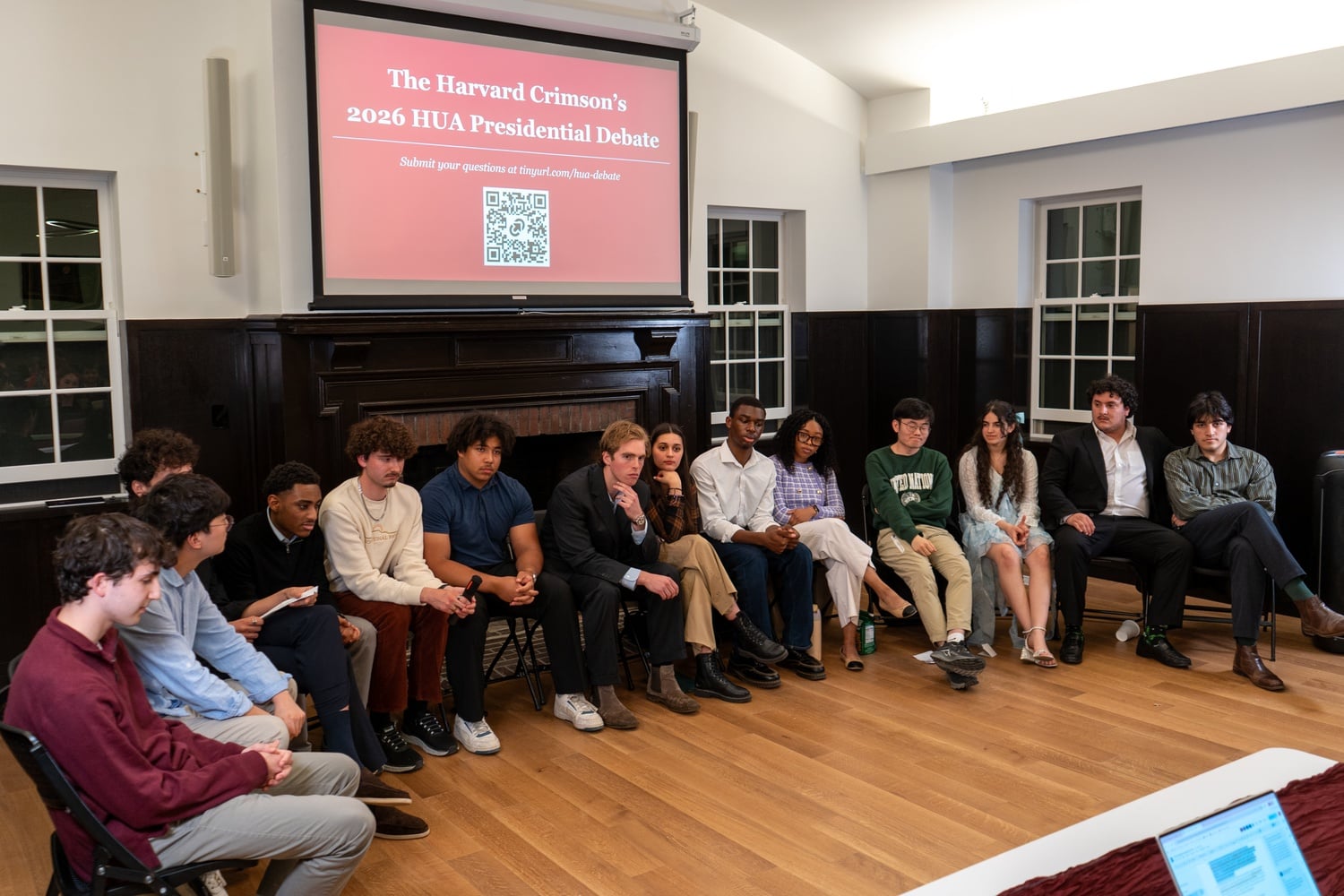
Seven HUA tickets took the stage Sunday to debate the limits of student government — and whether Sial and Thompson had managed to push past them.
Moderators from The Crimson’s Editorial Board pressed candidates on a central question: had the current administration lived up to its not to act as the “administration’s mouthpiece,” or had it fallen short?
One group in the audience was listening particularly closely.
Sial and Thompson sat two rows from the front.
“It was definitely a moment of reflection for me,” Thompson said. “I thought the candidates were unnecessarily, perhaps unnecessarily so very nice to Sial and I.”
But among students, reactions to their term were mixed — and often muted.
Some pointed to visible efforts, particularly early in Sial and Thompson’s tenure. Many, in particular, cited initiatives like subsidized airport transportation.
“The free Ubers to go home during winter break to the airport was a great initiative,” Ibrahim E. Omeish ’28 said. “I think they’ve been very active in the community, and I’m supportive of them.”
Sial, he added, “has always been really receptive to feedback and also really helpful whenever he needs to be.”
Others pointed to the pair’s advocacy for international students at a moment of particular tension.
“I think they did a really great job advocating for international students, especially at the very end of last school year,” Scarlett E. Eldaief ’28, a Crimson Editorial editor, said. “I don’t think I’ve heard a ton from them since then.”
But for some students, the administration’s presence was minimal.
“I actually don’t even know who the HUA co-presidents are, so I don’t really think they’re really effectively communicating with at least my part of the student body,” Chae-Hee Park ’28 said.
Others echoed that lack of visibility.
“I know nothing about them,” Adler T. Schultz ’26 said. “I don’t even know what their names are.”
For some, the HUA surfaced only during election season.
“The only time I feel like I really hear about them is for the presidential elections,” said Monika Rezic ’28. “Then after that, throughout the rest of the year, it’s just nothing — silence, complete silence.”
Thompson acknowledged those criticisms.
“Some of the criticisms I think are very fair,” Thompson said. “The one thing the HUA hasn’t been able to solve is just full engagement and visibility from day one with students.”
After a year defined by ambition — and constraint — he framed their work as unfinished.
“We tried to fundamentally improve the capacity and power of the HUA to make decisions and make differences,” he said. “I hope whoever takes up the mantle continues that fight.”
—Staff writer Alma T. Barak can be reached at [email protected] and on Signal at almabk.54. Follow her on X @almabk_.
—Staff writer Theresa F. Bartelme can be reached at [email protected] and on Signal at theresabartelme.15. Follow her on X @theresabartelme.
Want to keep up with breaking news? Subscribe to our email newsletter
Have a tip for The Crimson? Share it confidentially