Experts Warn U.S. Nuclear Credibility Has Eroded Amid Rising Global Threats
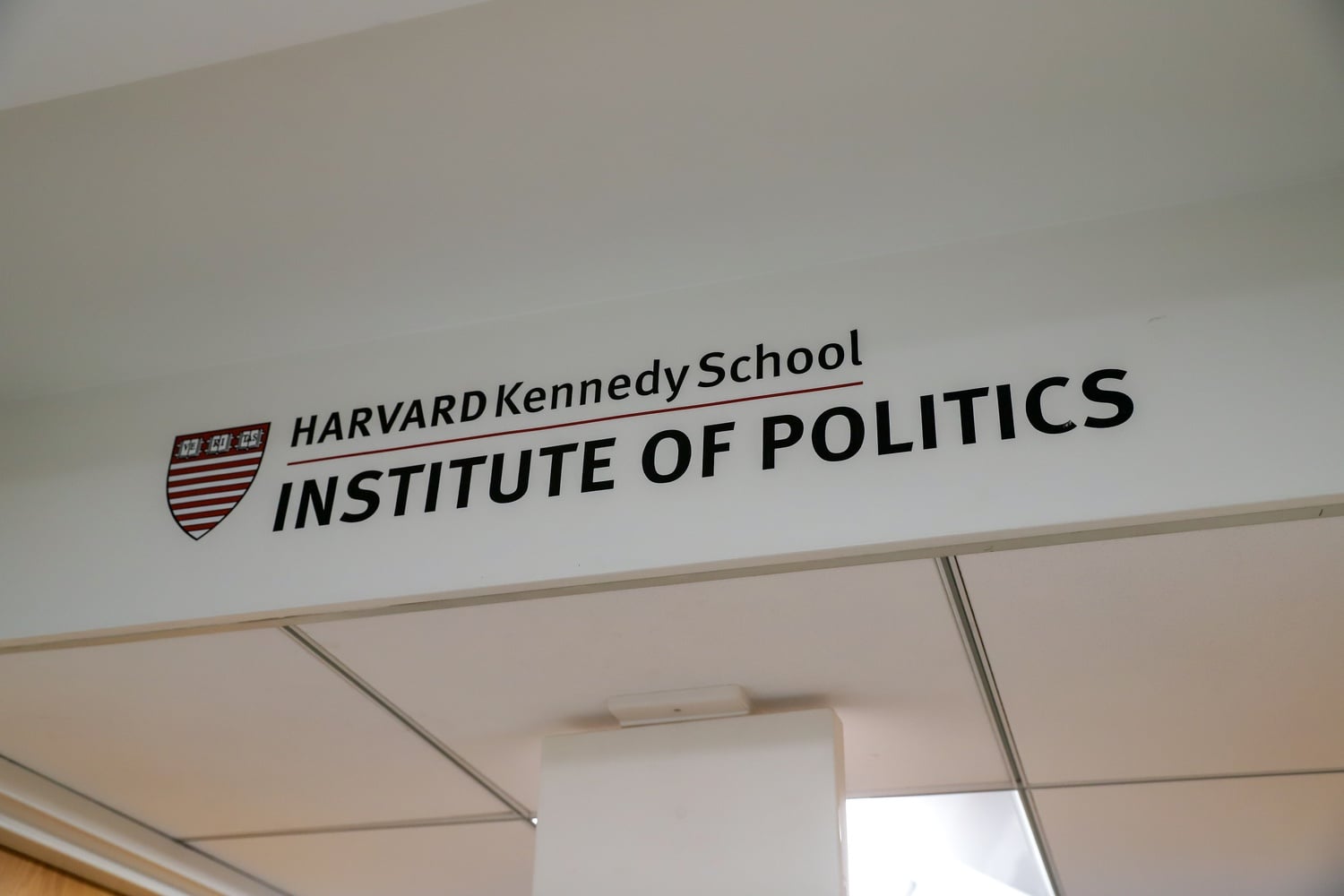
A panel of nuclear policy experts warned Wednesday that the United States’ credibility as a nuclear ally has weakened under the Trump administration at a time when China’s arsenal expansion and the collapse of arms control agreements are pushing the world toward a new nuclear arms race.
The panelists spoke at an Institute of Politics forum that inaugurated the Carnesale Convenings, a new Belfer Center series honoring former HKS Dean Albert Carnesale, whose scholarship has made significant contributions to nuclear policy and national security strategy.
HKS professor Graham T. Allison ’62 was joined by HKS professor Matthew Bunn, former NATO diplomat Rose E. Gottemoeller, and former U.S. Ambassador to the International Atomic Energy Agency Laura S. H. Holgate. HKS professor Meghan L. O’Sullivan moderated the event.
“There is no question Donald Trump has shaken the faith of our allies in the U.S. willingness to come forward in the terrible event that they are attacked with nuclear weapons,” Gottemoeller said.
Gottemoeller, who helped negotiate the New START Treaty — the last nuclear arms reduction agreement between the U.S. and Russia, which expired in February — argued that the uncertainty around Trump’s commitment to allies, however, cuts both ways.
“Can we be absolutely sure that he would not agree to extend this nuclear deterrent?” she said. “Vladimir Putin can’t. It’s a mind game.”
She noted that NATO’s nuclear infrastructure has never been stronger, citing the completed deployment of the B61-12 warhead in recent presidential administrations and every ally’s agreement to certify the F-35 for nuclear missions.
Bunn said China’s nuclear buildup — which has already more than tripled the country’s warhead stockpile and includes 300 new intercontinental missile silos — has shifted the conversation in Washington away from arms reductions and toward a potential buildup.
“The conversation among many who are involved in nuclear decisions in Washington is not about what’s the next round of reductions,” Bunn said. “It’s about: should we leave the New START limits behind and start building up our nuclear forces to respond?”
Get The Crimson in your inbox.
Bunn warned that Trump’s proposed Golden Dome missile defense system could prompt both Russia and China to expand their arsenals, while new technologies in artificial intelligence, cyber, and space are making nuclear stability harder to maintain.
“You have this whole set of non-nuclear technologies that are making nuclear balances more complex at least, and possibly less stable,” he said.
Allison offered a darker forecast, predicting that within the next decade, the number of nuclear-armed states — currently nine — will grow. He argued that countries have drawn a clear lesson from recent conflicts: possessing nuclear weapons deters attack.
“If Iran had been North Korea, would Trump have attacked Iran? The answer is no,” Allison said. He suggested officials in allied nations like Germany and Canada may already be weighing whether they need their own deterrents.
Holgate, who recently completed three years as U.S. ambassador to the IAEA, said geopolitics have overtaken the agency’s traditionally consensus-driven work. She said Russia has actively undermined the IAEA’s verification tools, while China has flooded the agency with staffers and used its development funding apparatus to brand internationally funded projects as Chinese initiatives.
“The spirit of Vienna has become a ghost,” Holgate said, referencing a joke circulating in the IAEA’s Board of Governors about the collapse of the body’s longstanding culture of consensus.
Holgate added that Russia’s seizure of Ukraine’s nuclear infrastructure introduced a scenario the international community had never anticipated. She warned that expanding global interest in nuclear energy will further strain the IAEA’s verification capacity if member states maintain their policy of zero budget growth for the agency.
Gottemoeller argued that future arms negotiations will need to address both traditional “hardware” like warheads and missiles, and newer “software” challenges like AI and space-based capabilities. She said the U.S. and China, as the two leading nations in AI development, are best positioned to set guardrails.
“Perhaps it is we, too, who lead the way in this new area that we have to tackle,” Gottemoeller said.
Bunn said allies concerned about American reliability should invest in collective security rather than pursuing their own nuclear programs, pointing to NATO’s European buildup as a model. But he said the nonproliferation regime’s durability ultimately depends on something more fundamental.
“The United States starting to behave as a more reliable partner for its allies,” Bunn said, when asked what single change would most strengthen the regime going forward.
Want to keep up with breaking news? Subscribe to our email newsletter
Have a tip for The Crimson? Share it confidentially