University Professor Noah Feldman Says Trump Administration Is Straining Rule of Law and Checks on Power
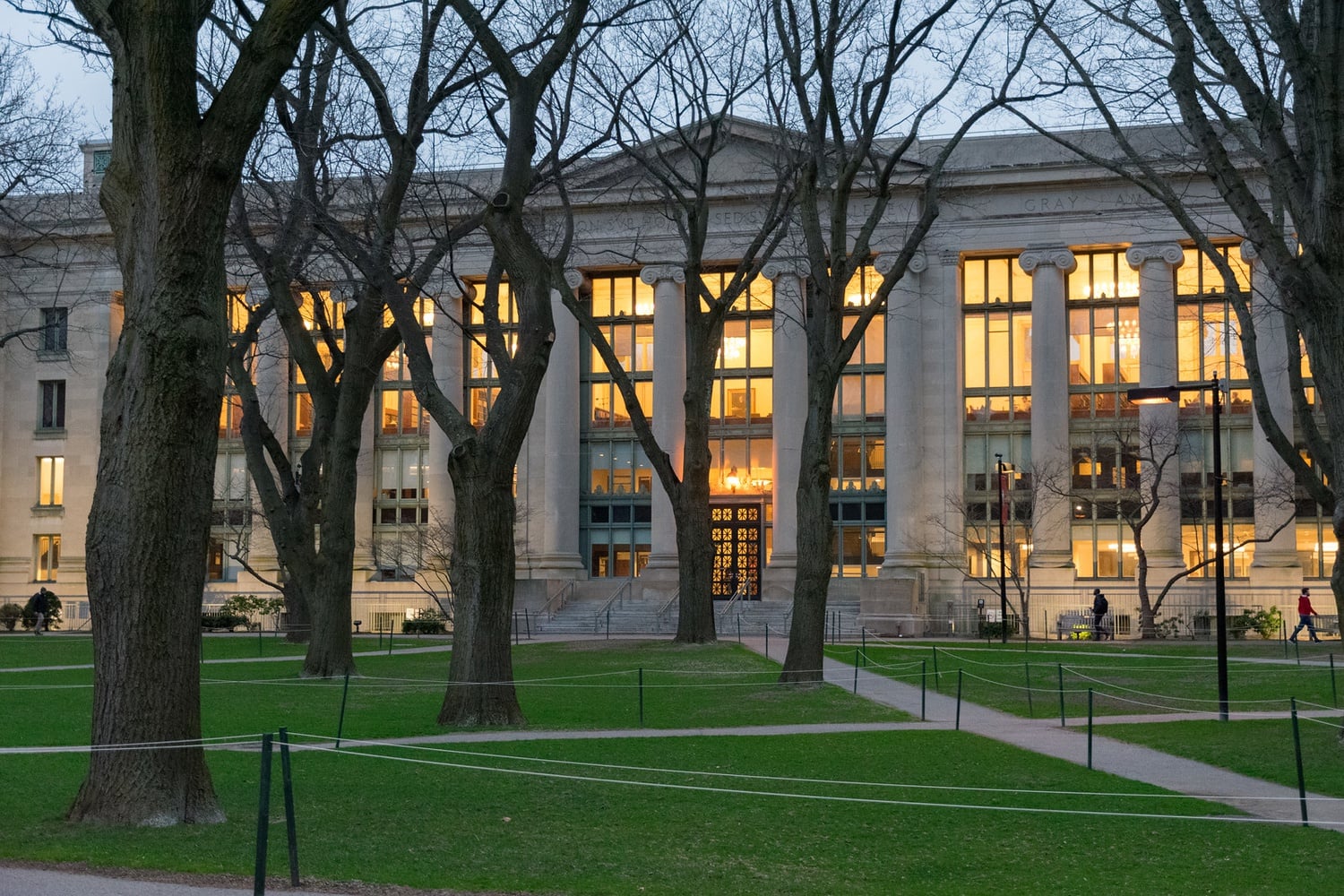
Harvard Law School professor Noah R. Feldman argued Tuesday that the Trump administration has intensified partisanship and strained the nation’s system of checks and balances, warning that the rule of law is increasingly unstable.
The talk, hosted by the Office of the Vice Provost for Advances in Learning, examined the erosion of legal norms during U.S. President Donald Trump’s second term.
Feldman, a University Professor, said Trump has repeatedly challenged constitutional and legal precedents while Congress has failed to serve as an effective check on executive power.
He pointed to several recent examples, including a sweeping national immigration enforcement campaign, actions targeting elite institutions and U.S. military engagement with Iran without congressional authorization.
Those moves, Feldman said, reflect a breakdown in the traditional balance among the three branches of government, in which Congress and the judiciary are meant to limit executive overreach.
District courts, Feldman said, “have been functioning as the front line” of defense against the Trump administration’s “war on the rule of law” — blocking unlawful actions from the federal government with increasing frequency.
He cited Harvard’s own legal clash with the administration as one example. U.S. District Judge Allison D. Burroughs ruled in September that an attempt to cut federal funding to the university was unlawful and ordered the funds restored. The administration later appealed to the U.S. Court of Appeals for the First Circuit, seeking to freeze the funding again.
At the same time, Feldman said the U.S. Supreme Court has, in some instances, undercut lower court rulings to “avoid direct confrontation” with the White House.
“The courts are afraid that the Trump administration might actually deny a lawful order,” he said, “and if that happened, and the courts were unable to force the president to comply, that would very substantially undermine the power and capacity of the judiciary.”
Get The Crimson in your inbox.
He said the Supreme Court’s role is especially critical in cases involving potential constitutional violations, including disputes over birthright citizenship and free speech.
“Along the way, we also saw pretty early on, presidential actions that, at least to observers who didn’t like them and who objected to them, were interpreted as violations of the freedom of speech.”
Feldman also described U.S. military action against Iran as a significant departure from precedent, arguing that Congress — particularly a politically polarized, Republican-controlled body — has not constrained presidential authority.
“It’s actually somewhat hard to imagine that a Democratic Congress with a Democratic president who had initiated hostilities of the kind we’ve initiated in Iran, would have insisted on constraining or limiting the power of the president — and that’s another indication that the separation of powers model is not working the way the framers imagined that it would work,” he said.
“Again, you can’t state strongly enough that, from the perspective of the framers, going to war against another country — and the United States is, by any rational standard, at war with Iran — was only supposed to happen if Congress declared war,” he added.
Despite those concerns, Feldman said the rule of law has not collapsed. Lower courts continue to challenge federal actions, and public engagement has played a growing role in checking government power.
He pointed to protests in Minneapolis after federal immigration agents fatally shot two U.S. citizens.
“In Minneapolis attempts by the local and state officials of the government to go to court to block what they alleged was effectively an occupation of their territory by ICE were not successful in court,” he said.
“That left the public — in the form of protesters — as the only real check on deviations from historical practices that, from the eyes of the protesters and from the eyes of many observers, myself included, looked and felt like they could be violations of the rule of law,” he added.
Shortly after the two shootings, Trump largely withdrew federal agents from the state and reassigned key enforcement leaders, including demoting the field commander and putting border czar Tom Homan in charge of operations.
“The reason it’s so significant is that the protest, in its continued basis, specify that we live under conditions in which the emergence of authoritarian violation of the rule of law was not viable,” Feldman said.
Want to keep up with breaking news? Subscribe to our email newsletter
Have a tip for The Crimson? Share it confidentially