No, Jay Powell Won’t Get You an Internship at the Fed
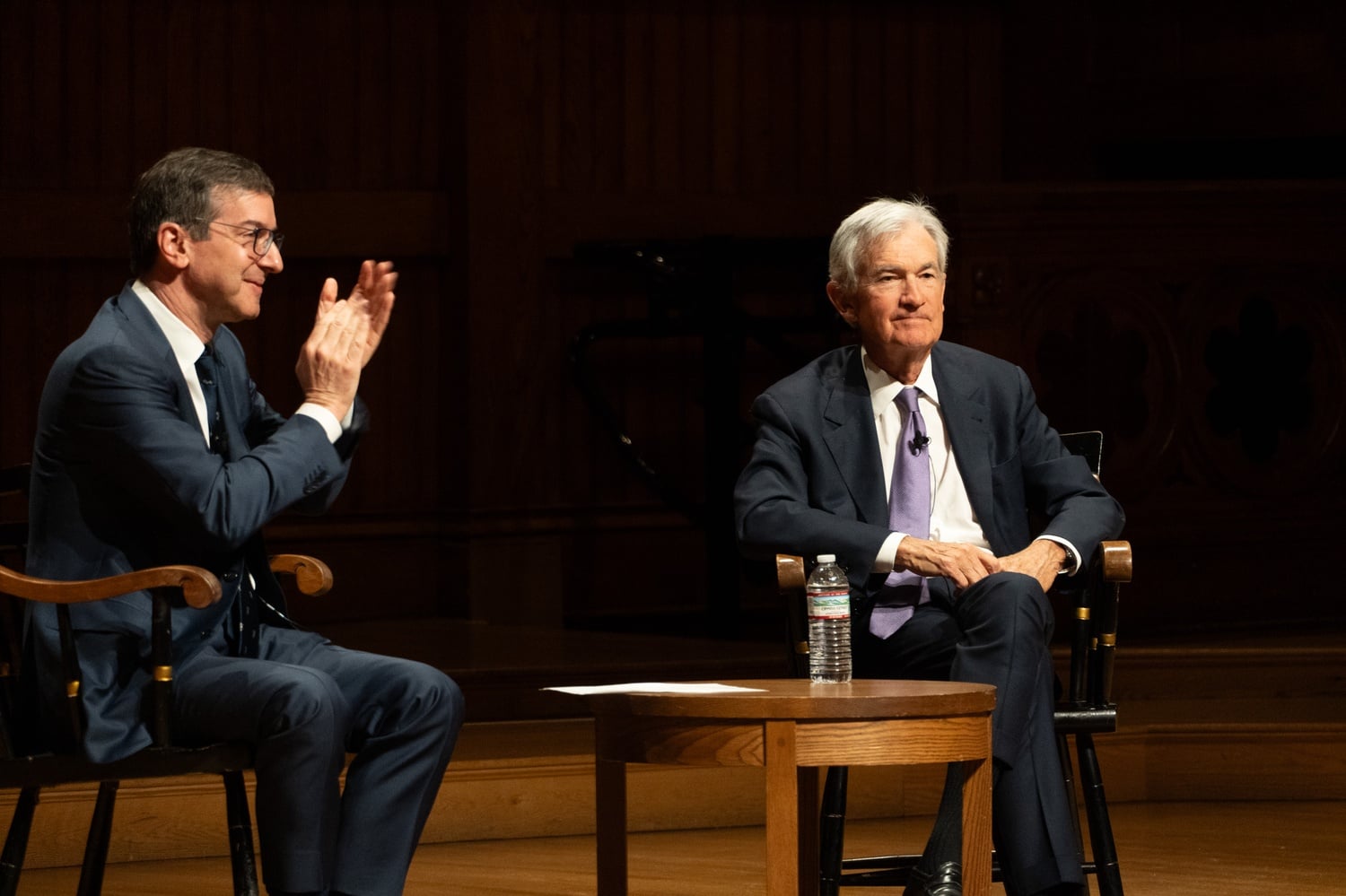
Federal Reserve Chair Jerome H. Powell visited Harvard last month. We could have asked him some better questions.
Speaking to students in an introductory economics class, Powell addressed a range of topics including the crisis in the Middle East, the independence of the Fed, and artificial intelligence. But when professor David I. Laibson ’88 opened the floor to questions, some fell quite short of the high standard for discourse that we should aim for.
It’s a problem endemic to guest appearances at Harvard.
Too often, question and answer sessions — in both classes and in forums like the Institute of Politics — are dominated by students who insist on subjecting audience members to unsolicited background on their year, dorm, and intended concentration. This introduction is invariably followed by the sort of question that leaves the rest of the room wondering if the person holding the floor actually cares about eliciting any modicum of novel information: “How do you deal with pressure in your job?” “What is your reaction to ideological opposition?” And, of course, a mainstay at the IOP: “What is the future of the Democratic Party?”
As Harvard students, we have the extraordinary privilege of direct access to some of the world’s most influential decision makers. It is our obligation to the rest of the country to prompt them to say something new — something distinct from what hundreds of hours of interviews, press conferences, and social media content have already put on the public record.
Part of my exhortation rests on the fact that Harvard students are demonstrably capable of engaging in meaningful dialogue with guests at our school. At the Powell lecture, for instance, one student’s question about stress in private credit markets drew a response that made national news. At the JFK Jr. Forum, former United States Secretary of State Antony J. Blinken ’84 addressed a student’s question about U.S. military aid to Israel during the war in Gaza by outlining the regional objectives of the U.S. and the limits of its ability to restrain Israel.
Both cases are a far cry from the rote answers that rote questions merit.
In my view, what drove these exemplary questions is a genuine curiosity about, and investment in, real-world outcomes. Of course, there is no comparison between an interest that stems from academic material taught in a previous lecture in the former case, and the immense pain of death on a massive scale in the latter. But this nonetheless unifying curiosity stands in stark contrast to the performative careerism that drives the auto-expository, networking softball. In other words: “here’s my name, get me a job later.”
And a performer need not have but one audience. In regular seminars and sections, many of us (myself, at times, included) perform for our instructors. There is no job to be won here, but every “that’s a great point, now here’s what I want to talk about” is a missed opportunity to pick up on an interesting conversational thread that could improve the learning experience for everyone in the room. When these opportunity costs accumulate, they reinforce a shallow intellectual culture where the quality of our discourse declines and institutional access is wasted.
To state the obvious, I am not suggesting that students need to come prepared to interrogate experts or professors as though they were defending a dissertation. That would run contrary to the educational function of such spaces. No one should be discouraged from quenching a thirst for knowledge because he or she is not particularly knowledgeable in the first place.
I simply urge my peers to make sure that it is indeed their curiosity, rather than a desire to show off, that grounds their contributions. As one of my peers on the Editorial Board writes, no one benefits from “nanny-state” attendance policies that force students who would otherwise miss class to attend and simply repeat what others have contributed. The same goes for students who do wish to actively participate. Their participation should serve genuine inquiry, not some professional or reputational goal.
So the next time we host a Powell figure in Economics 10: “Principles of Economics,” or another high-profile speaker swings by the IOP, don’t raise your hand to tell him that you are a freshman double concentrating in Government and Economics, and don’t ask something answerable by a Google search. If you still want to ask a question, it’s a good idea to do some research ahead of time; if not, just listening is fine too!
Even in total silence, you can squeeze in for a photo at the end — I certainly did next to Powell on the Sanders Theatre stage. But don’t expect a few malformed questions to land you an internship in his office this summer.
Michael Isayan ’29, a Crimson Editorial editor, lives in Apley Court.
Want to keep up with breaking news? Subscribe to our email newsletter
Have a tip for The Crimson? Share it confidentially