No Cover, No Minimum
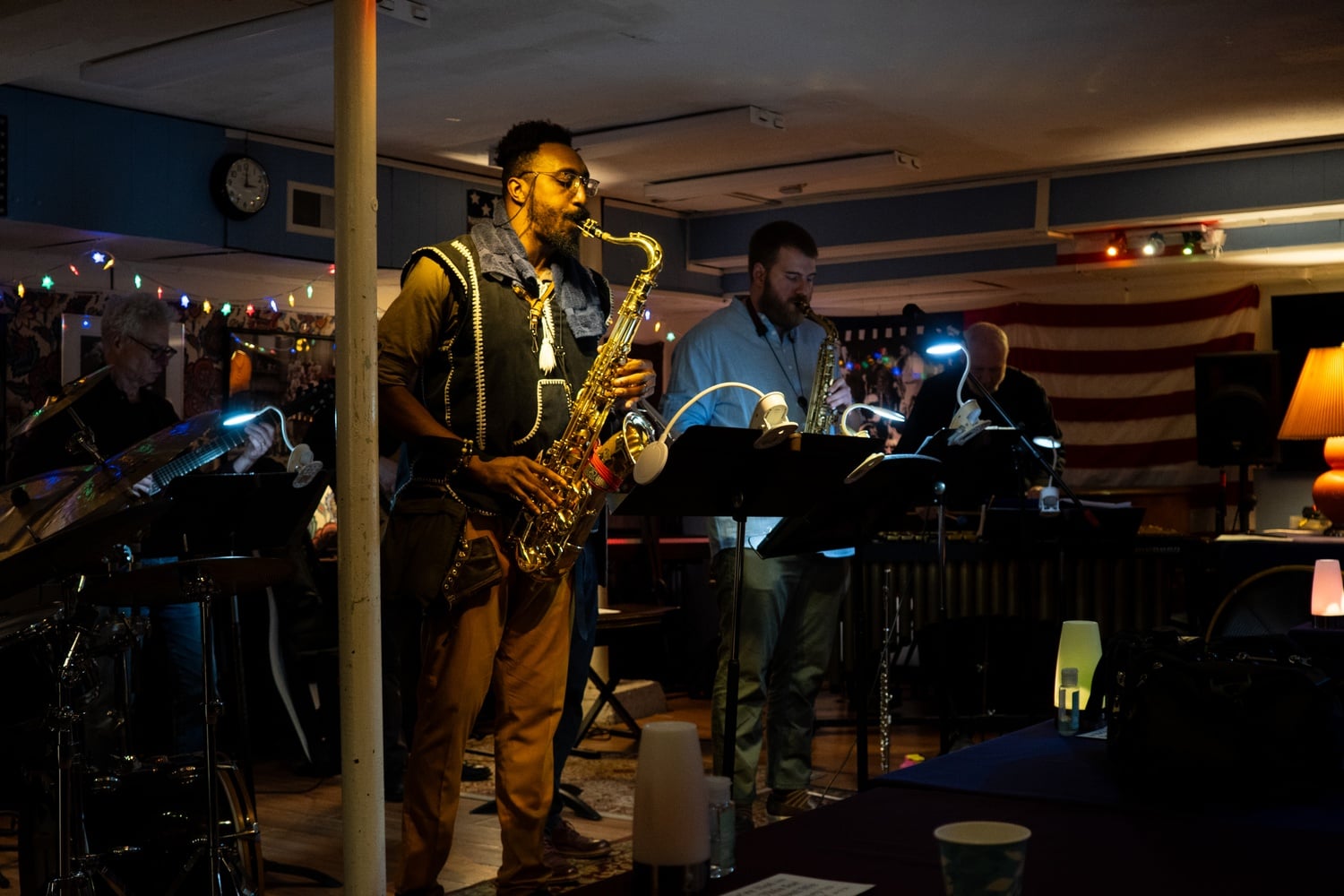
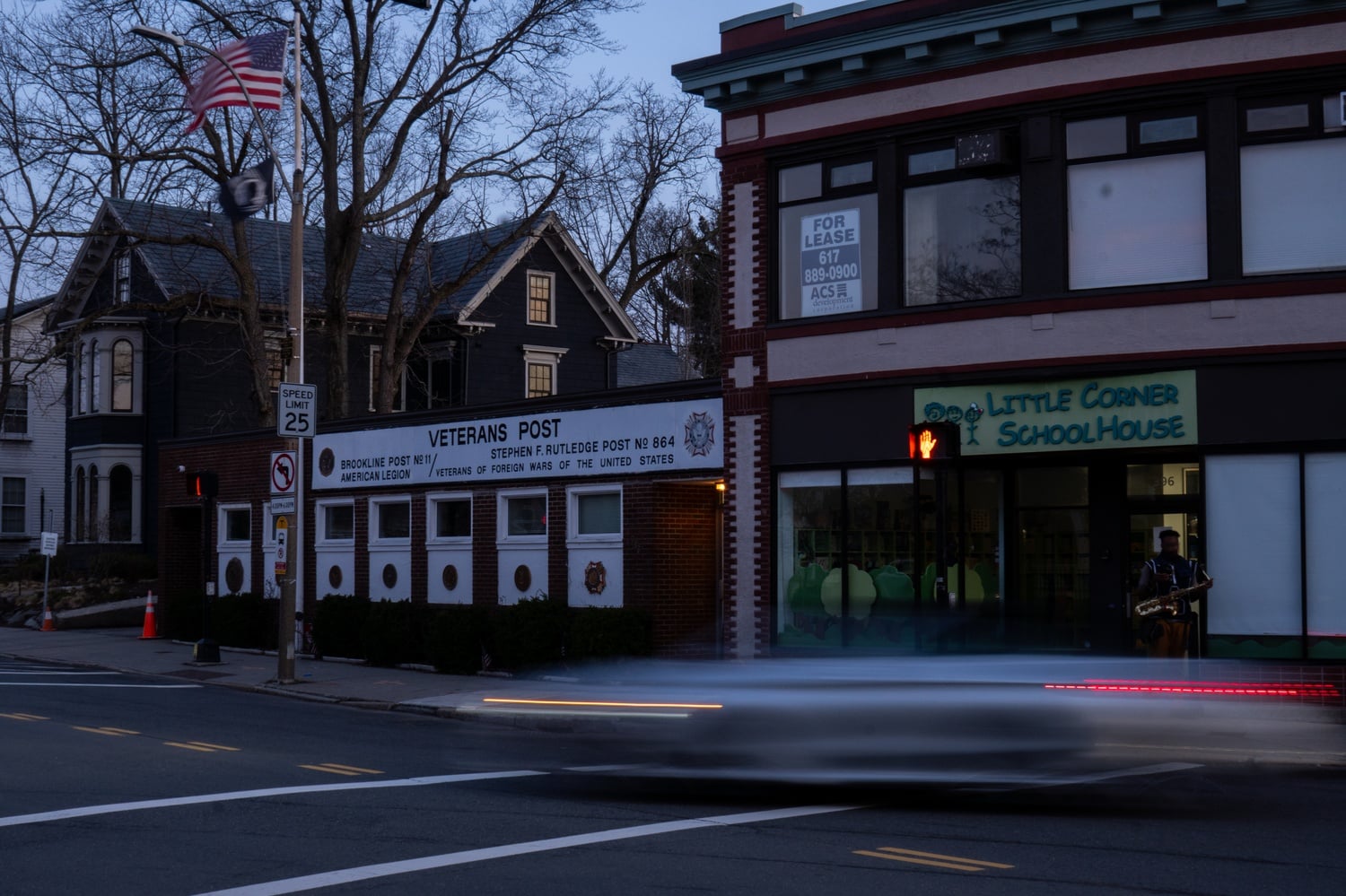
t’s a Friday night, and the sun is setting over the Brookline horizon. A lanky man leans against a wall, fiddling with his saxophone. When he ducks inside the Veterans Post — an unassuming building shared by the American Legion and Veterans of Foreign Wars — we follow close behind.
Walking down a narrow staircase flanked by photographs of former U.S. presidents, we reach a landing. The transitory space, where sheet music is scattered across a wooden table and instrument cases litter the floor, has become a de facto green room. Several musicians sprawl across a leather couch tucked into a small nook, surrounded by portraits of past Post Commanders.
Music spills out of a doorway, drawing us into the Post’s main room. A broken clock hangs on the wall, and colorful, star-shaped string lights illuminate photos of jazz masters interspersed with American flags.
Shortly after we take our seats, the soft jazz playing over the speakers fades, and a group of seven musicians performing as Bob’s Chili Combo begins their set. When their final tune winds to a close, a man with a silver-grey ponytail grabs a microphone.
“Welcome to the POSTunderground, where it’s always 3 a.m.,” says John Purcell into the mic. “We believe that music is a human right.” We’ll learn it’s a spiel he gives between almost every performance.
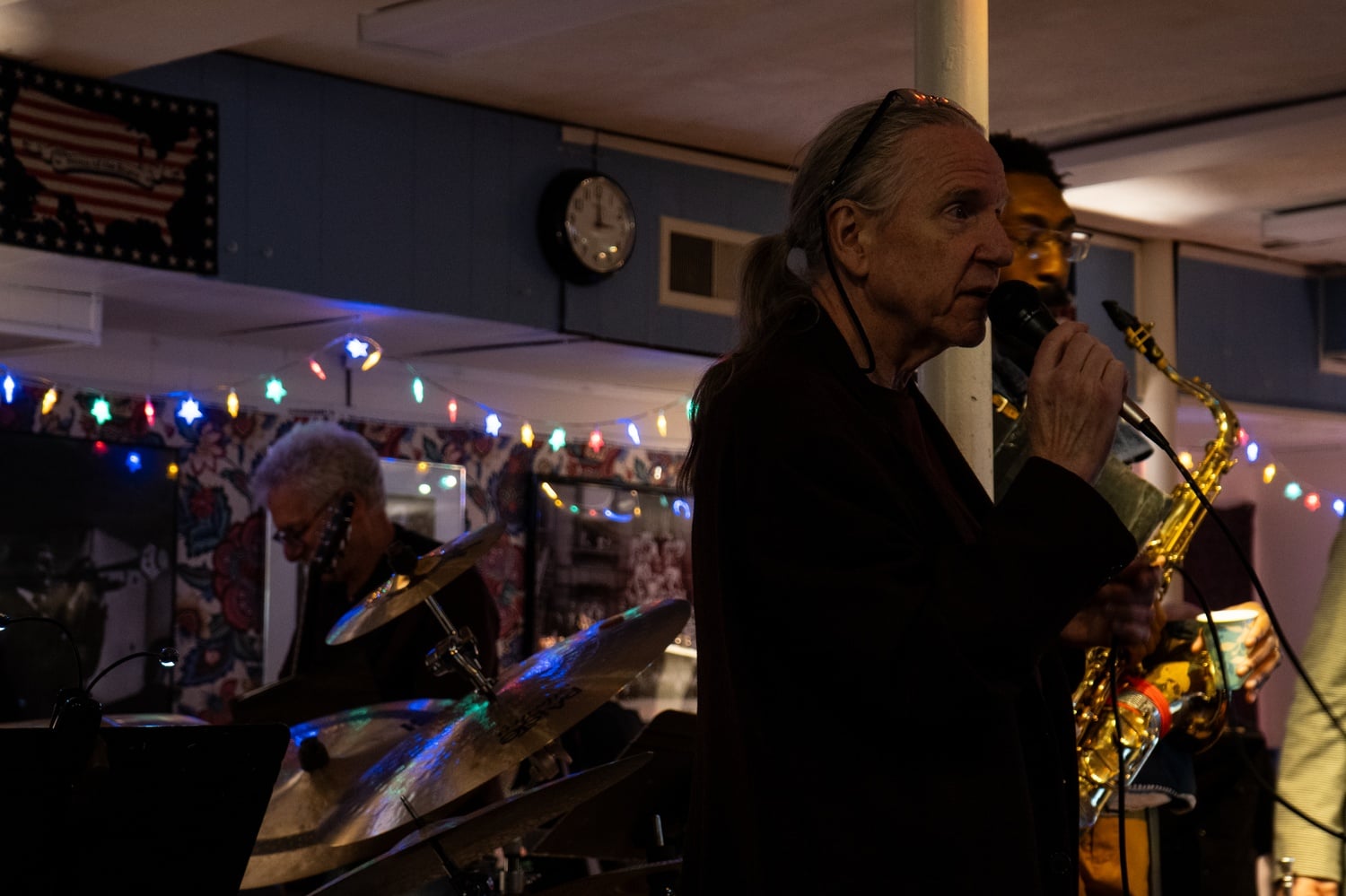
Bob’s Chili Combo shuffles off as he introduces the next act: the Albert Lam Sextet.
In the interlude, audience members weave between tables to join a line at the cash-only bar near the back. Some grab free cookies, chips, and chocolate from plastic bins as they wait for their $5 beer. The basement is full to bursting with a mix of retirees, legionnaires, and college-aged students, seated at densely packed tables and on chairs lining the walls. As new attendees file in, regulars exchange hugs and greetings. Purcell, who co-founded the venue in 2019, weaves expertly through the hubbub — greeting familiar faces and pulling out extra chairs from hidden closets.
At the POSTunderground, no one is turned away, and no one has to pay — except for drinks.
But as the space continues to attract larger crowds, subtle changes strain the venue’s mission. Amid an influx of new faces, the POST is trying to hold fast to two principles: that music is a human right, and that both audiences and musicians meet a high standard.
‘It’s Kind of Perfect the Way It Is’
With new bands and increased publicity, space has grown tight at the POSTunderground. Standing room is limited, and what seating exists is quickly claimed. As a result, attendance often exceeds the space’s official capacity.
“If the fire marshal came in and saw all these people, it would be shut down. Probably not permanently but,” Purcell says during an interview at a coffee shop on Thursday, trailing off.
Shutting down is not an option, Purcell says, but neither is turning people away. While it might be easier to ask newcomers to come back later, Purcell says he is reluctant to do so.
Instead, he has innovated. The venue is no longer only underground: an 86-inch flatscreen television now livestreams performances to a curtained-off upstairs space. The “Skyline Room,” as it’s been dubbed, may not replicate the live experience, but Purcell says it still offers something valuable.
The venue’s programming, he adds, helps drive demand.
The POSTunderground opens every other month, primarily on Fridays. During each run, eight bands rotate across four weekends, with the house band finishing out each evening. The fifth Friday is reserved for Wildcard Night, where six bands trade off to perform. The club has also introduced a monthly Saturday show for student performers from the Berklee College of Music and the New England Conservatory, affectionately titled “Berklee/NEC Night.”
Musicians outside the house band are not paid, nor are they required to pay to perform — a common practice at other Boston venues. Purcell describes the POSTunderground as a “rent-free performance space,” sustained entirely by donations rather than cover charges.
It didn’t take long for that support base to grow. Purcell initially brought his friends — established musicians in the Boston jazz scene — to the club to give it legitimacy. But the rotating schedule quickly filled up. Bands now wait months for a chance to play a set, largely drawn by respect for Purcell himself and the talent he uncovers.
“Word got around fairly quickly that John Purcell was trying to make a go of this,” KR5 drummer Thomas P. Goodkind ’72 says. “There was a serious jazz club developing that had really good music and was free to enter, so a lot of people were talking about it.”
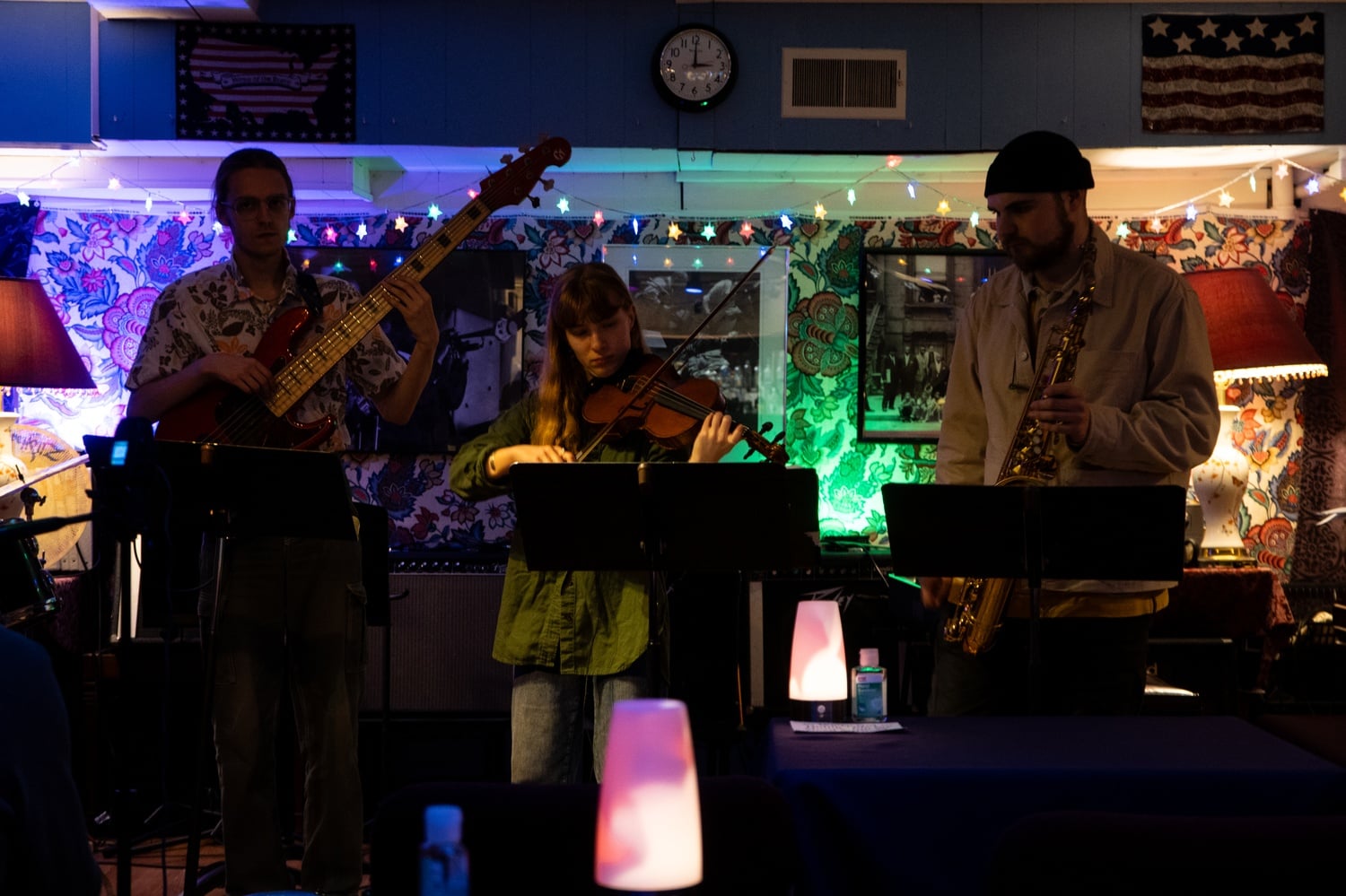
Now, the Wildcard bands and rotating groups are regular, established performers in the space. It’s the student performance nights — which feature different artists each time — that have brought new faces to the mix. One such newcomer is Berklee violinist Maya Leibowitz, whom we watch perform on a Saturday, the Berklee/NEC night. She says many young audience members who initially attend to support friends return even when they no longer know the performers.
Younger attendees cite the low cost and word-of-mouth appeal. Many have begun frequenting the POSTunderground — mingling with the older generation of patrons local to Brookline who learned about the club through the Veterans Post.
“It’s kind of easy to come in and just have a good time,” Max M. Jepsen ’26 says. “The junk food is a big hit, to be honest. We ate a lot of it. And they also got a bar with VFW prices — cash bar. It’s a nice, real place, I didn’t pay a dollah.”
The regular crowd at the Friday night shows skews older, and the 20-somethings entering the basement stand out.
“Whenever I see somebody who’s like, 20 years old, I’m like, what are you doing here? Do drugs, bro! It’s good, but I’m just like, it’s Friday,” says multi-instrumentalist John “Jack” E. Davison ’14, who played in two bands that night.
Others, however, see the influx of young adults as a sign of the lasting popularity of the genre. Despite a decline in jazz from its heyday in the 1950s and 60s, the success of the POSTunderground shows that there is still a space for the music to be heard and appreciated widely, Robert “Bob” P. Keough says.
Keough, a vibraphonist who led Bob’s Chili Combo’s set, sees the prevalence of college-aged listeners as a boon for the scene at large.
“People have been declaring the death of jazz for probably 40 years,” Keough says. “So it’s always really great to see some young people showing up and enjoying the music.”
That emphasis on the music itself is central to the venue’s ethos — and something every musician we spoke with praised.
The lack of a cover or band fee, says Leibowitz, clarifies “the difference between a gig and a show,” offering a space to perform without “ulterior motives.”
“There’s not a lot of listening spaces in general, in Boston,” Leibowitz says. “To have an actual performance space where people are really invested in what’s going on is super important.”
This word-of-mouth praise from both artists and attendees has brought in a larger audience, sometimes threatening Purcell’s carefully curated atmosphere. Although he hopes the POSTunderground remains a bastion of music-focused experience and not just a Friday-night hangout spot, Purcell says not every attendee has clearly understood his vision forof a jazz-centered haven.
“We don’t want the vibe to change, no matter how many people show up,” he says. “It’s kind of perfect the way it is.”
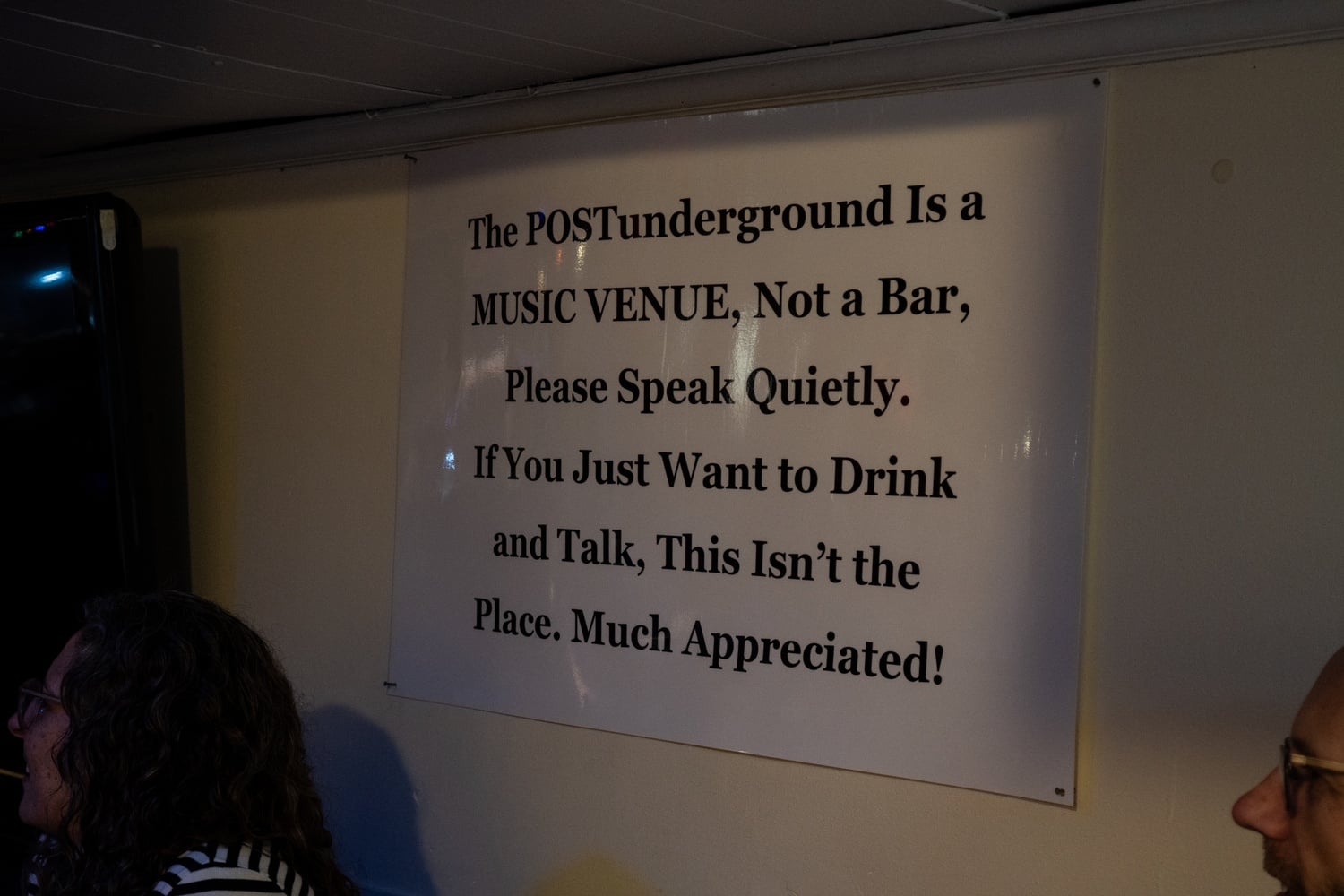
The space now includes reminders of its purpose, with large signs emphasizing that the POSTunderground is a music venue, not a bar.
“If You Just Want to Drink and Talk, This Isn’t the Place. Much Appreciated.”
At times, those reminders are necessary. One particularly rowdy group occupied a back table for years, but when their conversations became too disruptive, Purcell intervened.
“It’s not like talking is prohibited,” Purcell says, “but you should really be paying attention to the music.”
‘Desperate For a Place to Play’
Even for those drawn in by the social aspect, the emphasis remains on the music. “There’s an audience that comes in here that really wants to share jazz,” says frequent performer Gail Carey.
“It’s neighborhood folk and jazz musicians who appreciate jazz and want to hear good music, and there’s a lot of original writing and arranging that comes out,” he says.
Coy M. Simmons is instantly recognizable in a crowd; his curly beard is topped with a coiffed handlebar mustache, his snapback cap firmly in place despite standing squarely inside the venue.
Simmons, the saxophonist for FROCK, discovered the POSTunderground around 2021 and became an early regular at Berklee/NEC nights. He praises the opportunities the space creates, especially for “the younger cats” — emerging musicians — “because ultimately everyone can play here.”
Still, the standards are high. Simmons says early audiences could be intimidating, especially to bands like theirs who gave more avant-garde performances. The audience was open to being musically challenged, Simmons adds, “but they didn’t want to hear mediocrity.”
Younger attendees share similar expectations. Jepsen, sitting with a group of three other young audience members, says that though Berklee/NEC night offers an open space to play for younger musicians, “it does require some musicianship.”
But those standards shift depending on the crowd. Audiences are typically at their largest early in the evening on Friday nights, and decline as the night progresses. Saturday Berklee/NEC nights draw much slimmer crowds. The smaller the crowd gets, the more the bands seem to experiment.
On Friday night, the last band of the night took a particularly creative approach. While developing a setlist, KR5 elected to play the jazz standard “On Green Dolphin Street,”, but adapted the piece to sound as if they were “peeking around the corner in the dark,” by initially playing the melody backwards then forward.
Albert Lam Sextet tenor saxophonist Davison says bands at Berklee/NEC nights are also pushing the boundaries.
“I’ve seen some videos of the Berkeley/NEC nights that they do here, and they’re playing some really hip stuff,” he says as three other members of the Albert Lam Sextet nod.
Indeed, the bands we listen to on the Berklee/NEC night play with convention and explore the limits of the form. The Maya 4tet incorporates soft, blues fiddle into their jazz set, creating a unique sound that would have seemed out of place among the more traditional jazz groups on Wildcard Friday. Later, FROCK improvises for close to forty unbroken and sultry minutes for a crowd that dwindles to roughly seven people by the end of the set.
The opportunity to experiment makes POSTunderground a valuable space for jazz musicians, who Goodkind says are “desperate for a place to play.”
“There’s a very small upper crust of jazz musicians who can get paid to play,” he says. But the majority of musicians, for whom venues like the POSTunderground won’t offer a paycheck, “we’ll play just for the joy of playing.”
For Doug Spaulding, a saxophonist in KR5, the inherent quality of the music is secondary to the value it provides to those who listen. He says contributing to the venue brings him “great joy.”
“Now, I’m not the same person that you’re going to pay a thirty-dollar cover for,” he says, “but it’s good music absolutely.”
That joy — and low barrier to entry — keeps both musicians and audiences coming back.
“It is my favorite venue to play on the planet, because it is a place for people who want to hear music, and especially hear music with others,” Simmons says.
Attendee Joanne M. Riley agrees. “It’s all about the music, which is hugely important,” she tells us. “It’s just a fabulous experience.”
Because the POSTunderground curates high-quality musicians and high-quality listeners alike, the basement is rich with spontaneous connections. Musicians describe meeting future bandmates at the POST. Two realtors invite us to the Tiny Desk-inspired concerts they host. Audience members reconnect with friends and argue with bartenders. All thank John Purcell and give loud ovations between sets.
The crowd may ebb and flow. Students might come for a set, a cheap beer, and a conversation before heading elsewhere. Some legionnaires may bristle at more experimental sounds, while others embrace them. But for a moment, they share the same riffs, chords, and improvisations.
“That’s the overall point, is to have a scene where people can connect,” Purcell says. “There’s something really spiritual about everybody in the room listening to music.”
—Staff writer Hugo C. Chiasson can be reached at [email protected]. Follow him on X @HugoChiassonn.
—Victoria L. Dolan, an Associate Editorial editor, can be reached at [email protected].
Want to keep up with breaking news? Subscribe to our email newsletter
Have a tip for The Crimson? Share it confidentially