‘Who’s Afraid of Virginia Woolf?’ Review: Happy to Be Held Captive
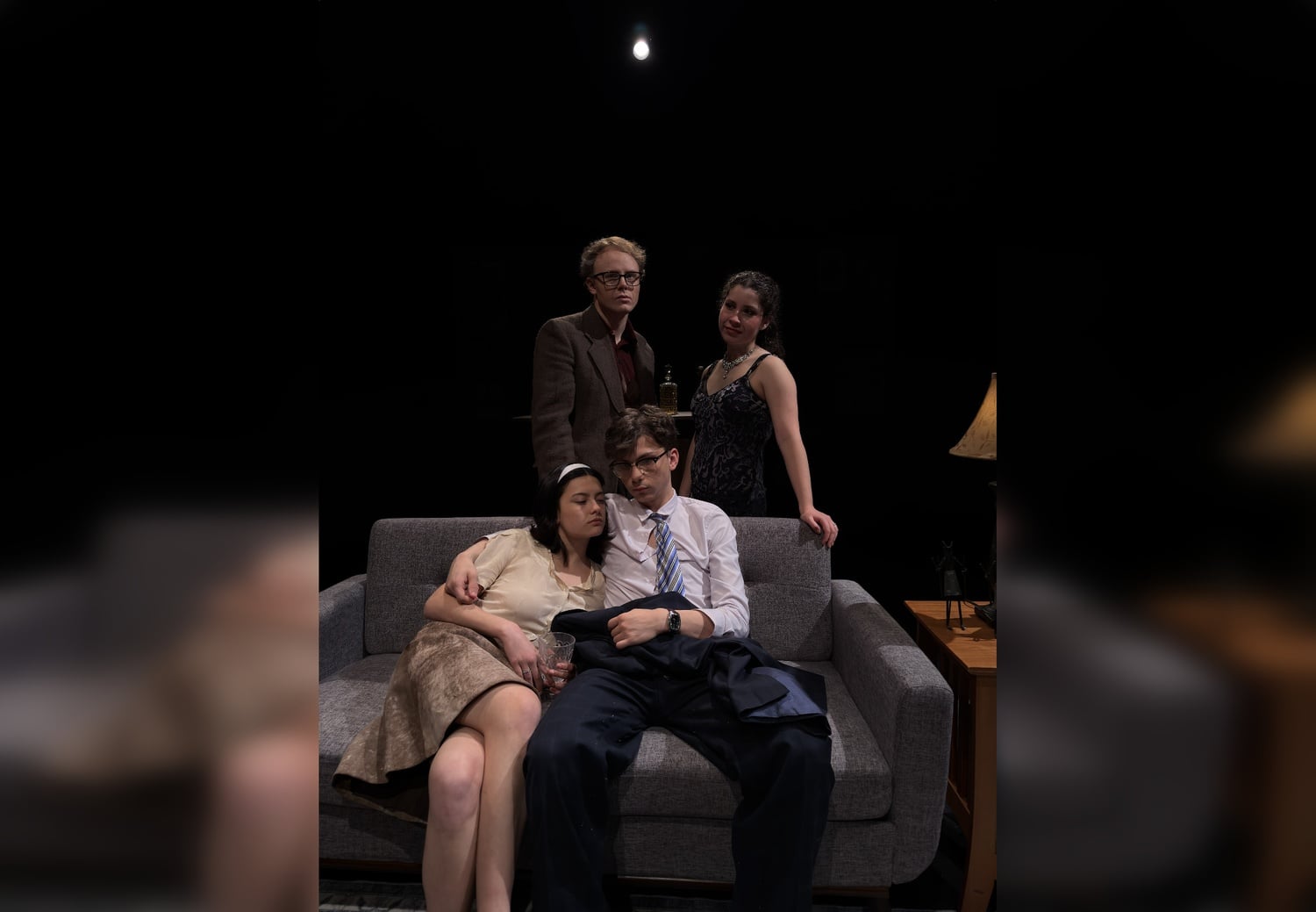
Nestled in the Loeb Drama Center’s black box experimental theater, “Who’s Afraid of Virginia Woolf?” presented a simple scene for audience members to intrude on — a classic living room, delicately embellished with statuettes, books, finely crafted furniture, and a bar perfectly suited for hosting. The work of the scenic and props designers George Atkin ’28 and Alexa M. Schmitt ’29, the set created a firm foundation for the lived-in, familial nature of the play. It was a visual clean slate, and to those not familiar with the synopsis of the show, perhaps a comforting image. What followed in the next three and a half hours utterly dashed any hopes one might have had of enjoying a pleasantly domestic performance.
The Harvard Radcliffe Dramatic Club’s spring production of the 1962 Edward Albee classic hit the stage in a drunken frenzy. A Tony Award-winning staple of the living room drama variety, it’s no surprise that the play immediately thrust its audience into the deeply personal and complicated, exposing them to the intimate world of others without warning.
The viewer was transported into the bitter and jaded marriage of Martha (Natalie A. Bernstein ’28) and George (Vander O.B. Ritchie ’26) as they return late at night from a university faculty party. Intoxicated and releasing their frustrations of the evening upon each other, their mutual resentment slowly becomes apparent. The arrival of younger couple Nick (Theodore R.W. Ansell ’29) and Honey (Oona Yaffe ’28) at the behest of Martha only amplifies the difficulties of their marriage, as they draw the couple into their twisted history, setting in motion an endless evening of psychological torment.
The four cast members seamlessly accomplished the challenge of delivering vibrant and convincing performances in such an emotionally jagged and intense play — a remarkable testament to director Ben L.C. Arthurs’ ’27 vision and intention. With only a three-week rehearsal period to capture exactly what he wanted the production to be, both he and the actors faced the uniquely difficult feat of sculpting their performances around a complex and emotionally-charged script. The result proved to be miraculous, and the production’s captivating performances made the show feel incredibly brief.
As they stomped, danced, and tore across the simplistic living room set, the four characters transformed the stage into a battleground, taking control of the space around them, never falling stagnant. Their familiarity with the set permitted them to emphasize the humanity of the content, reminding the audience that they are intruders upon a life that has already been settled in. Courtesy of costume designer Emily X. Kuang ’29, the four performers were able to fully embody the spirits of their character, sauntering around in tailored suits, disheveled dresses, and heels.
The four were able to focus on the complete embodiment of the nature of their characters. A strong standout, Bernstein immaculately tackled the depth of Martha with a uniquely impressive stamina and attack. She balanced Martha’s spastic and out of control character with an intentionality of her own, fortifying and actualizing her as a fully fleshed-out woman. Going even further, she peeled back the layers on the character, revealing a woman who, beneath her deep rage, contains a kindness and a desire to live a life without so much anger. Comfortable in Martha’s skin, Bernstein was masterfully equal parts vulnerable and outrageous.
Just as lived-in and comfortable was the tumultuous dynamic between Martha and George, a couple who are equally vengeful and accustomed to each other. To make a decades-long relationship believable on the stage is no small feat, and yet, Bernstein and Ritchie bounced off each other with the vitriol and deep-seated love of a couple with a very clear history. A couple that knows how to torture each other best, they provided a stable foundation for their projections onto Nick and Honey, a couple with history of their own.
The third act, titled “The Exorcism,” brought about the extreme climax of their evening of torment. Presenting the pinnacle of all four performances, and the grievances, humiliations, and histories existing between the two couples, this act was relentless — an all-out screaming match for the ages, with each character descending into absolute madness. As dynamics came to a head, the set was destroyed — evidence of both the domestic erosion that took place and the fully-fledged commitment each actor made to extreme physicality.
“Who’s Afraid of Virginia Woolf?” stretched its characters and actors to extremes, setting out to prove that anyone can be pushed over the edge if you shove them hard enough. Incredibly anxiety-inducing yet impossible to look away from, the show put suburban insanity on full display, subjecting its audience to the ugliest, most intimate parts of human relationships. Backed by the unbelievable dedication of each performer, the play was deliciously evil — a descent into hell that the audience was more than happy to join in on.
—Staff writer Ariana N. Barillas Santizo can be reached at [email protected].
Want to keep up with breaking news? Subscribe to our email newsletter
Have a tip for The Crimson? Share it confidentially