Former Supreme Court Justice Breyer Says Public Schools Are Essential to Democracy at HGSE Forum
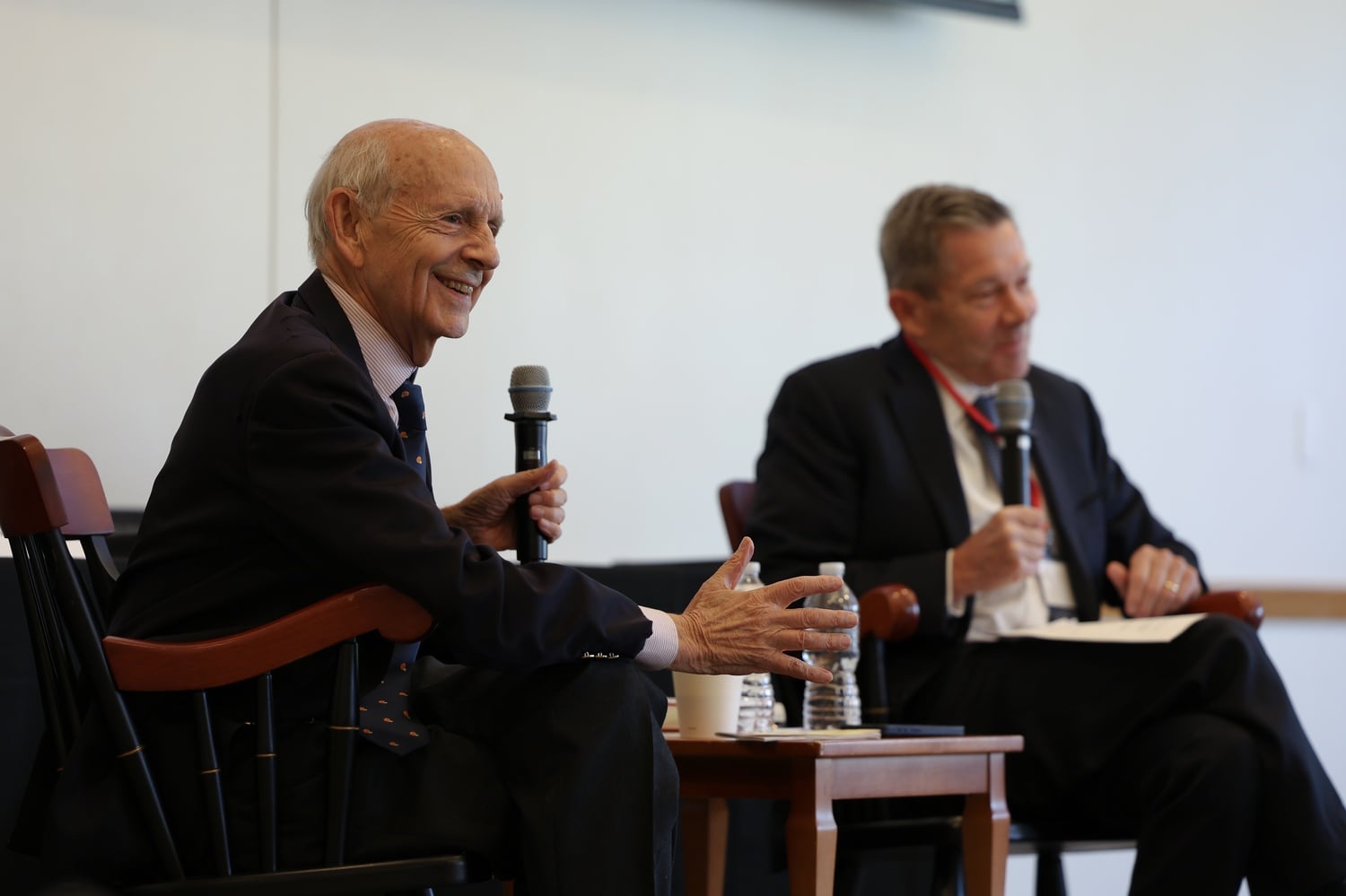
Former U.S. Supreme Court Justice Stephen G. Breyer said public schools are essential to sustaining American democracy and defended the use of judicial discretion in shaping education law at a Tuesday event at the Harvard Graduate School of Education.
Breyer, who served on the Supreme Court from 1994 to 2022, joined HGSE academic dean Martin R. West for a wide-ranging conversation on student speech, affirmative action, school vouchers, and the role of the judiciary in shaping education policy. The event was part of HGSE’s Askwith Education Forum series.
Introducing Breyer, HGSE Dean Nonie K. Lesaux said his career had “been about advocating for and defending the nation’s constitution and the institutions that are necessary to protect it, including America’s schools.”
“Democracies like people are not born knowing how to be successful,” Lesaux said. “A democratic society is cultivated and nurtured over many years and across many settings.”
Breyer returned to the idea that institutions — and the schools that prepare students to participate in them — cannot be sustained through rigid legal rules alone. He resisted the suggestion that judges can produce clean, universal tests for complex constitutional questions, describing the law instead as inevitably contextual.
Asked about Mahanoy Area School District v. B.L., the 2021 case in which the Court ruled 8-1 that a Pennsylvania school district violated a student’s First Amendment rights by punishing her for a vulgar Snapchat post made off-campus, Breyer said the case illustrated the limits of bright-line rules.
Schools retain authority over student speech, he said, but that power weakens beyond school grounds — and the line between the two is not always clear.
People often “want a list” of when schools can regulate student speech, Breyer said.
“But I don’t have the list,” he added.
Breyer also discussed his dissent in Parents Involved in Community Schools v. Seattle, the 2007 decision that struck down school assignment plans in Seattle, Washington and Louisville, Kentucky designed to maintain racial integration.
Get The Crimson in your inbox.
He said he remained unpersuaded by the majority’s view that the Fourteenth Amendment barred districts from considering race when assigning students, pointing to what he described as the country’s long and unresolved history with slavery and its aftermath.
“We have a big, big, big problem, and it will continue,” Breyer said of racial inequality. “It’s gotten better, I think, over my lifetime.”
Breyer also revisited his dissent in Zelman v. Simmons-Harris, the 2002 decision that upheld Cleveland, Ohio’s voucher program — an issue West noted has returned to national debate amid a wave of state-level school choice programs.
Breyer said his concern then, as now, was that publicly funded programs flowing to religious schools risked inflaming religious divisions and drawing the government into conflicts it could not easily resolve.
Breyer pushed back against the charge that the current Supreme Court is driven by partisan motives, even as he acknowledged its conservative tilt.
“I do not believe that the members of the Supreme Court are there to carry out some political agenda,” he said.
He offered a similarly measured assessment of the Court’s so-called shadow docket. Breyer said every appeals court relies on an emergency docket to handle cases in progress in the lower courts. What has changed, he said, is the nature of the cases reaching it — a shift from death penalty appeals toward major constitutional disputes between the branches.
Breyer closed with advice drawn from his four years working for the late Sen. Edward M. Kennedy. The senator, Breyer said, used to tell his staff to seek out ideological opponents, listen carefully, and build coalitions around whatever common ground emerged — even if it meant accepting 30 percent of what they wanted.
“Take, don’t hold out for 100 percent of nothing,” Breyer said.
Despite widespread concern over political polarization, Breyer struck a hopeful tone, pointing to neighbors who looked out for one another during the Covid-19 pandemic as evidence of an enduring civic fabric.
“I don’t think we’re too bad yet,” he said.
—Staff writer Mahpara Faatin can be reached at [email protected]. Follow her on Twitter @mahparafaatin.
Want to keep up with breaking news? Subscribe to our email newsletter
Have a tip for The Crimson? Share it confidentially