‘It’s All About Community’: How Club Passim Has Remained a Home for Musicians and Music Lovers for Over 60 Years
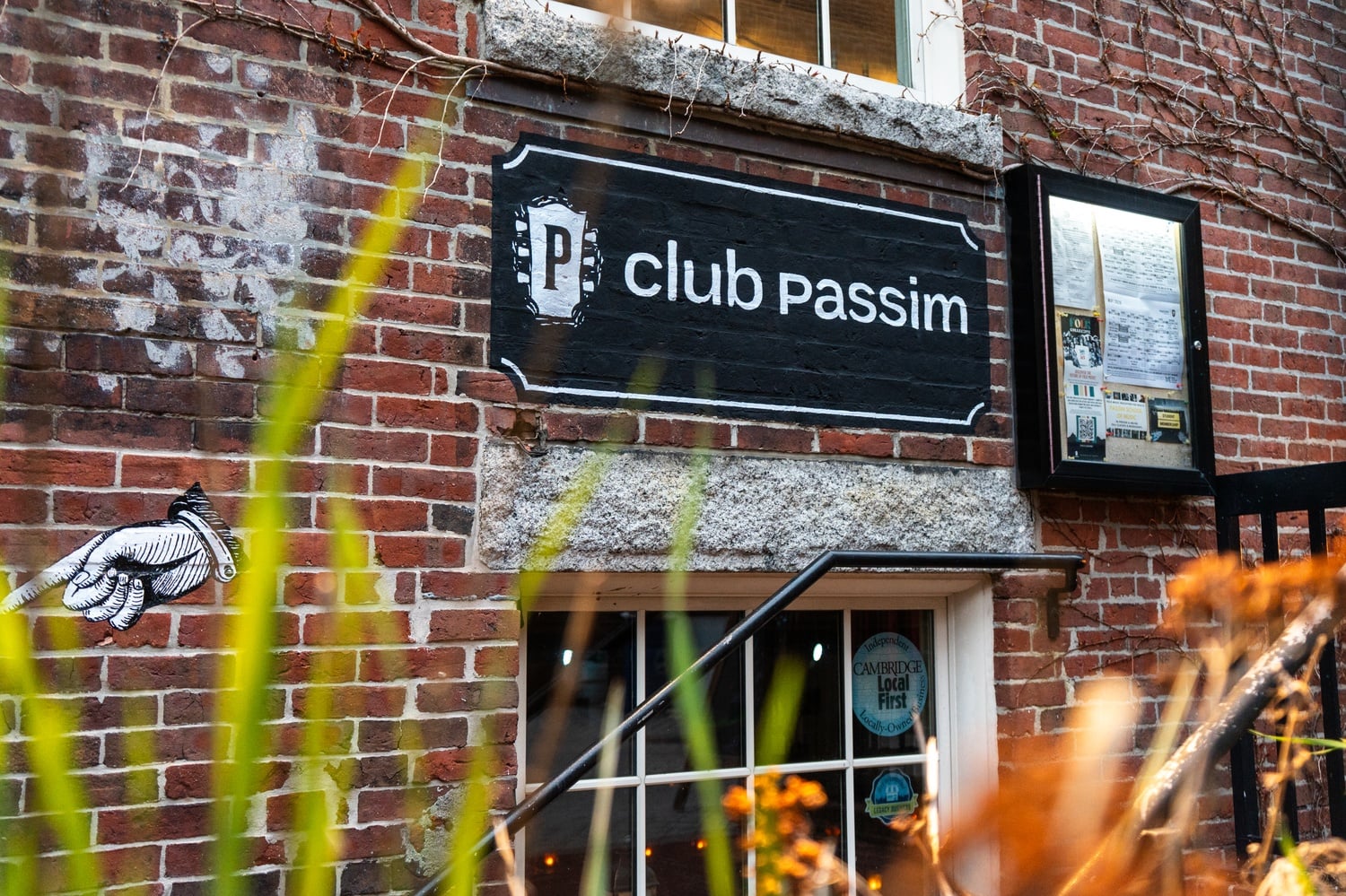
When you walk down the stairs of a quiet alley on Palmer Street in Harvard Square, you find a small, dimly lit basement with candles flickering on each table, rustic brick walls, and cobbled floors. You will also find a stage that has hosted countless musicians since the 1950s, including Bob Dylan and Joan Baez.
The folk music venue, Club Passim, hosts over 400 shows a year that draw in college students, families, and around 1,300 dedicated members to enjoy a diverse collection of sounds that span traditional folk, bluegrass, and even Celtic music. Along with live performances, Club Passim offers in-person music classes, teaching everything from bluegrass songwriting to clawhammer banjo.
Harvard Business School graduate and Club Passim board member, volunteer, and longtime fan Charles “Chuck” O. Honnet ’81 has been attending shows at the venue since he moved to Cambridge in the ’70s. Though he left the area temporarily, once he returned in 2007 he decided to give back and support young artists by volunteering at the club. His years of involvement resulted in him becoming a board member for Club Passim.
Honnet’s record label, Nine Athens Music, sponsors the club’s monthly Discovery Series events, where emerging artists, many of whom are Harvard students, perform on the Passim stage. The Discovery Series, along with Club Passim’s Campfire Fest and their open mic nights, are events available to student showgoers with a free student membership. In our digital age, Honnet emphasized the importance of live performance in connecting with others.
“It’s all about community, and it’s all about the message. It’s all about the stories, people getting together. It’s so important, especially in this day and age, for people to hear and participate in live music, and that’s true for artists performing in terms of the expression — their creative expression — as well as for the audience that receives it and thinks about what they’re saying and what they’re hearing. Music, to me, is one of the best ways to do that,” Honnet said.
A group of four music-loving, 23-year-old friends who met through Teach for America opened one of Club Passim’s monthly open mic nights on March 23. The ensemble has been seeking out similar events in the area. Group member Colin Singer said performing at a small venue like Club Passim offered up both a challenge of nerves and an opportunity for creativity.
“You’re kind of just putting yourself out there. It’s a challenge. I think we all took on challenges by teaching, right? And doing this program with Teach for America. And so, for me, it’s just a way to express myself, and also have fun with these guys at the same time,” said Singer.
Folk music traditionally features instruments like the acoustic guitar, harmonica, banjo, and fiddle. Though the genre’s golden age was in the ’60s, artists today, like those that perform at Club Passim, keep the spirit alive. Another Teach For America group member, Cameron J. Snowden ’25, said he appreciates the authentic messaging that he believes defines folk music.
“I think personally, for me, I love the kind of political messaging in it,” Snowden said. “I think the moment we’re in in the history of our country right now, as well as just the ability of anyone to post something that they’ve written or made online really lends itself to authenticity, finding a big audience. And I think all of those things speak to something that I like about folk music,” said Snowden.
Another regular open mic performer and Club Passim member, 71-year-old Bruno Giles, impressed the March 23 crowd with his simultaneous performance of the harmonica and the rhythm bones, a folk instrument consisting of two pieces that players deftly clap together with one hand to create intricate percussion patterns.
Giles, a member of the national Rhythm Bones Society and founder of his own open mic event in his hometown of Natick, Massachusetts, is entrenched in the music scene. Giles said the most rewarding part of performing at Club Passim was “sharing the music” and seeing other musicians grow in assuredness as they return to the stage time and time again.
“I like watching people go up there, even people who are up there for the first time. And you see the nervousness in their emotions and things like that. But then when they get going, they get their confidence, and they feel proud of what they did,” Giles said.
Since he began attending shows in the ’70s, Honnet said Club Passim has worked and still is working to broaden its reach to a more diverse array of artists, calling the club a “crucible” for learning and growth. He added that folk music and the club had a unique ability to unite music lovers of all backgrounds, creating an unmatched sense of belonging.
“It’s the music of the people, and it’s from every culture, every period in history imaginable, in terms of the community,” Honnet said. “It’s a community sharing of stories. It’s an expression, artistic expression, of different cultures and different peoples across time, and it’s all the way up to the most contemporary thing you could ever create, in terms of what’s going on in our society today and across the world.”
— Staff writer Avani Shah-Lipman can be reached at [email protected].
Want to keep up with breaking news? Subscribe to our email newsletter
Have a tip for The Crimson? Share it confidentially