Newly Sworn In, Berg and Zhao Seek to Build ‘Leverage’ Through Donor Networks and Outside Advocacy
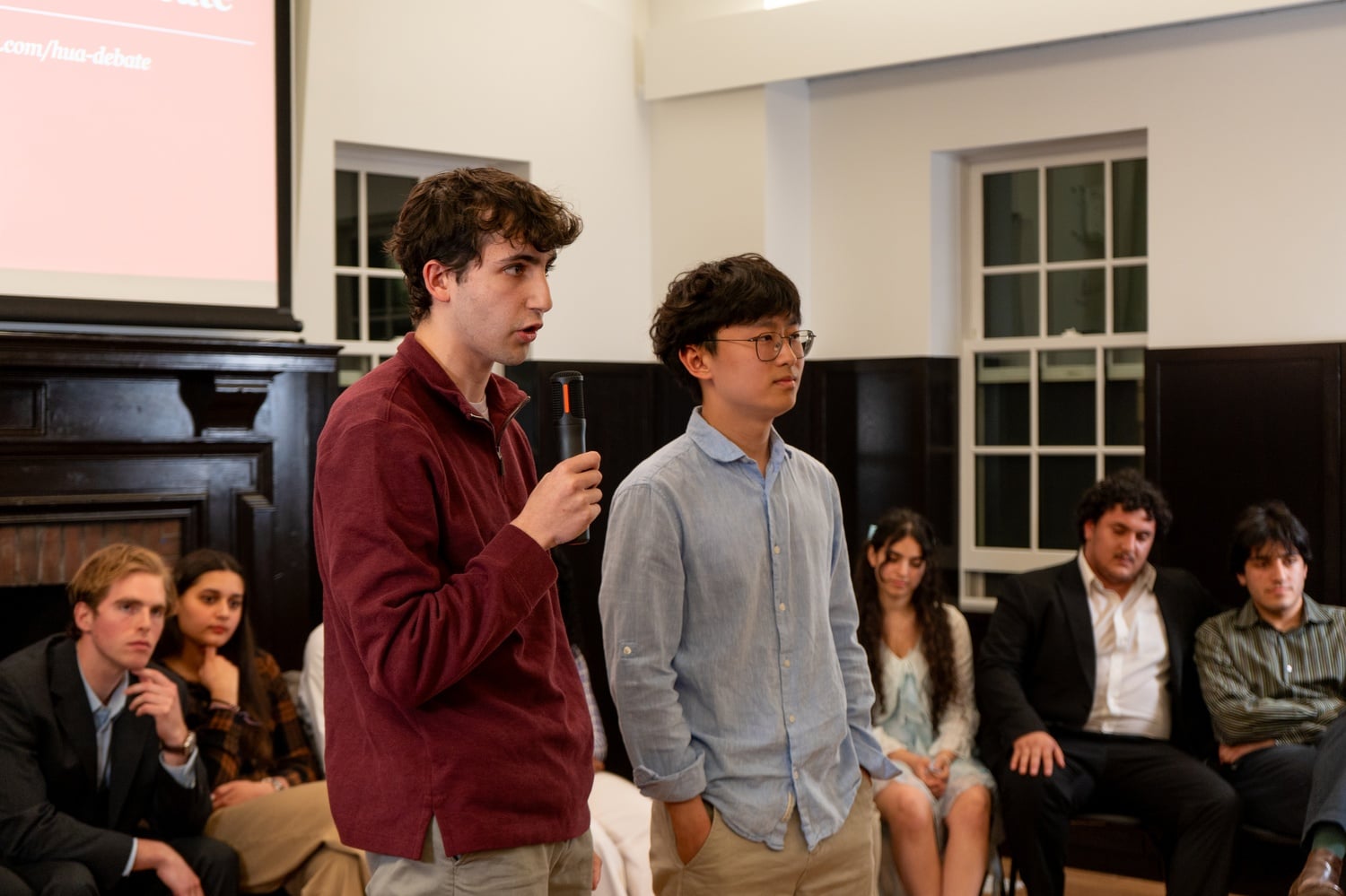
Zachary ‘Zach’ Berg ’28 is not big on stickers. His laptop has only one — a large decal advertising his run for the Harvard Undergraduate Association co-presidency and his pledge to “recenter students.”
In an interview before the election results, Berg said he and his running mate Daniel Zhao ’28 would be willing to “put everything on hold” to meet the goals of their campaign, which included raising $2.1 million through alumni donations and adding a “student observer” to the Harvard Corporation, the University’s highest governing body.
Berg and Zhao took office Tuesday, and the pair said they have already begun reaching out to administrators and coordinating with student organizations ahead of the next academic year, when the HUA will operate on the largest budget in its history.
“There are people that talk about getting things done, and there are people that actually get things done,” Berg said. “Our goal is to do everything we can to acctually get things done.”
Finances
Berg and Zhao campaigned on tripling the HUA’s budget through alumni donors, building on the gift fund launched last year by outgoing co-presidents Abdullah Shahid Sial ’27 and Caleb N. Thompson ’27.
Their first step, Berg said, is securing a speaking slot at Harvard’s alumni weekend in June, where he and Zhao hope to introduce themselves to a broad swath of Harvard Club members at once.
“The more people that you can get in front of, the more people that you’re able to donate,” he added.
Whether or not the HUA receives an official speaking slot, Berg said, “we will be there.”
“We will be introducing ourselves to let alumni know who we are, what we’re doing and what our mission is for the next year,” he added.
Get The Crimson in your inbox.
The pair also plans to reach out to individual Harvard Clubs — branches of Harvard-affiliated alumni clubs based in cities across the United States — though Berg said alumni weekend is the “first priority.”
“Alumni weekend is where it starts, certainly not where it will end,” he said.
Thompson attended alumni weekend last year to solicit donations for the fund.
Regardless of whether Berg and Zhao reach the $2.1 million mark, their term will benefit from a near-doubling of HUA funding driven by an increase in the Student Activities Fee. Berg said the HUA will not distribute the additional money evenly across student organizations — instead concentrating it toward organizations the body deems to be especially lacking.
“Not every organization currently has equal access to funding from the HUA,” he said. “Our emphasis will be first and foremost to make sure that the student organizations who literally do not have enough money to function as they are intended get their increase in money first.”
Berg said the pair will prioritize club sports — which often lack travel funding — along with what he and Zhao labeled “historically underfunded” arts, STEM, and affinity programs. They plan to allocate $200,000 to each of those four categories. Within those buckets, Zhao said, decisions will be made on a “case-by-case basis” according to semesterly needs.
Berg and Zhao also plan to cut the number of HUA events in favor of fewer, larger functions.
“We’re being more deliberate and intentional about each event so that it can fit in the budget while simultaneously providing the community experience that we think is really important,” Berg said.
Activism
Berg and Zhao plan to speak at a “Democracy Teach-In” on Friday hosted by Harvard Students for Freedom, a student organization formed last spring to oppose the Trump administration’s attacks on the University. The event is co-organized with Crimson Courage, an alumni group advocating for academic freedom and institutional autonomy at Harvard.
The Teach-In commemorates the “one-year anniversary of President Donald Trump’s initial attack on Harvard University,” and will emphasize resistance to federal pressure on “universities across the country” and “our freedoms,” according to the event page.
Berg said he and Zhao chose to join the event because their platform aligns with Students for Freedom on issues including the proposed observer on the Corporation and looser restrictions on outside guest speakers.
He also hopes collaborating with Crimson Courage will open alumni connections that feed into the HUA’s fundraising push.
The alignment with Students for Freedom follows the pattern set by the outgoing administration. Sial and Thompson frequently spoke at its rallies and to media outlets in their capacities as co-presidents.
As one of the first acts of their term, Sial and Thompson released a public statement on behalf of the HUA backing international students after the Trump administration moved to revoke Harvard’s authorization to host them — a break from the body’s usual reticence on political issues.
Berg and Zhao said they have not yet decided whether to issue similar statements on Students for Freedom’s broader activism against the White House, or on the strike recently started by the Harvard Graduate Students Union.
Berg described the pair’s activism and financial strategy as a single, “interconnected” effort.
“It is, hopefully, through the process of working with other people who care about giving students agency, we’re able to fundraise,” he said.
Berg also pointed to an effort to make HUA operations feel more “collaborative” than in years past, so that its members can feel “both confident and comfortable” with public statements made on behalf of the student body.
“We’re going to keep our options open,” Berg said. “We are now leaders of the HUA. We do not make statements as individuals. We make statements as an organization.”
Transparency
Berg and Zhao said they want to build an HUA with the institutional standing to enforce its own proposals.
Adding a student observer to the Corporation would be a step in that direction, they said — though the pair has not spoken with any Corporation members. Berg called that “a missing perspective that we think is important before we develop a full approach.”
Anticipating pushback from administrators, Berg and Zhao said they were wary of “knee-jerk reactions” and plan to frame the observer role as a transparency measure rather than a shift in power.
“If you’re framing it as, ‘We want to make sure the students understand the decisions that you are making,’ so that they have more context, it’s a lot easier to pitch,” Berg said.
“The administration does not have to give anything up,” he said.
They also plan to cite testimonials from administrators at peer institutions, and to lean on the leverage they hope to build through financial independence and outside advocacy.
“We will take every avenue that is available to us,” Berg said. “If we are able to have money or an endowment and financial independence ourselves, then we have some leverage. If we are working with organizing groups and talking to the media, we have some leverage.”
Berg said Thompson and Sial’s projects often stalled because administrators “were able to push aside a lot of their ideas because there were no severe consequences for not listening to the HUA.”
The groundwork he and Zhao lay this year, he added, could strengthen the hand of future co-presidents.
“We do want to make sure to put the work in — to set in the groundwork — to make sure that they do have more leverage,” Berg said. “That in the future they can choose how to use that voice, because the challenges of five years from now are not going to be the challenges of today.”
—Staff writer Alma T. Barak can be reached at [email protected] and on Signal at almabk.54. Follow her on X @almabk_.
—Staff writer Theresa F. Bartelme can be reached at [email protected] and on Signal at theresabartelme.15. Follow her on X @theresabartelme.
Want to keep up with breaking news? Subscribe to our email newsletter
Have a tip for The Crimson? Share it confidentially